“In the words of Lincoln, ‘one by land and two by sea…'”

Flags! Explosions! Independence! Power outages! After dousing firework remnants and sweeping away picnic debris, ooh and aah at these sparkling links.

Michael Drout remembers the teacher who taught him Old English.

I find this odd: a play satirizing the International Congress on Medieval Studies. (It’s not that different from most professional conferences, folks.)

Nancy Marie Brown recalls stumbling into medieval Iceland.

The Medieval Material Culture blog finds LEGO castles in Massachusetts.

Megan Arnott surveys medievalism in children’s cartoons.

Scott visits Charlemagne’s Aachen, and takes pictures.

In New York, Gargoyle Girl finds the gargoyles and grotesques of Gramercy Park.

Ephemeral New York spots weeping angels in Brooklyn.

Luminarium makes cookies for the wives of Henry VIII.

Steven Hart remembers how rabbit ears died.

Interpolations administers last rites in the middle of the road.

Benjamin Buchholz tries self-critique through Sudanese art.

Laudator Temporis Actii scans the letterhead of the Society for the Prevention of Progress.

George posits a travel theorem: read instead.

So Many Books likes reading on public transit.

Friend of this blog Lex “Kid Beowulf” Fajardo is featured in A Parent’s Guide to the Best Kids’ Comics.

When the Gypsy Scholar’s blog was plagiarized, he got the runaround from Google.

The Grumpy Old Bookman publishes Daphne Before She Died.

In a poem about the 1980s, Dylan knows there’s no sign of life, it’s just the power to charm. He also, delightfully, spins a ghazal: “’80s Music.”

The Book Haven introduces the North Korean poet who defected.

Rose Kelleher reads forms she hates to love.

Julie Rose asks: What are your books of a lifetime?

Bill Peschel recalls how Shirley Jackson could wield an awesome curse.

Finally tanz den Spatz with Sven van Thom, Berliner popstar turned…rapper?

“…and every time I wonder if the world is right…”

In 2009, after promoting my Charlemagne book and working on projects for other people, I was word-weary and exhausted. To make writing fun again—without worrying about marketability, editors’ impressions, or other people’s needs—I started composing poems inspired by the gargoyles and grotesques that adorn my friendly neighborhood neo-Gothic cathedral.

Three years and more than fifty poems later, this series is complete—and, to my amazement, the gracious folks at the cathedral have granted permission for their typically publication-shy beasties to show their faces in print. Later this summer, Looking Up: Poems from the National Cathedral Gargoyles will be available as a 138-page trade paperback. I’ll donate the bulk of the profits (whatever they may be) to the cathedral to help fund post-earthquake repairs.

Many of the poems will be freshly polished; here are links to the first drafts. (The final two poems won’t be posted here; they’ll appear solely in the paperback.)

A wild boar who wants to rule the world.
An octopus reappraising her lobster.
A bitter but alliterative Anglo-Saxon mother.
A Gollum-like monster on All Hallows’ Eve.
A creepy dragon with an Arthurian autumn elegy.
A tiger mother singing a Midsummer goblin song.
A bird and dragon, doomed to dance.
Medusa,
with angels.
A robot camera, conjuring a sprite.
An alligator, delaying salvation.
A rooftop-ruling monster.
A bellyaching, medlar-eating monster.
An insect with an identity crisis.
A skeletal beast decaying on Good Friday.
A unicorn with Easter dreams.
A caveman, soft on the inside.
A scholarly owl with stories to tell.
A dog on the trail of a thief.
Rilke, through raccoonish eyes.
A medievalist goat going all Carolingian.
A skeletal horse, mindful of Mother Goose.
A bird who celebrates Sukkot.
A snake with a taste for antiquarianism, and rabbit.
A smiling dragon.
A tradition-minded frog.
An indefatigable fish.
A monster, begging for silence.
A mouse with his eyes on circling skies.
A devil, exiled from the Garden State.
Two autumn rabbits, one thankful, one not.
A confused Boethian hamster.
Cerberus, barking mad.
A bat-creature, in Nordic disrepair.
A restless, bookish elephant.
An insecure, artsy deer.
The anecdotal basenji.
A lovelorn, molar-clutching monster.
A medieval-minded birdwatcher.
Pan,
not even mostly dead.
Baby Pan,
undaunted by snow.
A rooster, resigned to vicissitude.
Some vegetation, sinning through the weeds.
An administrator on form and façade.
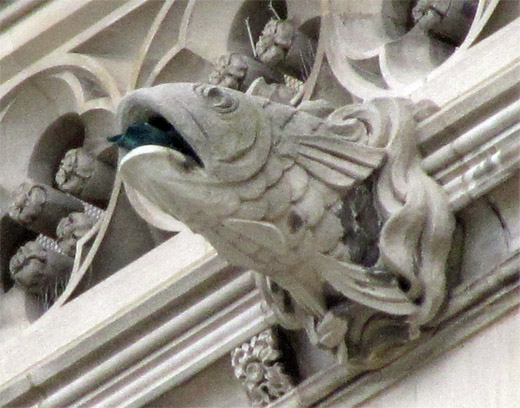
A fish who spouts one slippery riddle.
An angel on an Easter Vigil.
A monster, with a winter warning.
The bishop, recalling Chaucer.
A fallen angel, who knows his Chaucer, too.
A ghazal by a cicada…
…and a cockroach’s reply.

Thank you to everyone who linked, commented, or otherwise supported this project! I hope you’ll enjoy the resulting book.

“And after a while, you can work on points for style…”

[Here’s the latest in an ongoing series of reviews of all of Lloyd Alexander’s non-Prydain books. To see all posts in this series, click on the “Lloyd Alexander” tag.]
In 1963, seven years after writing a memoir about his cats and one year after publishing a book about New York’s first cats-only veterinarian, Lloyd Alexander must have foreseen a future in animal-themed nonfiction. With seven prior books to his name, none of them a blockbuster, he had, I suspect, warmed editors’ hearts as much with his love of animals as with his professionalism—which made him a suitable spokesman when the ASPCA came calling.

Apparently written to promote the ASPCA during a period of rejuvenation and expansion, Fifty Years in the Doghouse offers a brief history of the organization and the animal-welfare movement, but the real hero here is William Michael Ryan, a uniformed ASPCA special agent. Born in New York City in 1893 to a family of horse breeders, Ryan spent more than 50 years protecting animals and rescuing them from abuse, staring down gangsters and thugs while dealing with the banal cruelty of everyday people. Ryan comes across as a tough city kid, but his commitment to animals, even when the rescuee is a toad, suggests a superheroic sense of mission. “Humane work makes demands on the heart as well as on the head,” Alexander admits. “The number of people able to meet those demands is limited.”

Alexander’s publisher treats Fifty Years in the Doghouse as more than a copywriting assignment, letting the author use his familiar, gentle voice to tell Bill Ryan’s story—and letting him indulge his harmless obsession with cats. The resulting encomium is wildly unnecessary, but characteristically nice:

Economic and logistic considerations aside, it would be pleasant to believe that another factor operates in the growth of the cat’s popularity: that more people are starting to like cats purely because of the cat’s own remarkable qualities of affection combined with independence, gracefulness, intelligence—and the ability generally to stay one up on the human he deigns to live with. People with touchy egos can be driven to despair by a cat’s insistence on occasional periods of privacy and time for contemplation and meditation. The owner who prefers wildly enthusiastic tail-wagging to subtler and perhaps more intense demonstrations of love may develop the nagging impression that his cat doesn’t have a very high opinion of him.

But these are childish reactions. It may be that we are starting to enjoy cats more because we are growing a little more mature, a little wiser. In any case, cats have patience enough to wait for us to catch up to them.

Fortunately, Fifty Years in the Doghouse isn’t just another Lloyd Alexander cat book. Most of the time, the author steps aside, and Bill Ryan’s adventures speak for themselves. In short order, Ryan confronts a horse stuck under the front steps of a brownstone, a grizzly bear in Brooklyn, a Russian trade delegation’s pet wolves in a Midtown hotel, and a bull in the Madison Square Garden ladies’ room. As it turns out, Bill Ryan invented the standard cat-rescue grappling device and a sling to lift horses, and in 1963, few uniformed officers in New York could rival his barstool yarns:

When he reached the boardinghouse, Ryan saw that the policeman had not been accurate. The monkey was not a monkey, but a red ape. He was not the size of an airedale; he was much bigger. He was also in a foul temper. He squawked, huffed, grunted, bared his teeth, and Ryan could easily understand why the landlady had considered herself insulted.

“Well,” Ryan mused, “he is a big one, isn’t he?”

“Just put on a pair of gloves,” one of the officers advised, “and put him in the cage.”

Among the amusing stories of human inattention, Alexander relates examples of blatant cruelty, such as crippled ducklings, starved cows, and burned rodeo horses, pointedly, but without gratuitous detail. “Only a psychiatrist could unravel the motives of a 200-pound giant of a man who calmly beat a kitten to death with a rake,” he offers. “Or another man who stabbed his own wire-haired terrier with a pocket knife and left her to die in a trash can.” Although pathological cruelty is, he says, infrequent, “[o]f all the strange byways the Society has followed in its efforts to protect animals, the strangest has been the human mind itself.”

This realization leads to some of the better stories in Fifty Years in the Doghouse, such as the case of the fall-down drunk who denies owning a dog:

The man walked briskly to the desk. “I believe you people have my dog here.”

“What!” Ryan exploded. “At three o’clock this morning you didn’t have a dog. You didn’t even have a puppy.”

“My dog is here,” the man said firmly. “I want him back.”

“Mister,” Ryan said, “you can have any dog you want. Just tell me one thing. Why didn’t you make up your mind before? You knew damned well it wss your dog; and I knew damned well it was your dog. Why didn’t you save yourself a lot of time and trouble?”

The man drew closer to Ryan and lowered his voice. “That dog’s the best friend I got in the world. He’d give up his life for me if he had to. And I guess I’d do the same for him. But there’s something else,” he added sheepishly. “I go off the reservation sometimes. Once in a while maybe I drink too much. You got to understand this. I respect that dog and I don’t want nobody thinking he runs in bad company. So what else am I gonna do? What kind of a reputation would a dog get, hanging around an old drunk? Sure I let on he wasn’t mine. I didn’t want to embarrass him.”

Perhaps that’s the sort of kindly, aw-shucks anecdote most of us expect from Lloyd Alexander, but he knows to give the darker stories minimal adornment:

For many of the city’s anonymous millions, New York can be a lonely, unhappy town and their animals suffer in consequence.

Dear Doggie, a woman wrote to her pet chow, for three days I have waited for some kind of word from you . . .

Too emotionally disturbed to realize that animals can’t read, the woman finished her note, propped it on a table and swallowed a massive dose of sleeping pills.

A rescue squad found her barely alive and rushed her to the hospital. The dog waited patiently at the Society’s shelter throughout its owner’s long and difficult period of therapy. In time, she returned to claim her pet. She had learned something easy to overlook: that an animal’s love, like a human’s, no matter how strong it may be in reality, truly exists only when we recognize it.

Now forgotten, Fifty Years in the Doghouse got a fair amount of press in 1964. Half a century later, the book’s litany of animal anecdotes—monkeys in Manhattan! lions in the theater district!—becomes a blur, but poignant stories about forlorn pet owners, and the sort of daily heroism Michael Ryan embodied, make the book memorable, thanks to an author who puts animal-rescue tales into perspective.

“Ryan does what most humans would do—if we knew how,” Alexander concludes with a strange optimism, before clarifying: “And, also, if we were willing to take the time, to go a little out of our way.” One year away from publishing The Book of Three, Alexander turns a book about pets into a book about people, fostering a notion that would run through his writing for decades: the promise of human decency.

“Wonder if he’ll ever know he’s in the best-selling show…”

“In Washington, summer is a horror beyond the telling of it,” wrote Philip K. Dick in his 1968 “Self Portrait,” echoing the more effable sentiments of sweat-soaked D.C. residents this week. Dick is so associated with California—he spent nearly his entire life there—that few science-fiction readers, and almost no Washingtonians, remember that in the late 1930s, the budding author and his mother lived in the Cleveland Park neighborhood, or that Dick’s three years here echo in his work.

Dick’s novel Puttering About in a Small Land, written in 1957 but published posthumously in 1985, views several D.C. landmarks through the gauzy lens of personal mythology. Despite his prolificity and unabashed weirdness, Dick craved mainstream success, and he grounds an early sequence in Puttering About, a realistic tale of infidelity and doomed postwar dreams, in actual Washington places: Rock Creek Park, Massachusetts Avenue, and the Tidal Basin, which a character imbues with her own anxieties:

To her the Tidal Basin and the trees had a mysterious quality; they kept the countryside here in the center of the city, as if it could not be completely suppressed. Actually she was afraid of the Tidal Basin; it was part of the lines and pools of water that had cut into the ground by the coast, the canals and rivers and streams; Rock Creek itself, and of course the Potomac. When she came near the Potomac she believed she had been removed completely away from the present; she did not accept the fact that the Potomac existed in the modern world.

In keeping with Dick’s real life, the action in Puttering About soon switches to California, but Washington remains a place of origin and a repository for obsessive memory. In the 1966 novel Now Wait for Last Year, Dick returns to Cleveland Park—naturally, by way of Mars.

Like most Dick novels, Now Wait defies easy summary, but suffice it to say that it features pharmaceutically induced time travel, a dictator who battles aliens across alternate dimensions, and ancient gazillionaire Virgil Ackerman, president of the Tijuana Fur and Dye Company, which turns alien amoebas into spaceship control spheres. With the help of antiquarians and preposterous wealth, Ackerman pioneers the creation of Martian “babylands,” hyperpersonal theme parks that recreate fondly remembered places in a patron’s life.

Amusingly, Virgil Ackerman rebuilds Philip K. Dick’s childhood in Washington, D.C., circa 1935:

Wash-35 consisted of a painstakingly elaborate reconstruction of the specific limited universe of childhood which Virgil had known, constantly refined and improved in matters of authenticity by his antique procurer—Kathy Sweetscent—without really ever being in a genuine sense changed: it had coagulated, cleaved to the dead past…at least as far as the rest of the clan were concerned. But to Virgil it of course sprouted life. There, he blossomed. He restored his flagging biochemical energy and then returned to the present, to the shared, current world which he eminently understood and manipulated but of which he did not psychologically feel himself a native.

Imagine my surprise when I learned that I live in a latter-day version of Wash-35:

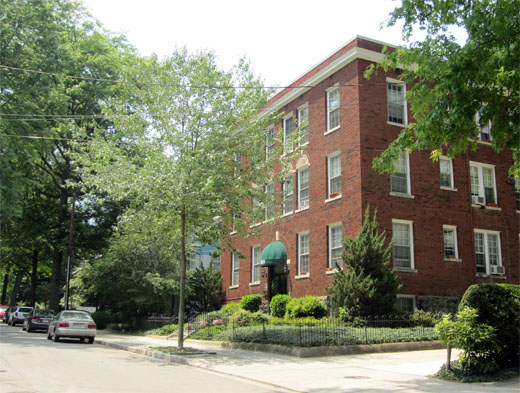
The omphalos of Wash-35, a five-story brick apartment building where Virgil had lived as a boy, contained a truly modern apartment of their year 2055 with every detail of convenience which Virgil could obtain during these war years.

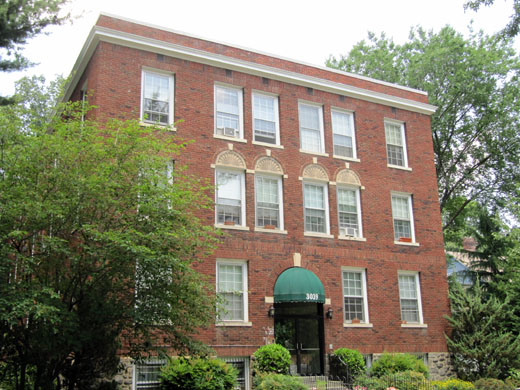
Dick misremembered how many floors his childhood omphalos had, but it’s still there, around the corner from me, the only apartment building on a leafy, house-lined street.

Several blocks away lay Connecticut Avenue, and, along it, stores which Virgil remembered. Here was Gammage’s, a shop at which Virgil had bought Tip Top comics and penny candy. Next to it Eric made out the familiar shape of People’s Drugstore; the old man during his childhood had bought a cigarette lighter here once and chemicals for his Gilbert Number Five glass-blowing and chemistry set.


Dick recalls doing most of those same things in his “Self-Portrait.” The drug store has gotten a facade-lift and a new name, but it’s right where Dick left it, and kids still pop in there after school to buy junk food. Dick would like the place; the scanners talk to you.

(I’ve yet to find an elderly neighbor who remembers “Gammage’s.”)

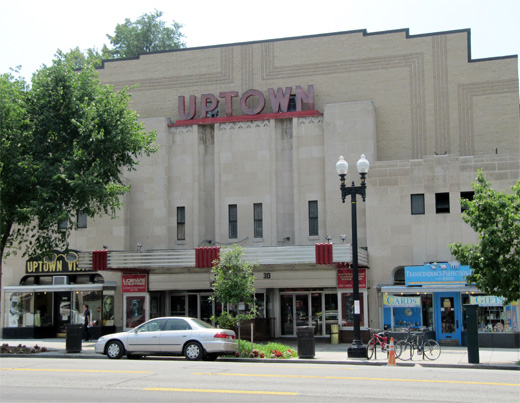
“What’s the Uptown Theater showing this week?” Harv Ackerman murmured as their ship coasted along Connecticut Avenue so that Virgil could review these treasured sights. He peered.

It was Jean Harlow in Hell’s Angels, which all of them had seen at least twice. Harv groaned.

The Uptown has shown the various Blade Runner re-releases and director’s cuts. Prometheus is playing there now.

The ship taxied from Connecticut Avenue onto McComb Street and soon was parking before 3039 with its black wrought-iron fence and tiny lawn. When the hatch slid back, however, Eric smelled—not the city air of a long-gone Terran capital—but the bitterly thin and cold atmosphere of Mars…

On a late June afternoon, the atmosphere at 3039 Macomb Street NW is anything but cold and thin, but the year could be 1935, or 2012, or 2055.

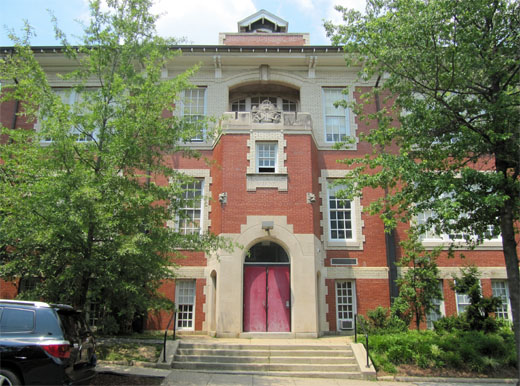
Uphill, west on Macomb, looms another Philip K. Dick landmark. After a miserable stint at an experimental school in Maryland, young Phil spent second through fourth grades here in Cleveland Park at John Eaton Elementary.

Despite a homely concrete wedge that joins Eaton’s two older buildings, kids from the 1930s would recognize the place immediately. In Divine Invasions: A Life of Philip K. Dick, Lawrence Sutin summarizes Dick’s time here:

Phil attended the John Eaton School from 1936 to 1938, for grades two through four. He was absent often, a pattern condoned by Dorothy [his mother]. His report cards reflect good academic work on the whole, with one of his lowest marks, a C, coming in written composition. But a comment by his fourth-grade teacher was admirably prophetic: “Shows interest and ability in story telling.”

Perhaps Dick’s Eaton years were more formative yet. The playground, more spacious now than it was 75 years ago, may have been the site of Philip K. Dick’s first epiphany, as recounted in a 1981 interview:

I really think—I’ve thought about this—and it goes back to an incident when I was in the third grade, where I was tormenting a beetle. It was taking refuge in an empty snail shell. He’d come out of the snail shell and I’d mash at him with a rock, and he’d run back into the snail shell. I’d just wait ’til he’d come out.

And he came out, and all of a sudden I realized—it was total satori, just infinite, that this beetle was like I was. There was an understanding. He wanted to live just like I was, and I was hurting him. For a moment—it was like Siddhartha does, like was that dead jackal in the ditch—I was that beetle. Immediately I was different. I was never the same again. I was totally aware of what I was doing. I was just transformed—my essence was changed.

I find it unnerving to live for years in a neighborhood of attorneys, technocrats, students, and barhoppers, only to detect, suddenly and at every turn, the slight, childish footsteps of the most bizarre science-fiction writer of the 20th century.

Weirder, though, was this.

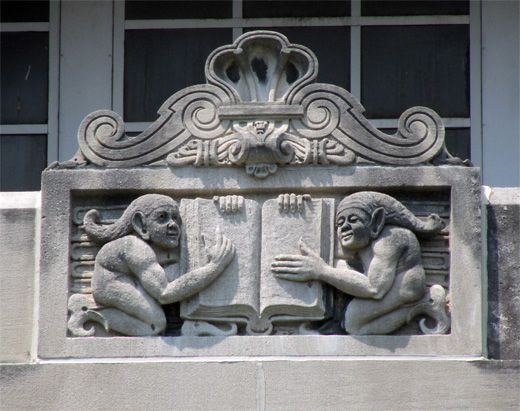
I noticed those bibliophilic elves over the doors of Eaton Elementary yesterday, when I went to take a snapshot of the school. For 17 years, I’ve walked past Eaton, visited the school with friends’ kids, and voted in local elections there, but somehow I’ve never spotted these elves, the sort of whimsical adornment everyone knows I actively look for.

Friends assure me that the elves have always been there. Have they? Wouldn’t I have seen them?

When you find your neighborhood in a Philip K. Dick character’s Martian recreation of Philip K. Dick’s childhood, you start to think that someone may be messing with you, that maybe you’re the baffled beetle in someone’s dawning epiphany. “My god, that is eerie. Really freaks me,” Dick wrote in 1970, after his friend Bhob Stewart found himself, purely by chance, at 3039 Macomb. “The ghost of a little boy who is now a middle-aged SF author must still be playing there.” If so, I haven’t seen him, but a whispering elf tells me this: there’s no guarantee that I won’t.

“In the summertime, when all the trees and leaves are green, and the redbird sings…”

Interesting links are the English-muffin sandwiches of the Internet: start your day with one and you’ll power that much more profitably through the hours, all thanks to lingering in the virtual Frühstückszimmer of your mind…

The Book Haven discovers what Frankenstein has to do with Walt Whitman’s brain, and, less whimsically, the man who volunteered for Auschwitz. 

Nancy Marie Brown votes for the most influential writer of the Middle Ages.

Dylan pens “Disreputable,” a great ghazal.

“Maybe the dingo ate your baby”: Steven Hart hears cruelty in popular culture.

Has Dr. Beachcombing found trolls in Staffordshire?

Brevity wonders: an essay renaissance?

University Diaries does Bloomsday.

The Classical Bookworm likes Duolingo, where translation leads to learning.

Collected Miscellany hails A Hero for WondLa.

So Many Books wonders what books mean to you.

Dan at Obscurorant underestimated H.P. Lovecraft.

Cinerati remembers Star Frontiers.

Adrian Murdoch reports on the discovery of the first Roman camp on the Mosel.

Rohan Maitzen says no, Middlemarch is not book-club suicide.

Bill Peschel thinks Hemingway and Gellhorn would hate Hemingway and Gellhorn.

Gregory Ferrand, painter of neat stuff like this, is part of Art-o-Matic.

First Known When Lost climbs “a flight of steps that end in mid-air, and there is nothing but the sky above them.”

“I heard telephones, opera house, favorite melodies…”

Five years ago, I tinkered with a template, raised this blog’s roof-beams, and wrote a hasty first post promising “a place to ponder books, writing, teaching, and medievalism.”

To my ever-renewing amazement, people continue to read this site, leave comments, and email me about gargoyles or curiously unignorable Charlemagne ephemera. Amid the mass stampede to social media, blogs are still valuable places to explore untrendy cultural niches or stretch a notion beyond the epigrammatic—so even if I update this site unpredictably, I’m in it for the long haul.

Thanks to all of you whose eyeballs make “QP?” a pleasure to write! I hope you’ll continue to find it worth your time. For now, here’s a sort of “greatest hits” anthology from the half-decade that was.

* * *

Every day, new readers find the blog through these posts:

* * *

Poems inspired by the National Cathedral gargoyles have lately dominated this blog. The poems will end soon, but this summer I’ll collect them in a small book to raise funds for post-earthquake repairs. Stay tuned.

* * *

Meet some medievalists who left their mark on the world:

* * *

We found that Robert E. Howard, creator of Conan, was a prolific poet, while one of the great female voices in science fiction has been disowned by her alma mater.

In 2008, I started reading all of Lloyd Alexander’s non-Prydain books and writing capsule reviews. (Five more to go!)

* * *

The lighter side of medievalism:

* * *

Applied paleobromatology:

* * *

When you visit the Cathedral of St. John the Divine, what sex are the angels?

 * * *

In Louisiana, my family and I found medieval saints in the Lower Ninth Ward, explored the castle Mark Twain loathed, chased monsters in New Orleans, found medievalism by Lake Pontchartrain, and tailgated at a Cajun ring-joust.

Of course, medievalism abounds in the South. Just look for a Gothic synagogue in Georgia.

 * * *

Amid Ren Faires and the umpteenth Arthurian novel, we may forget that medievalism is often grim stuff. Remember the Balkans, where medieval nostalgia stirs unnerving memories of the Battle of Kosovo and puts the capture of Radovan Karadzic in context.

Likewise, the 2008 war the Caucasus meant rediscovering the medievalist nationalism of South Ossetia and muddling through the baffling history of Georgia.

* * *

In 2008, the credit crunch reminded us that financial derivatives have medieval roots.

* * *

 Of course, anything Charlemagne-themed is blog-fodder here:

* * *

Is The Brief Wondrous Life of Oscar Wao not only a Dominican-American story, but also a New Jersey novel?

* * *

What are we losing, perhaps, in the rush to digitize?

* * *

Can filmmaker Oscar Micheaux teach us something about the Middle Ages?

* * *

Which medieval poem was translated by Langston Hughes and T.S. Eliot?

* * *

The late Christopher Logue, adapter of The Iliad, knew how poetry sounds with a mouth full of blood.

“See the curtains hangin’ in the window…”

Summer is nigh, the beans in my garden aspire to wind ’round a trellis, and sunshine breeds an early crop of clever and interesting links.

The Virtual Society for the Study of Popular Culture and the Middle Ages finds knights at a Rhode Island community college.

Nancy Marie Brown rides an Icelandic horse named Doubt.

Jonathan Jarrett gets a kick from a medieval scribe who was also a “visual learner.”

Luminarium bakes up medieval illuminated initial cookies. (Hat tip: Dave Lull.)

Patrick at Anecdotal Evidence puts Donald Justice and Edward Hopper side by side.

The Book Haven sees fog around bad weather imagery.

Bill Peschel thinks publishers could stand to learn a little showmanship from Star Wars and Tor Books.

Jake Seliger reiterates what you should know before you start a graduate program in literature (although I think his advice applies broadly to the humanities).

Flavia, newly tenured, ponders pseudonymity and its discontents.

Adrian Murdoch finds a German museum disappointing.

James Gurney discovers a video interview with Andrew Wyeth, who wished he’d painted his father.

Dylan pens two ghazals: “And Flowers” and “Zephyr.”

Gabriele at Lost Fort takes you to the delightfully named Dunstaffnage Chapel.

George visits Mount Vernon.

Wuthering Expectations reads Washington Square.

Chris at Hats & Rabbits wonders how he’ll die.

First Known When Lost asks, “What will your epitaph be?”

“No ceiling bearing down on me, save the starry skies above…”

RIDDLE

I saw on the strand     the strangest of sights:
A gleaming pageant     that passed from the sea,
Their foremost borne,     that fine-bearded king,
Through sculpted chambers      skeined with sea-weed,
Mute twirling trumpets      trailing his wake.
Sailing beside him,      his silent white lords
Were marred by the maulings     of millions of wars.
Light on the shoreline,    their lonely race
Watched and waited     wordless ages
For imminent signs.     Silence drained heaven,
Then a dry rustle     like rain in ascent:
The whitecaps boiled        bone-dry, leaving
deserts unplundered,     plains without end.
Long they beheld here     horrors of old:
Ravenous monsters,      maws ringed with arms,
Pried their bulk blindly   from beds of muck
As nobles sternly     stiffened their spines,
For all was lost.     The lords yielded,
Shedding their swords     and shields of gold,
Hurling their helms      hard on the dune,
Laying their war-gear     now lightly aside,
Once-bright armor         bristling with rust.
With no last cry      they cracked their spears;
No howling braced     their broken ranks;
Insensibly stone-eyed     as statues at dawn,
Their remnant sank      in the sand where they stood.
Then forth from the snare     of a fisherman’s nets
In their relics reborn      I rose to my shrine
To wait for water.     Their world is dust,
And so is this matter.     Now say what I am.

(For all the entries in this series, hit the “looking up” tab, or read the gargoyle FAQ.)

“Merciless, the magistrate turns ’round…”

This pair of grotesques has always struck me as eerie. Is their fecundity enough, or are we meant to wonder what they smother under stony vegetation?

EMAIL FROM THE COMMUNITY GARDEN RULES COMMITTEE

No worm discerns the robin; we dispense
With blazing wing to herald your offense.
The slug secretes his shadow under chard
Where you malinger, lest your way be barred
By negligence that chokes your bolting plants.
We yet may cast you out, beyond the ants
That vainly pray for peonies to burst.
The mess you fell today you raised up first
In indolence. For fear of flaming brand
You hide with mites; we pluck you out. Now stand
As wordless witness wild around you breeds.
The wages of our mortal sin is weeds.

(For all the entries in this series, hit the “looking up” tab, or read the gargoyle FAQ.)

“…at a place where you can walk across, with five steps down…”

Starting today, more than 3,000 scholars, profs, and students will flock to Kalamazoo, Michigan, for the annual International Congress on Medieval Studies, an event that often prompts yuksters to claim it’s peculiar that medievalists should convene in a small city in the Midwest, as if the coasts, or bigger cities, are inherently more hospitable to historical musings.

…which, of course, is silly. Having just rolled back into D.C. after a 3,600-mile roadtrip, I’m pleased to share a few postcards from the medievalist Midwest, evidence that the Middle Ages wind also through the prairies and plains—if not as vitally as the Mississippi, then at least with the same circuitous certainty.

“The hammer of the gods will drive our ship to new lands….” You’ll find a Smithsonian-funded scale replica of a Viking knarr in Alexandria, Minnesota, a town with a gigantic Viking statue and a thriving spurious-runestone-based economy.

In downtown Minneapolis, look up to spot these funny, blockheaded grotesques on the spire at Central Lutheran Church, which just completed its neo-Gothic bell tower after nearly 80 years.

At the Cedar Rapids Museum of Art, you can see how Iowa’s own Grant Wood (painter of America’s great medievalist icon) combined his usual humor with a designer’s eye for medieval church pews to create this early-1920s “mourner’s bench” for the principal’s office at the local junior high.

At the Plaza in Kansas City, Missouri, you can’t miss this gawkworthy replica of La Giralda, a minaret-turned-cathedral-tower in Seville. The Kansas City Giralda (shown here artlessly photographed from a moving car) represents the tower after its adornment with post-medieval doodads. (To the best of my knowledge, the one in Seville never had a Cheesecake Factory on the ground floor.)

On North 18th Street in Kansas City, Kansas, look up to see this grotesque on all four sides of the tower at St. Paul’s Episcopal Church, designed by an artistic medievalist rector. According to a friendly parish worker we met, the church plans to sell reproductions of this mascot; he’s known as “the Grinning Gargoyle.”

Whether you’re en route to Kalamazoo or writing and teaching in what some would consider a far-flung place, look up and gaze around. Chances are, a deliberate reworking of something medieval is craving a chance to leer back.