“Way over yonder in the minor key…”

Sometimes a tiger mother makes more sound than sense, but obscurity is useful: It forces you to ask, “Will I understand this when I’m older, or is this nonsense?”

ST. JOHN’S EVE
(MIDSUMMER SONG)

When leaves that leach from every tree
Like bitten insects blight and curl,
The swollen moon may let you see
  But once a goblin girl.

Be quick: The brindled moths detest
To stir the brack and shallow air
Of seeping June, where scinnhiws nest,
  Yet you will find her there.

Their sodden boughs admit no strand
Of summer-wasted moon to stream
But one, but she must make her stand
  Within her sallow beam.

She snuffs the muck, but scarcely finds
The spoor of misremembered things,
As “Love, O careless Love, my mind’s
   Not right,” she sifts, she sings,

She scents, she turns—her eyes aflash
Like stars above a harrowed field
That starve their spark in cosmic ash,
  Eternity revealed

In silver curls, inflamed with sweat,
In reckless lilies, late awoke;
Their withring stems she stoops to let
  Enwreathe her, lest she choke,

While through the gloom, she stalks the word
That calls the rake of summer rain.
As some slight boy who nursed a bird
  But set her wing in vain,

She raises high her plunder fair,
She offers up a secret thing,
She grounds her glyph in graceless air,
  While wild around you ring

The beadling eyes that light abide
To see the perfect rind unfold,
To gnaw the hidden fast inside
  That goblins long to hold—

Her eyes will rise; you cast yours down.
Before her sneer, betray no guile.
And to her grin, extend a frown;
  In this, you whet her wile.

And if she riddles, answer straight;
And to her white, you echo black;
But when she fangs, embrace your fate,
  And her, and bite her back.

Then run, as you must always run,
And learn what you will never learn,
And goblin glances roundly shun;
  But let the memory burn.

Beyond the bramble, timbers blaze,
So join us as we rouse with song
The lazing dawn, and know our days
  Will never be this long.

Let seven into fathoms fall,
Let three around the wake-fire whirl,
And let your summer scant recall
  But once a goblin girl.

(For all the entries in this series, hit the “looking up” tab, or read the gargoyle FAQ.)

“Thursday, I don’t care about you…”

It’s Friday; I’ve got links for you.

Mandy Brett pens a nice defense of the professional editor.

Alex Carnevale contemplates “the macabre unpleasantness of Roald Dahl.”

Alan Jacobs wonders why writers make writing sound awful.

Cynthia Haven hears Orwell when public figures “take full responsibility”—and when she looks at book-blurbs.

The “100 Reasons NOT to Go to Graduate School” blog is up to reason #61, “unstructured time.”

Reviewing In the Basement of the Ivory Tower, Jake Seliger highlights a useful term: “dispossessed of context.”

Interested in medieval jousting? Historian Steve Muhlberger has a $100 book for you.

Katy Perry sings a poignant cover of the Fountains of Wayne song “Hackensack.”

I like this: a blog devoted to parodies of “American Gothic.”

Ephemeral New York sees the strange and scary faces of Chelsea.

Lingwë looks at a Hogwarts professor’s curious name.

First Known When Lost marks the start of cruise-ship season with Philip Larkin.

A Momentary Taste of Being reads The Painted Veil by W. Somerset Maugham.

Hats & Rabbits hears what kids say about their parents.

If you have a background in Greek, Latin, and French, speak at least one additional language (Spanish, Italian, Mandarin, or Japanese), love drama and the arts, can teach philosophy while helping sail a yacht, and have mastered at least one martial art and you exist outside of a J.D. Salinger novella or Dos Equis commercial, then Gwyneth Paltrow would like you to tutor her kids.

The Chronicle of Higher Education sees “students who are full of it.”

“…to holes of their own making in the cracks within the walls…”

For four years, “Quid Plura?” has chased medievalist echoes in New Orleans—the statue of Ignatius Reilly, a shrine to a French saint, the glitter of Joan of Arc—as well as medieval-ish statuary in Cajun country and miscellaneous medievalism on the North Shore.

Yes, here there be saints—but where are the medieval monsters?

Earlier this week, on a hot afternoon, we sought to answer that question by turning to someone who slays them.

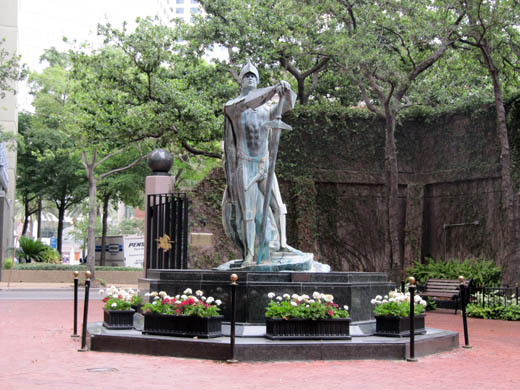
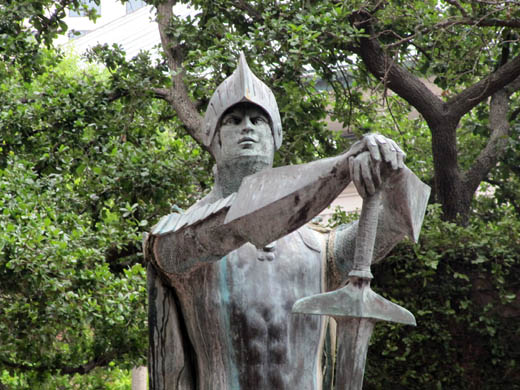
What say you, heroically-abdomened St. George in a hotel courtyard just outside the French Quarter?


George points west, so we’re off to the 16th Ward, where the beasts atop Tilton Memorial Hall at Tulane are timelessly monstrous rather than strictly medieval…

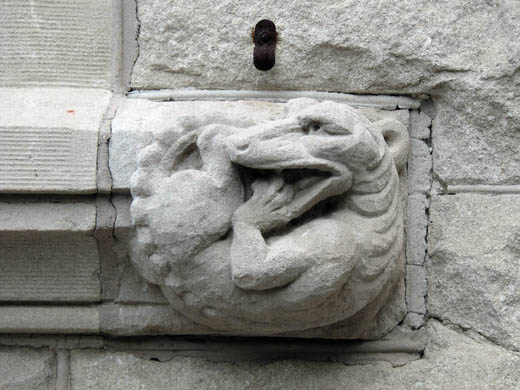
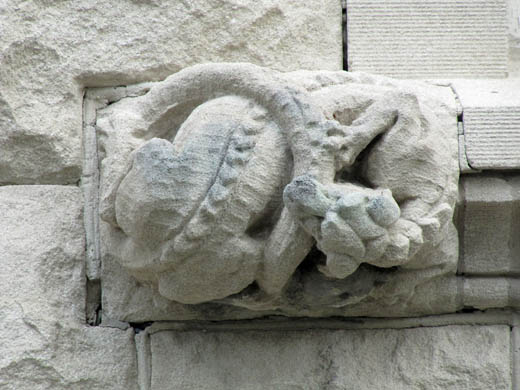
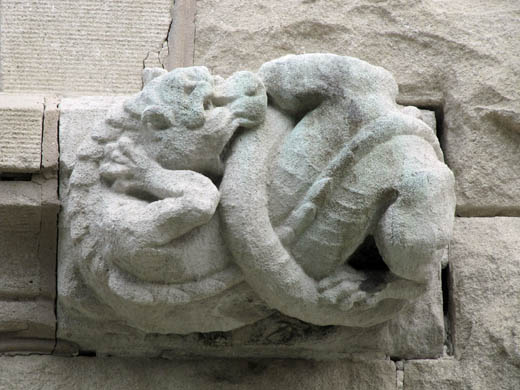
…but the alley behind the building hides a clutch of caudophagic dragons.

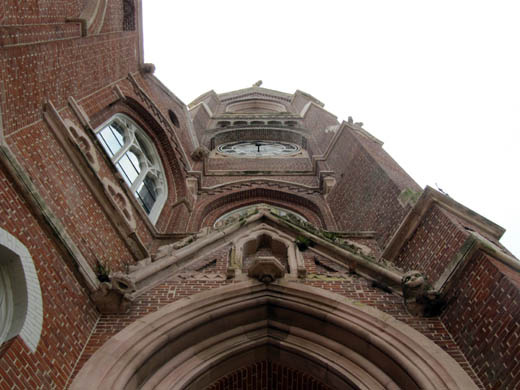
Heeding the call of the neo-Gothic, we take the streetcar east into Ward 12 and trudge down to the impressive St. Stephen Church on Napoleon Avenue…

…and when we look up…


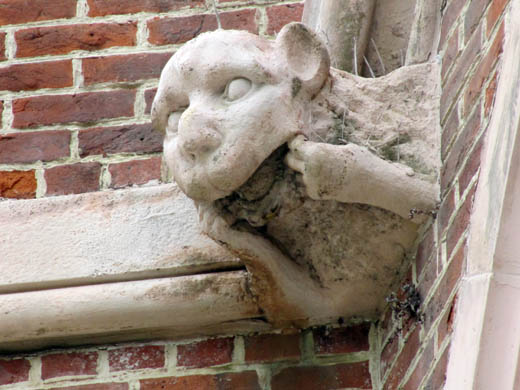
…the neo-medieval mocks us.

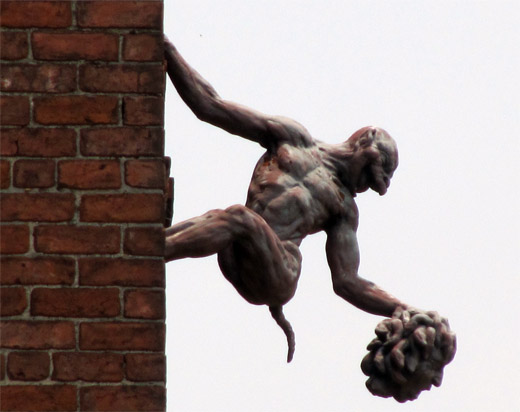
Yet we cling to the hope of grotesquerie, just as two miles to the east, on Jackson Avenue in Ward 10, something clings to the side of a gutted 19th-century synagogue…

…a creature not quite medieval…

…but poised to petrify your inner ten-year-old.

“I’m alive, I’m dead, I’m the stranger…”

[Here’s the latest in an ongoing series of reviews of all of Lloyd Alexander’s non-Prydain books. To see all posts in this series, click on the “Lloyd Alexander” tag.]

To borrow a library book is to make a promise; to return it is a sacred duty. That’s the premise of The Jedera Adventure, the fourth Vesper Holly tale—but that description makes Lloyd Alexander’s 19th-century heroine and polymath sound downright mundane. The book in question is a manuscript in Avicenna’s own hand. Vesper’s late father checked it out of a library in the North African desert, and it’s 15 years overdue.

Regular Vesper Holly readers know where this is going: Vesper and her guardian, Professor Brinton “Brinnie” Garrett, travel to the fictional land of Jedera, where—aided by her perfect command of Arabic—she marches with the French Foreign Legion, settles an ancient tribal war, resolves a star-crossed romance, charms a brooding desert warlord, and again outwits her nemesis, Dr. Helvetius. She also becomes the first human being to fly.

At this point, an adult reader wonders: Does the target audience for this series want to adore a flawless teenage genius? Do they expect an enemy so cartoonishly evil that he invents the petrol-powered airplane just so he can exploit the natural resources of others, re-institute the global slave trade, and subdue the world through aerial bombardment? As the Vesper Holly formula calcifies and the characters feel sketchy and interchangeable, I long for the more serious author who knows that choices often bring hard consequences for grown-ups and children alike.

Alexander does tease readers with a new character: Marelle, a colonel in the French Foreign Legion. His dual loyalties hint at plausible conflict in an otherwise harmless world:

“So it is my first duty to avoid trouble and not to stir it up or seek it out.  It is a practical policy. For myself, I would prefer it if the French were not here at all. But I am an officer. Above all, an officer of the Legion. I command. Also, I obey.”

This attitude struck me as unusual. Most of the colonials I had met during my travels set the natives an example of European civilization by brutalizing them. Marelle, as Vesper drew him out a little more, was not usual.

She soon learned that he had been born in Mokara of a Jederan mother and French father, that he was fluent in all the tribal dialects, and that his devotion to Jedera was as fierce as his devotion to his beloved Legion. He was the sort of person who should be a governor-general and seldom is.

It’s not the job of a light adventure series to paint a complex and harrowing picture of French power in North Africa, but the subject is an odd one to raise and then dismiss four pages before the end of the book, when Marelle and a noble desert outlaw acknowledge that they are only temporary allies:

“Arrest me?” An-Jalil’s eyes glinted. “Will you try your Legionnaires against my Tawarik?”

“I said it was my duty,” replied Marelle. “I did not say I would carry it out. Why should I deprive myself of a gallant opponent? Another day, perhaps. Or perhaps not. Be warned. It may be different with those who someday will take my place. The times have changed. You, with your honor and chivalry, are not modern.”

“Are you?” answered An-Jalil. “We are both only temporary. The desert and the mountains will outlive us. But a day must come when the French leave my land, as others before them have done.”

There’s hope here for drama. Alexander lets it pass.

Still, Colonel Marelle brings clarity: He shows how safe this series is. Unlike the heroes of Alexander’s Prydain books or his Westmark series, no one in a Vesper Holly book is ever in any real danger. Religion doesn’t exist, so Vesper can resolve age-old cultural conflicts with implausible ease. Even our skittish narrator, Professor Garrett, accepts that a feisty, 18-year-old white girl commands respect, even worship, from warrior-nomads in 19th-century North Africa.

My copy of The Jedera Adventure says the book is meant for readers between the ages of 10 and 14, but it feels like it’s aimed at a much younger crowd. With her perfect command of history, literature, languages, and science, Vesper is competent, but effortlessly and unsympathetically so; she’s a sharp contrast with Lidi, the heroine of Alexander’s 2002 novel The Rope Trick, whose life is a series of compromises made ever more frustrating by her failed quest for magical escape.

Alexander once told an interviewer that the Vesper Holly books contain no fantasy, but I don’t think that’s right. It’s a term that suits stories where girls never deal with a difficult choice.

“And of course you can’t become if you only say what you would have done…”

To a ninth-century monk at Salzburg, June was a month for plowing. When your own labors leave you weary, drive deep the furrows of your mind with these sharp and spiffy links.

Michael Livingston shows you what it’s like to edit a medieval text. (He continues his lesson in part two.)

Christopher Abram, who blogs at Old Norse News, has just published the very cool-looking Myths of the Pagan North.

Because “people don’t ‘get’ Czeslaw Milosz,” Cynthia Haven suggests taking authors on their own ground.

What do a Pakistani-American fourth-grader and Isaac Bashevis Singer have in common? Anecdotal Evidence tells you.

Steve Donoghue discovers My Robin, Frances Hodgson Burnett’s 1912 tribute to a backyard bird.

Lingwë digs for Tolkien’s worms.

Jake Seliger ponders writing in terms of computer programming.

Frank Wilson argues that “thank you” is harder than it sounds.

Nicole reads Chinua Achebe reading Joseph Conrad.

First Known When Lost presents “The New House” by Edward Thomas.

Looking up, Ephemeral New York spots tradesmen on a 41st Street building.

Hats & Rabbits tells a parable of marathon.

I’m not on many e-mail lists, but this one I like: Poetry News in Review.

SpokenVerse recites “Nude Descending a Staircase” by X.J. Kennedy.

“Cover my eyes and ears, ’til it all disappears…”

“I feel like I spent the day scooping out portions of Mondoville’s memory—lobotomizing an educational institution,” writes Prof Mondo, lamenting a book-cull at his small college library:

We’re getting rid of some 25,000 volumes, somewhere between a quarter and a third of our overall holdings. To be fair, something had to be done. Our building is simply inadequate for our collection, many of the books are obsolescent, and many others hadn’t been opened in years — indeed, a colleague of mine found a set of Thomas Hardy’s works, many of which had unopened pages. The library has been held together with spit and baling wire, thanks to an overworked, underpaid, and insanely dedicated staff.

Furthermore, our students are ever less likely to venture into the stacks. They do their research online, relying on the library’s online databases to find articles and such.

The good prof finds the cull troubling for many reasons, but he ends on this desolate note:

Finally, there was the sense that I was engaged in a kind of intellectual Black Mass, inverting the sacrament that I was meant to perform. I love my students, but I also love the worlds of literature and ideas; indeed, I show my love to my students by offering them these other things I value so much. These books, these ideas in them, matter so much to me that I’m devoting my life to the business of letting those stories and ideas survive another generation. But instead, I spent today making it that much less likely that a Mondovillian might encounter someone’s story or idea, even through a confluence of idleness and serendipity. Education is meant to help the mind grow, and I see libraries as symbols of the growth that has gone before us. Instead, I spent today making our symbol shrink. I couldn’t shake the feeling that this was the opposite of what I do.

Also today, at the Atlantic Monthly, Megan McArdle makes a not-unrelated observation:

Today, according to Amazon, eBooks have surpassed print books entirely; they are selling more Kindle editions than they are selling from all of their print formats combined. Since April 1st, they’ve sold 105 Kindle books for every 100 print editions.

The speed is remarkable, but the outcome doesn’t surprise me.  I buy almost everything for Kindle now, unless it doesn’t have a Kindle edition, or it has lots of pictures that I want to examine in detail.  Which is to say, not many.  Frequently, if it doesn’t have a Kindle edition, I don’t order it at all.

McArdle is generalizing about trends in reading solely from her own experience, but I don’t mind countering with anecdotes of my own.

* * *

For example, if a pundit needed to research the background of the Icelandic financial crisis, the 2010 book Wasteland with Words: A Social History of Iceland might be a boon. Unfortunately, it’s not available as an e-book. Neither is The Islander: A Biography of Halldór Laxness, the first English-language bio of the author who brought Icelandic culture to the notice of the world. A clever pundit might know to allude to his novels.

If you’re dabbling in verse, The New Princeton Encyclopedia of Poetry and Poetics is indispensable (and addictively browseable). Many of its entries contain better, more, or just different information than you’ll find online. This 1,383-page tome has been in print for nearly 20 years, and apparently it still sells well, but there’s no Kindle edition.

For several years, I’ve wanted my students to read Brian Stone’s translation of the Alliterative Morte Arthure. I don’t know why Penguin Classics let it fall out of print. Fortunately, you can buy it used for two bucks or read it for free in hundreds of North American libraries. There’s no Kindle edition.

Last Thanksgiving, I made jawārish, a carrot jam from a 13th-century Islamic cookbook. Published in 2009, Medieval Cuisine of the Islamic World is packed with neat recipes and commentary. There’s no Kindle edition.

* * *

“But wait,” I hear yon straw man cry, “who cares about Icelandic social history? Who but you wants to read an encyclopedia entry about the Ultraism movement in Spanish poetry? And seriously, dude, medieval Islamic carrot jam?”

The digital age is supposed to help all of us pursue our passions and explore our intellectual interests. Ostensibly smart people—journalists, especially—shouldn’t endorse only what’s mainstream or popular or shut out sources of information because they don’t appeal to one’s sense of novelty.

It’s troubling for a pundit at The Atlantic to say, essentially, “If it doesn’t exist for my cool new e-reader, then as far as I’m concerned, it doesn’t exist.” That’s an admission of willful ignorance—and we already have problems with journalists who can’t see beyond their own worlds.

Besides, medieval Islamic carrot jam is tasty.

* * *

“You must be a Luddite!” Guess again, scarecrow. I share my home with thousands of books, but I’m increasingly unsentimental about them. Becoming Charlemagne is doing well on the Kindle, I’ve self-published an e-book of a translation of a medieval romance, I’m reading Ulysses on my smartphone, and I’m in the market for a 10-inch Android tablet for reading and storing academic PDFs. Liking technology doesn’t make you anti-print. You can be pro-both.

* * *

Another rustle from the straw: “Eventually, everything will be online!”

Verily, I say unto you: Are you so positive that we’ll have several more decades of the stability and prosperity required to digitize “everything” that you’ll bet centuries of accumulated knowledge on it?

I fled grad school 13 years ago, but I’d love to be a budding medievalist now, when I can access online dictionaries for Latin, Old English, and Old Icelandic and browse the Monumenta Germaniae Historica without schlepping over to campus. I’m keenly aware of how much progress universities, government agencies, corporations, and museums have made in digitizing material that many dismiss as obscure.

And yet, two years ago, at the National Park Service archive, I glimpsed just how far we have to go. Around 2,000 of the best photos in their historic image collection are online, but their physical archive holds millions of objects, including posters, newsletters, snapshots, and un-photographed doodads like vintage ranger uniforms. The entire collection was overseen by just two employees. When they weren’t scrambling to fulfilling never-ending requests from commercial publishers and calendar makers, they occasionally found a moment to scan some old slides. At this rate, unless a legislator takes up their cause, most of their collection will languish forever in file drawers.

So if you’re a pundit, a historian, or a photo editor and you’re relying on digitized stuff to tell a story, you’re likely spinning the same yarn as everyone else. To tell a bigger story, to show or say something new, you’ll need to push away from the computer and patiently seek out an archive.

* * *

Megan McArdle concludes:

What will happen to the pleasures of pulling a random book from the shelves of a home where you are a weekend guest?

They’ll be replaced by other pleasures, like instant gratification.  And it’s probably more gain than loss.  But I’m just a little bit sad, all the same.

It’s not just about “pleasures.” What about the brainy kid whose parents are either too poor, too disdainful of education, or just too ignorant to give him a Kindle or an iPad? Yes, nearly anyone who wants Internet access can get it, and inquisitive kids are resourceful kids, and the Internet offers brilliant opportunities for intellectual exploration—but there’s no reason to diminish or destroy one convenient, low-tech, time-tested way to feed the brain.

“But you know,” croaks yon straw man, flailing his arms, “it’s expensive to store books in a big building and pay for a staff to maintain them.” Of course it is—but preserving and propagating knowledge is a core function of a college or university. Most American campuses have dozens of costlier programs and facilities that would wither if anyone were challenged to justify their educational merit.

Harvard isn’t trashing a quarter to one-third of the books in its libraries or turning them into glorified Internet cafes. If your college your kid attends is, you may want to ask a dean why they assume their graduates will never compete against kids with big-name degrees. (You might also ask them: “Would you send your child here?”)

* * *

But then why would most people associate libraries with learning anymore? Ads in D.C. Metro stations tout public libraries as places to take yoga classes and hold meetings, and the library system’s website assures the aliterate that a new library “offers more than just books.” (Whew! No one will think you’re a nerd!)

My own neighborhood branch is extremely popular, and the staff is terrific, but when lawyers in million-dollar homes use their library cards to check out government-subsidized Backyardigans DVDs for their kids, we aren’t exactly living the Carnegie dream.

* * *

Maybe there’s hope. In November, I sat in a bayou and beguiled my seven-year-old nephew with the exploits of Beowulf. Last week, by phone, he told me that during a recent visit to the local library, his quest for a sufficiently gory version of Beowulf led him to books about Theseus and the minotaur, the labors of Hercules, and Odin and Loki.

These books may change the course of his life; they may be a fad. Either way, a first-grader in rural Louisiana senses what pundits and college administrators forget: Random access to analog information is a freedom all its own. The Internet is wondrous, and e-readers are great, but if you let technology circumscribe and define your intellectual world, you literally won’t ever know what you’ve missed.


“Und das zehnte Wunder zieht an dir vorbei…”

If ignorance is the sinus infection of the mind, then spiffy links are surely antibiotics. Temporarily deprived of my own voice by just such a bug, I’m happy to point you to people with neat things to say.

Remember when Fabio got hit in the nose by a goose? In this event, says Hats & Rabbits, “lies all of the profundity of the questions of fate and Creation.”

“When the Poles throw a party–they don’t settle for half-measures,” says Cynthia Haven, who’s celebrating the Czesław Miłosz centenary in Krakow.

Do you have “the one-body problem”? The “100 Reasons NOT to Go to Graduate School” blog is up to #58.

“First, who would have thought to compare Williams and Faulkner?” A Momentary Taste of Being re-thinks William Carlos Williams.

“The literature of the Holocaust is so vast that newcomers to the subject are disheartened from beginning,” says D.G. Myers, who offers an annotated list.

Between the time when the oceans drank Atlantis and the rise of the sons of Aryas, the Conan Movie Blog analyzes the trailer for the forthcoming CGI-fest.

“But above all, One Who Walked Alone is brave.” The Silver Key reviews Novalyne Price’s memoir about Robert E. Howard.

“You can’t imagine how thrilling it is for mid-list authors to discover that our out-of-print books, something that we believe had no monetary value, are suddenly worth tens, if not hundreds, of thousands of dollars,” says Hollywood writer Lee Goldberg, who nonetheless qualifies the e-book gold rush.

“English has become the universal language if you spend your life in airports and international hotels. It’s not the lingua franca of humanity. It’s a fairy tale we tell ourselves.” The president of the MLA calls for bilingual high-school grads.

“Or you could use some Elvish words as a signal to your friend that the guy hitting on you at the bar is creeping you out.” As a Linguist ponders constructed languages.

“‘That original color–brown, tan, beige, whatever you want to call it–must have been designed by an alien,’ he said.” Yes, the Commodore 64 is back.

“I happen to be a kind of word whore. I will read anything from Racine to a nurse romance, if it’s a good nurse romance. Many people just aren’t like that.” Jake Seliger reads the Paris Review interview with editor Robert Gottlieb.

“Nothing good can happen for these people who, we know, have decades of bleakness ahead.” Bibliographing reads Underground, Antanas Sileika’s novel about Baltic partisans after World War II.

“We got the grant!” Anglo-Saxonist Michael Drout gets funding for lexomics, and explains what lexomics is.

Ephemeral New York finds stonemason grotesques in Clinton Hill “reminding passers-by that constructing gorgeous architecture takes skilled hands.”

“There was an interest in everything Nordic because Emperor Wilhelm spent most of his summer holidays in Norway.” And that, says Gabriele at the Lost Fort, is why there’s a modern stave church in Germany.

“… some people have complained that although when you check in at Lufthansa online ‘you can choose between Herr/Frau, Dr, Prof, Prof Dr, you cannot choose Prof Dr Dr.'” University Diaries notes another German politician accused of plagiarism.

“Some lawyer in Boston sent me a letter—this man, this adult, had gone to the trouble to write in great big letters: stop writing about geology.” John Hawks likes John McPhee’s thoughts on writing about science.

“Whether deserved or not, R. S. Thomas has a reputation for not being the life of the party.” First Known When Lost reads Thomas’s poem “Abersoch.”

“One side will have to go.” On YouTube, Tom O’Bedlam recites “Aubade” by Philip Larkin.

“I need a phone call, I need a raincoat…”

“I love a rainy night,” Walahfrid Strabo mused in A.D. 838 in a verse epistle to his friend Gottschalk. “It’s such a beautiful sight: I love to feel the rain on my face, taste the rain on my lips in the moonlight shadow.” Here in D.C., we’re too weary of rain to share Walahfrid’s glee—but in with the bluster come bright, blooming links.

Anecdotal Evidence chats up a neighbor with “nothing to think, and little to say.”

First Known When Lost goes home across the shires with a poem by W.S. Graham.

Life is better than art, but Hats & Rabbits knows we tell ourselves otherwise.

Cynthia Haven considers the “bland endeavor” of National Poetry Month.

Dame Eleanor Hull ponders introversion, professorhood, and bonding with students.

Lingwë reads reactions to “Goblin Feet,” an early Tolkien poem.

The Silver Key notes fantasy-based befuddlement from critics who don’t know the genre.

Julie K. Rose posts a beautiful painting: Girl Reading by Peter Vilhelm Ilsted.

Open Letters Monthly has books you can walk on or sleep in.

Dame Nora plays The Sims Medieval.

Jesse Freedman likes the academic novel Stoner.

Ferule and Fescue asks why there isn’t more Protestantism on American television.

Bill Blackbeard, comic-strip archivist extraordinaire, has died.

Ephemeral New York notes the photography of Saul Leiter.

If you’re into royal weddings, the World of Royalty blog is all over it.

Lost Fort visits Norway, with characteristically lovely photos.

As a Linguist remembers expat life in Istanbul.

If you’ve visited Iceland, you’ll recognize the view from this Reykjavik webcam.

“So, I’ll continue to continue to pretend…”

CANTERBURY BELLS
(GOOD FRIDAY)

Campanula may bow; they dare not bend,
Though shafts of sun seem ever more remote.
I do not think the rain will ever end.

You breed prosodic lilacs and pretend:
“The drocts of April / pairst us to the rote;
Campanula may bow / they dare not bend,”

But poems (even this one) condescend;
You still need your umbrella and your coat.
I do not think the rain will ever end.

“I’ll drown my books!” you cry. (Yes: God forfend
Your graveside vigil lack some pithy quote.)
“Campanula may bow; they dare not bend—”

It comes out wrong. But what did you intend?
You plucked your eyes for pearls, and dimly wrote:
“I do not think the reign will ever end.”

Oremus: What can sodden bells portend
When even you misdoubt one hopeful note?
Campanula may bow; they dare not bend.
I do not think the rain will ever end.

(For all the entries in this series, hit the “looking up” tab, or read the gargoyle FAQ.)