“There’s a picture-view postcard to say that I called…”

[This post originally appeared in January 2005 on the now-defunct blog that preceded “Quid Plura?” It seemed fitting for this week.]

Journeying to Canterbury is no longer quaint. Medieval pilgrims ended the trip tired and footsore and damp, but fields and villages now fly past train windows at speeds that test the imagination of the wide-eyed medievalist. Go ahead: Count the spires. Pretend you’re a motley-clad traveler rambling past hedgerows while a whistling minstrel spurs you on with his idiot’s rendition of “Greensleeves.” The vision fades. In moments, a smokestack or minaret shakes you from your Pre-Raphaelite reverie, as well it should.

In Canterbury, you’ll seek in vain for the pregnant hope that called to medieval pilgrims, but you will encounter the humanity, the “God’s plenty” Dryden saw in Chaucer: throngs of foul-mouthed schoolgirls, market-stall merchants hawking grape leaves and portraits of Elvis in frames. In the holy gloom of the cathedral, docents outnumber clergy; tourists outnumber docents. Beyond the quire, Becket’s shrine once stood exposed to devotional groping; in its place sits a lone candle, roped off for its own protection. In a more fervent and tactile age, parsons and plowmen might have found it disappointing—or maybe they’d distinguish, as we often do not, between things that are transient and things that are lasting and real.

At Canterbury Cathedral, that flame lights the murk where distinctions blur. Stand where Becket was murdered, by arches carved with jagged Romanesque fangs, and the pained reaction Eliot ascribed to the masses is sudden and true: “But this,” he wrote, “this is out of life, this is out of time, / An instant eternity of evil and wrong.” But then you look away from Thomas’s name gouged in red across the floor and those magnificent walls and windows draw your eye up, and up, and up. You’re happy; you’re lost in heavenly complexity.

Thirteen years ago, I found Canterbury with my best friend, almost by accident. Last week, while he hunched over law books in a Cambridge suburb, I went there with his wife, a dear friend in her own right but in 1992 someone I didn’t know existed. Part of my return was a vain attempt to confirm small, cherished myths—Did they move the bus station? Where’s that place we ate breakfast?—but after several cold, quiet hours with fellows like Anselm and Becket I cared less for 1992, 1399, or 1170 than I did for the future. Who will join me next time? Will it be their eight-month-old son, destined to inherit his dad’s sword-and-sorcery gene and his mom’s eye for architecture? Will I pause in those chapels with someone I’ll meet tomorrow, or ten years hence? Will it be someone who’s yet to be born?

I don’t know; it’s good not to know. Now that I’m home I imagine two things: One day I’ll wander back through Canterbury, and when I do, I won’t be alone. I may have no need for saintly intercession and miraculous cures, nor boundless faith in either, but to anticipate that next visit is to plan out a new sort of pilgrimage. If that turns out to be one more thing I was wrong about, so be it—but waiting to see who walks beside you is, even for the most aimless of pilgrims, a fine premonition of hope.

“…and eyes full of tinsel and fire.”

Facing east, this rooster on the southwest tower greets the winter dawn, but not without trepidation.

SOLSTICE SONG

Come and grace our gleeful number;
Come and shake off snows unknown.
Bells will ring while wood-woes slumber;
Bells will ring for you alone.

Rave with uncles reeked in holly;
Reel with aunts who saw you born.
Whirl away your grear-tide folly;
Hearth-life dwindles ere the morn.

Haul the ash-bin ’round the byre;
Feel the pinelight breathe your name.
From the tongue of colder fire
Cracks and calls a hotter flame.

Run and chase your sweet-lipped singer;
Run and race your hope anon.
Bells will ring where’er ye linger;
Bells will ring when you are gone.

(For all the entries in this series, hit the “looking up” tab, or read the gargoyle FAQ.)

“Probi fuimus, sed non durabimus…”

[The trappings of Christmas, though bountiful, always include reruns. Here’s a seasonal “Quid Plura?” flashback from 2008.]

For all its opulence, the palace was a hall of drear. It glittered, the chamberlain knew, but it long ago ceased to shine. Enthroned, the pope passed the afternoon without the hint of a whisper. He was now another of the chamber’s countless statues, a decoration to be dusted, an object of occasional veneration. Clerks and notaries flitted beneath him; they attended to petitioners and saw to the snuffing out of candles.

The chamberlain sighed. He wished for a window. How many more hours of misery awaited him? The incense stung his nose. He ached for a cup of wine.

“A chanter from Seville to see you, sir.”

The chamberlain blinked. The small priest before him was sweaty and red. Was this forgettable creature always so twitchy? No matter; it was time to be a tyrant.

“The Holy Father has no interest in Andalusian vagrants. Send him away.”

“Sir, you really want to see this.”

They always promised marvels. What came instead? Puppet shows. Mimes. That donkey with the law degree.

“Have we no legitimate business to conduct?”

“No, sir, not after this.”

The chamberlain gave his old hand-wave of resignation. Boredom trumped tyranny on dull winter days; regret would soon bury them both.

Moments later, a dark-haired man wearing humble clothing entered the room. The chamberlain approached him, mindful of protocol.

The Spaniard strode past him and burst into speech.

“Holy Father! Far have I traveled, and strange sights have I seen, but today I bring music that shall warm men’s hearts and give glory to Almighty God!”

The chamberlain rolled his eyes.

“Your Holiness, in Sevilla, the city of my birth, I was a scholar of music in all its myriad forms. I knew the call of the muezzin, the savage chanting of ancient Gaul, the bawdy refrains of the Genoese shipmen. From Cordoba to Samarkand, my name was known to many. Raspy minstrels, cantors from the patriarchal tombs—strangers came from far and wide that I might discover their songs.

“But to my enduring shame, O Holy Father, one form of music was entirely unknown to me. Rumors reached me of a marvelous style of singing, a sound full wondrous to hear. Its secret, travelers told me, was guarded by monks at the ends of the earth, where they sang unending hymns of Saint Nicholas and other Christian subjects too numerous to mention. Desiring to know this music which few living scholars had heard, I left my comfortable home and my company of flatterers, and I chased vague whispers over strange and lonely paths.”

The chamberlain glanced at the motionless pope. Was he asleep? Was he breathing? Had this long-winded fool at last bored the pontiff to death?

“Holy Father, I sought this heavenly choir in the terrible places of the world. I sailed through ice in the realms of the north, where hard men laughed at my desperate quest. I traveled eastward into Araby, but I journeyed in vain, for there I heard only frivolities, and never celestial sound.

“Winter came. Forlorn, clad only in rags, I faced starvation on frigid mountain peaks. Through the intervention of God—for how else to explain that fortuitous day?—I was rescued by the brothers of an order whose patron I am forbidden to name. But there, Holy Father, while I rested, healing through Our Lord’s salvific grace, strange music amazed me as I lay in my cell.

“That miracle I bring to Rome this day.”

At the far end of the chamber, golden doors opened. Three tiny, hooded figures glided silently over the marble.

Bile rose in the chamberlain’s throat. A dwarf act! He crossed himself. These always ended in sacrilege. Where were the guards?

The Spaniard raised his right hand.

“Hit it, boys.”

A weird, piercing music filled the air: an unearthly chant that flowed magically from beneath three tiny cloaks, an eerie, impossible singing that bathed the great hall in a strange and transcendent cheer. Priests and monks froze where they stood, beguiled by a falsetto that not even castrati could create.

Tears welled in the chamberlain’s eyes. Was this the choir of Heaven or of Hell? The verse of these singers was in some alien tongue—foreign, yes, yet oddly familiar. He understood none of it, not one single word—but he knew it would haunt him for the rest of his life.

And then, as quickly as it had begun, the singing ended.

The hall was silent. Eternities passed. No priest or monk dared blaspheme the place with motion—not a cough. Everyone stared at the singers.

Finally, with trembling voice, the chamberlain found nerve enough to ask: “Are you men…or angels?”

The three beings reached up with tiny hands and reverently lowered their cowls. Solemn faces peered out at the world, wide-cheeked faces with prominent teeth set beneath large, benevolent eyes. Their features were mingled in brown, shaggy fur.

The chamberlain gasped.

“What manner of monk are these?”

From far behind him came a stir of precious robes and a voice not heard here in ages.

“Non monachi,” declared the quaking, agitated pope, “sed chipmonachi.”

The giggling of the pontiff resounded through the hall. Priests rushed to his side, desperate to calm him. The chamberlain fell to his knees as confusion around him swirled.

The stranger from Seville folded his arms; then he looked at his singers and frowned.

“If they think that’s something,” he muttered, accustomed to such chaos, “just wait ’til they see you fellas dance.”

“‘You’re all wrong,’ I said, and they stared at the sand…”

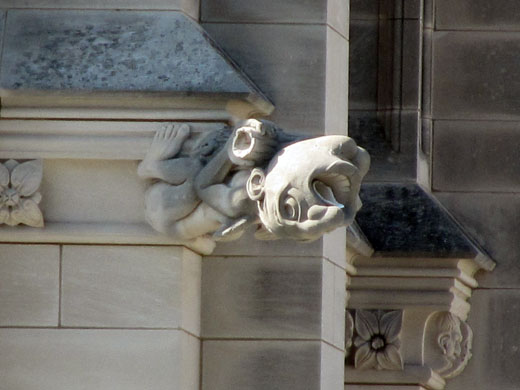
The horned fish on the north nave gets scant sunlight as the winter wears on, but seasonal shadows help him seem more sinister than absurd. He’ll tell no tale about himself; fish feed on the exploits of others.

TRIOLET
(SHIPWRECK SONG)

“Take up a line”—and so we sail
Behind the storm. We hold our own;
When luff-seams shred, our lidmen pale
Take up a line. And so we sail,
And when you dread that sureties fail
The loves of men on strands unknown,
Take up a line and sew. We sail;
Behind the storm, we hold our own.

(For all the entries in this series, hit the “looking up” tab, or read the gargoyle FAQ.)

“What would an angel say? The devil wants to know.”

In the murk of winter, the Cathedral of St. John the Divine makes you wend your way backwards through time—across traces of terrible fire, beneath vaulting conceived Romanesque but raised Gothic, past altars that look far older than they are. In the end, behind the sanctuary, is the beginning: the cathedral’s oldest chapel, where the saints of the Eastern church—Origen, Ignatius, Chrysostom, Basil—reign in their respective niches.

Across from them, around the portal, stand columns of angels. Though stacked head to toe, they rarely catch the eye, and they’ve gone largely unnoticed since 1905, when for one week, all New York was called to ponder them.

Gutzon Borglum was 38 years old. He had trained in Paris with Rodin, and his public monuments would soon rise across the United States, but for now, fame eluded him. A decade away from failing to carve Robert E. Lee into Stone Mountain and two decades before sculpting Mount Rushmore, Borglum set his mind and hands alike to a modest task: the careful making of angels.

Strongly nativist even by the standards of his day, Borglum admired the Klan, and the world would soon deem him cranky, stubborn, and confrontational. Yet the sculptor was none of those things on October 4, 1905, when Episcopalian officials stopped by his studio to see his plaster casts:

The clergy were admiring them when the up-State clergyman stopped before two statues, and broke the silence with this:

“Whoever heard of a woman angel?”

The clergy gasped: then the truth dawned upon them. For hundreds of years all over the world art had been depicting angels as female and in no place in the Bible could it be ascertained that angels were other than male.

The questionable figures were two of twenty angels meant for the Chapel of St. Saviour: the Angel of the Resurrection and, more sensitively, the Angel of the Annunciation. “It seems to me,” Borglum would later say, “that it is repugnant to every gentlemanly sense to conceive of a man performing that role. The idea is such a delicate one that I made the figure of even the woman shrink back after she had told the Virgin, as if it was almost too sacred a thing for her to put into words.”

Angelology focused the minds of New Yorkers. After claiming in its report on Borglum that 15th-century painter Fra Angelico had depicted female angels, the New York Times drew the ire of an anonymous Jesuit:

A headline on Page 6 of your to-day’s issue tells the public “We’re Wrong About Angels.” Indeed you are—you.

It would be interesting to know of one period or one picture where art has “depicted women angels.” As for Fra Angelico da Fiseole, he was a follower of Church tradition and of scholastic philosophy: the former of these invariably represents angels as appearing in the likeness of young men, while the latter teaches that angels are really incorporeal and sexless. Christian art, conventionally obliged to choose a sex for its angels, followed the hint given by the language of the Church, which invariably makes the names of the angels masculine—”Sancte Michael, Sancte Gabriel, Sancte Raphael,” never “Sancta.”

A day later, the Times replied with a cheeky editorial:

If Mr. BORGLUM had taken the trouble to read his New Testament in Greek before putting hand to clay on his commission for angels he would have avoided this shocking error in sex. He would have noted that AGGELOS is neither feminine nor neuter, but masculine, and so your angel must show in some fashion that he belongs to the tyrant sex. Bootless the plea that HOMER makes the lovely Iris a messenger of the goddess, and the Edda introduces the Valkyrs, who are tomboys, if you will, but maidens ever fair, as messengers of Wotan. These be pagan toys with which a properly Christian sculptor has naught to do . . . The book—what does the book say? Well, it says that angels are masculine. There you are.

Of course there must be women angels in heaven, for even MOHAMED stocks his Paradise with houris, but they never come down . . . Very likely the sensibilities of lady angels are too fragile to stand the coarseness of human life. Suppose one of them should light upon a wife beater, or see a car on the Brooklyn Bridge with forty men seated and thirty women standing! . . . We believe that with the astuteness of the fair sex raised to a heavenly degree these lady angels leave such chores to the males.

As newspaper nationwide chattered about Borglum’s angels, Dr. William Reed Huntington, chairman of the cathedral’s Sculpture Committee and the most influential Episcopal priest of his generation, fielded odd questions:

“I think in sacred art, as far as I know, face and form never indicate either male or female, but I must confess I never saw an angel with whiskers.”

“Or a moustache, doctor?” he was asked.

“No. Nor a moustache,” he replied.

“From some source or other,” ran a coy report two days later in a Pennsylvania paper, “came a horrid rumor that Mr. Borglum intended to put whiskers on the faces of his angels, so that there could be no question hereafter as to their sex.”

Voices rose, less a choir than a din. The New York Christian Herald hinted that the debate was a silly one, for where does scripture consistently show that angels even have wings? The New York Evening Post cited Emanuel Swedenborg on the existence of female angels. At the behest of newsmen, Jewish Encyclopedia editor Joseph Jacobs sifted through the Kaballah.

Borglum’s supporters minimized what happened next. In 1952, his wife Mary lamented that the affair “put upon the sculptor a stigma, a mark of an evil temper, which he carried to the end of his life.” A sympathetic 1961 biography suggested that the incident never happened at all.

Yet press reports from the following week are clear: Gutzon Borglum smashed the two offending angels:

I felt like a murderer, but that was the only thing to do under the circumstances . . .

I didn’t want an express man to haul them away to be stored somewhere. I didn’t want any one to touch them except myself. So I simply broke them to pieces myself, and I should hate to tell you how I felt when I did it.

Oh yes, I am under contract to do that work for the Cathedral. The word came that the angels must be men, and men they shall be.

That gentle, elegant sculptures proceeded from Borglum’s hands speaks well only of his talent; art and virtue are often estranged. Still, the sculptor showed surprising grace a few days later when he explained his plan for the cathedral’s first chapel:

The group was described by a text from the New Testament: “I piped to you, and ye did not dance.”

It symbolizes the despair of a woman who, finding that her appeal to the man’s higher nature has failed, turns away from him, and only the ensuing silence awakens him.

“I was impressed with the idea in this way,” said Borglum. “I went to a concert with a friend and heard Ysaye play one of Brahms’s compositions exquisitely. I was moved, delighted, enthusiastic, and I turned to my friend to discuss it with him. He was silent, the music had not touched him, we could not meet, and I was disappointed.”

A century later, most pilgrims to “St. John the Unfinished” scarcely glance at Borglum’s reverent, unironic angels, and no one remembers what they represent. At least two of the statues recall a week when angel faces roused pedantry, dogmatism, or scorn in otherwise decent people. Only Borglum, in the wake of his outburst, enshrined a contrary notion: that infamous people can bring about beautiful things.

In a season of hope, pause before Borglum’s angels, which a 1937 guidebook called “worthy of more than passing notice.” They may not move you, but when you know what they’re saying, they never seem silent again.

“Angels we have heard on high, tell us to go out and buy…”

“Now, the world don’t move to the beat of just one drum,” Alcuin famously advised Charlemagne in a letter that outlined the dangers of proselytizing to conquered tribes, “and what might be right for you may not be right for some.”

Medievalists know this better than anyone—which is why, as Christmas approacheth, the e-mails keep coming, as relentless as pistachio mongers in eighth-century Aleppo: Jeff, what should I get for the medievalist in my life?

Shopping for medievalists is easy. Here are ideas for unusual presents, all of which will be more gratefully received than those Medieval Times gift certificates you gave everybody last year.

APPLIED PALEOBROMATOLOGY

Turn tesserae of taste into a floor mosaic of flavor with A Taste of Byzantium: The Cuisine of a Legendary Empire.

Wipe away that gazelle-milk mustache and dine like a caliph with Medieval Cuisine of the Islamic World.

Dig for traces of medieval history in Joan Nathan’s new book, Quiches, Kugels, and Couscous: My Search for Jewish Cooking in France.

Let fly the yams! Defend the Land of Cockayne with a tabletop trebuchet (I’ve built this one! It’s pretty neat), and then lay siege to the sweet, spongy fortress that falls from your castle-shaped bundt pan.

Pretend this doesn’t sound dirty: Set your mouth on fire with Dante’s Inferno Balls.

“The heavenly aroma still hung in the house. But it was gone, all gone! No lamprey! No lamprey sandwiches! No lamprey salad! No lamprey gravy! Lamprey hash! Lamprey à la king! Or gallons of lamprey soup! Gone, all gone!” So go on, order tinned sea lamprey from Russia and feast like Havelok the Dane.

THE BUSINESSE OF MEDIEVALISM IS BUSINESSE

Do your loved ones live where Beowulf and strategic pricing techniques intersect? Refer them to Wiglaf Pricing, which “take[s] up Wiglaf’s example and seek[s] to aid executives in making the right decision under difficult circumstances to yield dramatic strategic improvements.”

If you own a business in the U.K., perplex your cringing minions with medieval team-building exercises, or smite them with your inflatable morningstar.

“VITÐ ÉR ENN, EÐA HVAT?”

Medieval Icelanders deployed the term “downward-facing dog” with unseemly specificity. Nonetheless, a lesson in runic yoga will de-stress your workaholic Viking.

The next time someone whines that medieval texts are unfilmable, hit them, literally, with this: the Icelandic adaptation of Gisli’s Saga on DVD. (While you’re ordering across the whale-road, why not snag some soda named after Egil Skallagrimsson?)

FROM THE SNORRI STURLUSSON BATHTIME FUN COLLECTION

You’ll be eager to hit the clubs and father all of Europe after scrubbing with Charlemagne Shower Gel.

I don’t know what to say about soap inspired by Dante’s Purgatorio, beyond “don’t get any in your eyes!”

Like Ibn Fadlan, I have mixed feelings about Beowulf soap made from honey and beer.

Wife of Bath bath salts may give your ablutions auctoritas, but they’re no substitute for experience—or penicillin.

HALL, HEARTH, AND HOVEL

Swing by the Got Medieval store, where Carl sells an awesome assortment of household doodads featuring medieval manuscript monkeys.

Make your den look all the jauntier with details from English cathedrals. (I especially like the hedgehog.) Or line your mantle with Chaucer-themed art tiles from the Moravian Tile Works in Pennsylvania.

Stop using the Exeter Book as a beer-mat! Rest your flagon on medieval story tiles: Celtic musicians, Tristan and Isolde, a scribe, or a Viking insult stone.

While waiting for your vowels to shift, have a drink and admire the Norman knights coaster set.

How tired must Martin Foys be of nodding and smiling every time he unwraps these Bayeux Tapestry cushion covers?

BAUBLES FROM THE GIFSTOL

Develop a new ear for Middle English with Ellesmere mini-Chaucer earrings.

Don’t just study Chaucer’s Prioress; be her, with this AMOR VINCIT OMNIA bracelet.

Every woman longs to hear it: “He went to the Pierpont Morgan Library!” This Christmas, give her jewelry based on the cover of the Lindau Gospels.

There’s a poem in this: a heart encased in chain mail.

MIRABILE VISU (ET DICTU)

Grendel’s mom sez: “Preserve your child’s teeth and hair in a pewter castle-shaped reliquary—but catch the shrieks in a cup of gold.”

Incubus wearing you out at night? Secure your bedchamber with a dragon-themed lock and key.

Write a check for $64,350 and that 15th-century printed copy of Boethius can be yours. (Take heart: shipping is only $10.)

In the “Quid Plura?” household, we’re all about the True Meaning of Christmas: the anniversary of Charlemagne’s imperial coronation. This year, rock like a tinsel-draped Carolingian with Christopher Lee’s weighty-brass concept album, Charlemagne: By the Sword and the Cross.

A mere $3.3 million can buy you the lifestyle of a heavy-metal medievalist: the late Ronnie James Dio’s house is for sale.

No one ever gets me what I really want: a picture of Dante and Beatrice in the Lincoln Tunnel.

LUDICRAE SUMUS

It’s Iceland, or Fontenoy, or Hastings, or this place, when your head’s down over the pieces of the Lego Castle chess set or the Lego Viking chess set. (They can always pillage the Lego Medieval Market Village.)

If cerebral tabletop games are your thing, try the highly abstract (and fascinating looking) Carolus Magnus.

Pre-order The Sims Medieval, though you won’t see it until March.

“AND EEK IN WHAT ARRAY THAT THEY WERE INNE…”

This isn’t strictly medieval, but those of you in academia may want the Lands’ End “FeelGood Professor Cardigan.” (If you’ve a Ph.D, students can call you “Doctor FeelGood.”)

If you further need to look the part, the Canterbury Cathedral Shop sells a necktie featuring the heraldic shield of the Black Prince of Wales and a Canterbury Tales stained-glass window scarf.

Washington National Cathedral also has gargoyle ties, and no Celticist should be without the Book of Kells tie. 

Maybe Christmas isn’t the right season to draw attention to a sexy female Robin Hood costume, but it’s a fine time to remind you not to dress your child like a medieval monk. (And please, I beg you, don’t dress your dog as a jester.)

Happy shopping—and nowell!

“…irgendwo in der Tiefe gibt es ein Licht.”

Yes, we have heard the glory of the pilgrims, how those dour chorophobes subdued their neighbors and performed bold agricultural deeds—but when you’re unaccustomed to hot Novembers and the flapping of turkeys toward Valhalla fails to drown out football, you roam the strands of bleak retention ponds with a seven-year-old looking for grass snakes and fish.


In the mud, behind ferns and broken boughs, rests a sleeping stone baby.

One of you raises the obvious point: “If we get too close, will its eyes snap open?” (Unanimity. Two steps back.)

“How’d he get here?”

“I don’t know, man. I imagine it’s a mystery.”

“Did people put him here?”

“Maybe he just washed up on the shore, like a king in a famous old legend.”

“Wait, what legend?”

“You’ve heard of the Vikings, right? One of their very first kings.”

“Who? What was his name?”

“Well, nobody knows where he came from, or where he went when his ship sailed away, but I heard that his tribe called him Scyld…

Then you find that some stories don’t really need snow, and you’re thankful for more than just turkey and pie as you rest in the bayou, wide-eyed at sunset, surrounded by monsters and kings.

“Walking back to you is the hardest thing that I can do…”

Sure, the average American associates this week with football, tryptophan, and noncommital nodding during awkward conversations about politics, but here at “QP?” headquarters, Thanksgiving means only one thing: experimental recreations of carrot jam from the medieval Islamic world.

Carrot jam? Yes, carrot jam. Known in Arabic as jawārish, the dish appears in a cookbook called The Treasure of Useful Advice for the Composition of a Varied Table, probably compiled in Egypt or Syria in the 13th century. The recipe is translated in Medieval Cuisine of the Islamic World by Lilia Zaouali, and while Islamic cookbooks are just as blithe as European cookbooks about assuming expertise on the part of the reader, this one seemed like a no-brainer. After all, sweet carrot dishes are common today, and carrot preserves and marmalade aren’t terrible exotic—so again we endeavor to answer, probably in vain: What did the past taste like?

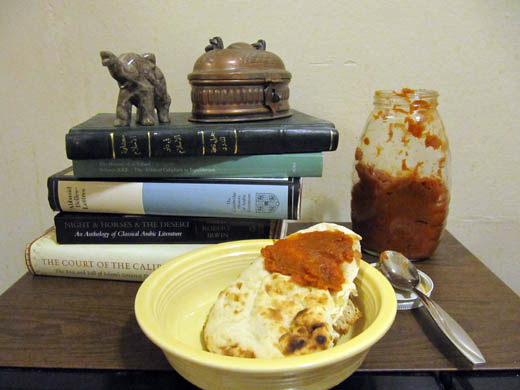
First, our ingredients: cookbook, carrots, honey from a friend’s New Jersey apiary (plus two plastic-bear backups), various spices, and a can of Chef Boyardee Ravioli that had nothing to do with this recipe but whined about being left out of a group photo.

From the recipe:

It is necessary to select fresh, red carrots, to wash them, clean them, and cut them as thinly as possible. Put them in a ceramic pot, add a little bit of honey, and cover them with water.

Lacking red carrots, I had to go with plain old orange. Here they are, simmering in the Le Creuset like flunkies in Charlemagne’s bath house.

Thus sayeth the recipe:

Cook them until they are soft, then strain off the water with a sieve and add a quantity of skimmed honey equal to that of the carrots.

An hour later, a pound of carrots yielded around a cup and a half of carrot glop, to which I added one cup of honey. Rather than bore you with lame photos, let’s hail the return, by popular demand, of the Trapper Keeper Unicorn of Applied Paleobromatology.

Distracted by the hard work of mushifying a few carrot chunks with the aid of Sir Braun de Hand-Mixer, I failed to witness a shocking crime on the countertop behind me.

Did you know that the tradition of selling honey in bear-shaped containers derives from the Abbasid practice of importing actual bears from Europe, squeezing them while upside down, and seasoning food with whatever spurted from their skulls? The caliphs really were that wealthy.

The recipe calls for spices:

Mix in seasonings chosen from among pepper, ginger, cardamom, cinnamon, cubeb, spikenard, mace, galangal, aloe wood [Aquilaria agallocha], saffron, and musk.

Fresh out of spikenard, and stunned by the recipe’s endorsement of a freeform jazz odyssey of spices, I opted for four I knew I had in my cabinet: 1/4 teaspoon each of pepper, ginger, cardamom, and cinnamon. (I’m not positive that “pepper” in a medieval Middle Eastern recipe meant “ground black peppercorn,” but so be it.)

I mixed up this little masala, dropped it into the honey-and-carrot mush, and did as I was told:

Cook to thicken the carrot jam.

Twenty minutes later, carrot jam was bubbling like sweet orange lava.

Two teaspoons of spices turned out to be too strong for fewer that two cups of carrot jam, but holy hopping Barmakids, hot jawārish a la Sypeck is tasty.

Medieval Islamic royalty had a sweet tooth to rival modern America’s, as I found when I whipped up a batch of tabaahaja, the wince-inducing candied lamb of the Abbasids, but carrot jam just isn’t that strange. Scale back the spices and you could probably convince Thanksgiving guests that you’re feeding them Aunt Harriet’s sweet potato mash, albeit with a throat-catching kick. (I suspect a version with spikenard, cubeb, and galangal might land harder on the Western palate.)

One question lingers: In the medieval Islamic world, was “jam” eaten hot? Zaouali’s book doesn’t say. The jawārish recipe includes only one more line: “Pour it into a glass jar and consume as needed.” Which is what I did.

You know what? Cold jawārish smeared on toasted naan isn’t bad either. The pepper and coriander give the jam a kick we more commonly expect from heated food, but that’s because of the spices and quantities I chose. Medieval Islamic cooks were free to make this stuff with whatever spices they wanted, as are modern paleobromatologists.

Of course, I can’t help but pine for the ideal jawārish chaser: a cold, fizzy glass of galangal soda.