“Tiny purple fishes run laughing through your fingers…”

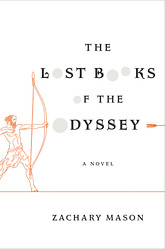
As much as C.F. Cavafy would nag me to focus on the voyage rather than the destination, some straits are best sailed through quickly. Behold this Wall Street Journal article about The Lost Books of The Odyssey:

The author of a new novel that re-imagines Homer’s “Odyssey” isn’t a classicist or a literary scholar. Zachary Mason, 35, currently works as a computer scientist specializing in artificial intelligence at a small start-up in Silicon Valley.

Let’s sit on the sand and ponder this trireme full of waterlogged assumptions. Do most readers who browse the Web or still pick up a newspaper believe that only classicists and lit scholars use ancient epics as creative springboards? That Homer belongs to professors? Even though one of Homer’s best-reviewed “re-imaginers” can’t read a word of Greek?

Or are we to be surprised that a computer scientist wants to re-tell The Odyssey? Everyone knows that people who ponder artificial intelligence for a living are incurious louts who never read outside their field. All that boring technical stuff is useless on the windy plain of Literature, where the spears of touchy shatter on the burnished shields of feely.

But I’ll not read the reporter’s mind. Maybe I’m misunderstanding the assumptions she presumes we share.

The unlikely authorship is one of several unusual details…

Or maybe I’m not. Next paragraph.

Mr. Mason has never set foot in a writing workshop…

Many novelists never do. People who read are not surprised by this.

The book’s “unlikely authorship” having been established, the article dazzles us with details:

The story of how “The Lost Books” came together is an odyssey in its own right. Mr. Mason, who says he has long been inspired by Odysseus’s story, but has no formal training in the classics…

Mason wrote for six years; got no response from literary agents; was published by a small press; then gained wider notice after winning an award. No doubt the process was frustrating, but there are far less direct routes to literary fame. I’m pleased by Mason’s success, but not even a weatherman flailing for a segue would call it an “odyssey.”

And in case you forgot, there it is again: “no formal training in the classics.” Yes, non-classicists seeking inspiration in The Odyssey is unthinkable.

I don’t know why newspapers and magazines talk down to their readers like this, but even a cyclops wouldn’t so badly misperceive the gulf between a book-savvy readership and the rusty tropes a reporter is expected to marshal when writing about authors. The world is wider than our own experiences, and it offers as many routes to publication as there are books, or interpretations of Cream songs. Like Mason’s novel, an author profile should re-tell a story with a fond, familiar theme: good writers come from everywhere.

“From Arcadia to the stone fields of Inisheer…”

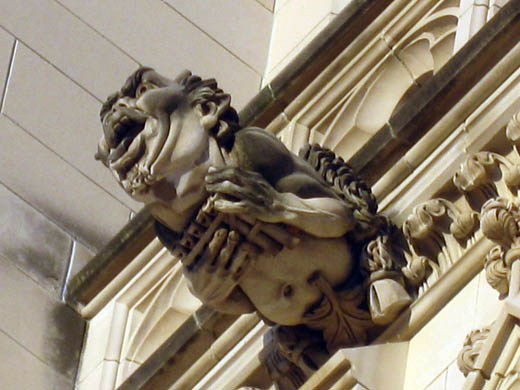
Few visitors to the National Cathedral glance up to see who’s perched on the facade just north of Creation. What follows is unreliable; the snowstorm, and my interlocutor’s ancient Greek accent, made accurate transcription rather difficult.

PAN

Leave “kyrie” and “tirra lirra” be,
And let me sneer and jeer and leer at thee.
The gates of dawn are bricked and bolted fast;
The springs of piping pastors fell at last.
Now winter twists my reeds like broken wings,
And Philomel abhors the hymn she sings,
Yet all the world adjudges me the thief?
Perhaps I am. So peep behind my leaf,
And spurn what sailors swore in days of old;
I am not dead, dear Thamus—simply cold.

(Above: Pan on February 6, 2010. Below: Pan on December 3, 2009.)


(For all the entries in this series, hit the “looking up” tag.)

“It’s getting so you never know when things are better left alone…”

So “Quid Plura?” enjoyed a record number of visitors in January. Who knew you were all so curious about the inner lives of gargoyles?

Perhaps you’ll also like these random links, which have been hand-selected and flash-pasteurized especially for you on this chilly Tuesday evening.

Novelist Leslie Pietrzyk talks about her autographed copy of The Catcher in the Rye.

This refreshing New York Times piece debunks the tedious conventional wisdom among English teachers that J.D. Salinger was holed up in Cornish like Hitler in his bunker.

Speaking of people who bowed out before others got sick of them, here’s an interview with Bill Watterson.

Sometimes, life’s second acts surprise me: Larry Tagg, bassist for the underappreciated ’80s pop band Bourgeois Tagg, is now writing books about Abraham Lincoln.

The author of The Invisible Hook defends the medieval trial by ordeal.

Jake Seliger re-reads High Fidelity.

Shatner reads Poe.

Lingwë asks, “When is an English root word like a Mafia don?”

“…unladen, empty, and turned to stone.”

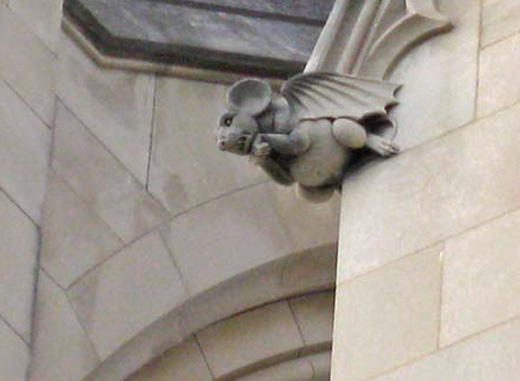
The rodent poised on a buttress on the south nave of the National Cathedral didn’t go where I expected—but that, I suppose, is the point.

DIE FLEDERMAUS

You say: “No mouse was meant to fly.”
I woke with wings, so why
Should I not try

To streak and swoop from roof to peak,
Refining my technique?
Perhaps next week,

You’ll dwindle as I soar aloft,
You sorry souls who scoffed,
And, landing soft

In straunge strondes, I alight
A pilgrim benedight;
But then, by night,

The leatherwings my roost surround
With prophecies profound;
Without a sound

They flap from crags and belfries cold
A bat-king to behold.
So would you scold

A faulty mouse whom Fortune spurned,
Whose rote she left unturned?
For I have learned

A larger life demands a leap.
When all the world’s asleep,
From spiry steep

I’ll wing where mice may safely twitch:
Moel Hebog will bewitch,
And Lovćen’s rich,

And Eldfell smolders, bare and bleak—
Perhaps a perfect peak
Where all who squeak

May lightly laze, like long-shed sorrow:
Fuji, Kilimanjaro
…so, tomorrow.

(For all the entries in this series, hit the “looking up” tag.)

“There’s a club, if you’d like to go…”

The dour bishop on the south nave of the National Cathedral needs to spend less time judging tourists and more time reading the Cura Pastoralis. Does anyone understand what he’s yammering about? I don’t.

ORDINARY TIME

When January thaws, and spirits fall
Like late December sleet that spattered all
These roots and stumps, you stumble, overwrought,
The virtue in your veins engendering nought
But wheezing as you clamber to repeat
This uninspired ritual: to greet
Another crop of claimants at the source,
In chapels where this custom runs its course
And small fools hum a hymn for Heaven’s sake
(Which only keeps the bigger fools awake),
Then something pricks your wan and warbling heart;
To compensate, you contemplate the art
Of forming crooked cloisters with your hands;
Below, the palmers sneak from sundry lands
And cross the lines of tales that didn’t end.
Along the leaves of centuries, they wend
To seek a saint. His holy, blissful trick?
He once helped others when that they were sick.
And here your daydream fails. In disarray,
You pace the nave alone. You sulk away.
You haunt the darkened pub, and down a beer,
And swish the foamy dregs, another year.
Vocations call for patience, this you know;
Devout or not, your pilgrims never show.

(For all the entries in this series, hit the “looking up” tag.)

“The circuit boards are linking up in rhyme…”

The people have spoken!

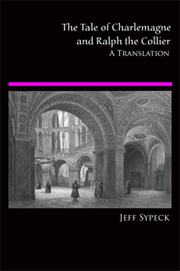
The Tale of Charlemagne and Ralph the Collier is now available for the Amazon Kindle.

The crack staff of editorial kobolds here at “Quid Plura?” headquarters made every effort to tailor the Kindle version to the quirks of the device rather than simply upload it and let the formatting fall where it may. Since the poem survives only in an early printed edition, a version for the first generation of serious e-readers does seem entirely appropriate. (At least to the kobolds, who end up trying to think way too deeply when they don’t have any proofreading to do.)

To download a copy for the Kindle, go here. To read more about this translation, or to order a shiny new paperback copy, go here.

Everyone else, stay tuned! More medieval madness, Charlemagniana, and gargoyle goodness is on the way.

“…and every one of them words rang true, and glowed like burning coal…”

[UPDATE: As of December 2012, information on purchasing The Tale of Charlemagne and Ralph the Collier as either a paperback or an e-book can be found here.]

In 2007, I posted my translation of the 15th-century romance “The Taill of Rauf Coilyear,” a 972-line Middle Scots poem about the kerfuffle that ensues when Charlemagne, separated from his entourage by a snowstorm, seeks refuge in the home of a proud and irascible collier (a sort of medieval Tommy Saxondale). Combining folklore motifs with burlesque humor and elements of chansons and chivalric romances, “Rauf Coilyear” is a lively but rarely-read tale of courtesy, hospitality, and knighthood. To my knowledge, it’s also the only medieval romance in which Charlemagne totally gets slapped in the face.

Because enough people found the earlier version both readable and entertaining, I’m pleased to make The Tale of Charlemagne and Ralph the Collier available as a snazzy 56-page paperback. The translation—which imitates the form of the original in 75 thirteen-line rhyming, alliterative stanzas—is freshly polished and lightly annotated, and the bibliography is current. I’m offering this little book as a literary curiosity, an experiment in self-publishing, and a way to help defray the costs of maintaining this blog.

To preview this book, you can see a low-res PDF of sample pages or view larger images of the front and back cover.

No one else has ever translated “Rauf Coilyear” into rhyming, alliterative, modern English verse, and I doubt anyone else will be nutty enough to try—so whether you’re a longtime reader of this blog, a student of medieval literature, or a collector of truly obscure manifestations of Charlemagniana, I hope you’ll find this translation a satisfying read. Despite what Mamillius claimed, sometimes a sad tale isn’t best for winter after all.

“Leona! Something to slip into the hymns next Sunday!”

Magna Carta, the Peace of Westphalia, the Declaration of Independence—all of these once-mighty works of human ingenuity crumble like ketchup-stained ATM receipts when placed alongside the mere promise of the one thing that everyone has been emailing me about this week: a symphonic metal concept album about Charlemagne performed and sung by veteran character actor Christopher Lee.

As someone who grew up in New Jersey during the 1980s, I feel qualified to note that the preview clips posted on YouTube suggest less “heavy metal” and more “weighty brass.” However, any bearded dude who’s portrayed the likes of Saruman surely knows how to grimace musically, so I have no doubt that Charlemagne: By the Sword and the Cross will weave trancelike melodies that slip over the transom of social consciousness and insinuate themselves into your dreams. But will it kick butt? We’ll have to wait and see.

“…and he claws at the door to be let out at night…”

Gasch’s Guide to Gargoyles and Other Grotesques says that this bone-clutching critter on the north nave of the National Cathedral is a basenji, an African dog that can’t bark but does tend to yodel. Our neighborhood basenji earned his place in the 1959-1960 gargoyle design competition; his artist, as you’ll see, is already the subject of apocrypha.

EPIPHANY

Bereft of bark, I bat my bone about,
And do my simple service as a spout,
And in my mind I romp across the grass
And nip at skirt-clad ankles as they pass,
And let no lofty insight cloud my brain;
Discernment falls and drips away, like rain.
…but once, a sunny pilgrim made me think:
Her left hand clutched a sketch-pad sopped with ink,
Her right hand led her son—and in my spine,
I knew those hands determined my design.
That sprinkler-misty morning, I awoke
And listened to my maker as she spoke:
“Imagine: When a thousand years have flown,
We’ll look up and see this pup-spout of our own.”
The boy stepped back suspiciously and said,
“I hope by then we’re looking down instead.”

(For all the entries in this series, hit the “looking up” tag.)

“Why don’t you ask him who’s the latest on his throne?”

Having spent years watching Washingtonians pass beneath him, the elephant on the west facade of the National Cathedral has lost all patience for us. While the old line about elephants never forgetting is generally true, it’s just as true that elephants don’t remember what they’ve read in ways that we smaller-brained creatures would consider logical. As such, this discontented bibliophile sees the city through his own singleminded filter. You know how elephants are.

UBI SUNT QUI ANTE NOS CONCULCAVERUNT?

Send for some plaid piper; let him march the mice away:
Staffers squeak and scatter into fifty shades of gray.
No heroes hold the hilltop hall, nearby presides a fool;
Let Shanthi and Kandula and Ambika romp and rule!
Come, my trunk-faced children! Stomp from Carthage to the Alps.
Make the Romans quaver from their sandals to their scalps!
Send for Ethiopians, with war-mounts wont to kneel
By the walls of war-torn Mecca, and watch Abrahama reel.
Send for Greeks where tesserae wash up along the strand;
Find tuskers in the market tracing crosses in the sand.
Send riders out to Roncesvalles; let Roland raise his horn!
Bring Isaac and Abul Abaz from Baghdad’s bangled bourn.
Send for steeds from Siam, where we didn’t yield an inch!
Send for Blair in Burma (though he’ll shoot you in a pinch),
And Wallinger and Buckingham and one who hears a (who?)
And Jumbo (how?) and Jim Crow (what?) and Samwise Gamgee too.
Send for (ah!) Ganesha on a ten- or twelve-arm day!
Let trunks transform to trumpets, blow bureaucracy away,
And laugh as legends leap and lunge and light up dull D.C.!
(And if, at last, nobody comes, then maybe send for me.)

(The blogger apologizes to Langston Hughes. The elephant, of course, apologizes to no one.)

(For all the entries in this series, hit the “looking up” tag.)