“Your face, your race, the way that you talk…”

Recently, the “Charlemagne” column in The Economist declared Playmobil Man its “European of the Year,” noting persuasively that Homo playmobilis offers “a striking snapshot of European aspirations, anxieties and foibles.” That approach to toys, I’d hasten to add, also says something about how they see history:

There are Playmobil knights and barbarians, pirates and Roman legionaries, all wielding lethal weapons. Europeans can even live with American military toys, if they are old enough: there are Playmobil cowboys from the Wild West, and soldiers from both sides in the American civil war.

The difference is philosophical, says Mrs Schauer. There are no more knights and pirates, so their combat is a “resolved story.” Modern war is “really horror.” That is echoed by Gabi Neubauer, a librarian buying toys in Nuremberg. She suggests that “it is more honourable to fight with a sword, somehow.” Not all explanations are as high-faluting. Asked why Playmobil makes any tiny toy guns at all, Mrs Schauer admits “otherwise, we probably wouldn’t be accepted by boys.”

To the modern toy-shopper, a medieval battle may seem more honorable when viewed through the thick lens of history. But when 14th-century conflicts continue to perplex, and frustrate, and threaten to come between allies, it’s iffy to claim that the knights of old Europe belong to a story that’s somehow “resolved.”

If you’re just catching up on the news of the weekend—Kosovo’s declaration of independence and the reaction it’s causing in Serbia—you’ll see that most articles skimp on historical background. They summarize briefly the wars of the ’90s, but doing the subject justice is nigh on impossible. Even for many foreigners with Balkan connections, disentangling the skein of religion and culture and old ideology is the work of at least half a lifetime. Besides, seeing Kosovo with no more than two decades of context, or panning back only a century, is like opening a book more than three-quarters in. To begin understanding what happened this weekend, you have to go back more than 600 years.

The Battle of Kosovo is murky indeed, but shadowy memories of this turning point in Serbian history did survive the centuries, first in oral tradition and then, in the 19th century, in the written records of a patriotic Serbian philologist. (You can order a hard copy from Ohio University Press or read all the poems online.) Commanded by a noble named Lazarus, the Serbs clashed in June 1389 with the invading Turkish forces of Sultan Murad at Kosovo polje, the Field of Blackbirds. The epic tradition is wonderfully vivid: Lazarus doesn’t want war, but he refuses to pay tribute to the sultan. Elijah appears to Lazarus as a falcon and forces him to choose the destiny of Serbia: glory on earth, or glory in Heaven? Lazarus thinks—then he makes his choice fast:

O Dearest God, what shall I do, and how?
Shall I choose the earth? Shall I choose
The skies? And if I choose the kingdom,
If I choose an earthy kingdom now,
Earthly kingdoms are such passing things—
A heavenly kingdom, raging in the dark, endures eternally.

Before the battle, Lazarus celebrates his slava—the feast-day for his patron saint—with a last supper and grim prophecies of betrayal. The Serb leaders know that the Turks vastly outnumber them; Ivan Kosančić declares that “[i]f all the Serbs were changed to grains of salt, / We could not even salt their wretched dinners!” Nonetheless, they agree to tell Lazarus that the Turkish army consists of children, old men, and cripples, but Lazarus seems to know otherwise. The Turks easily slaughter the Serbs, but much of the epic tradition dwells on the poignant stories of individuals, such as the Maiden of Kosovo, who wanders the carnage looking for the man she was supposed to marry; the nine Jugović brothers and their father, whose deaths cause their mother to die of heartbreak; the redemptive bravery of a falsely accused hero; and the treachery of his accuser. Much of the Kosovo epic is unverifiable, even ahistorical, but the fragment we have is a powerful read. Its legacy, though, is both tragic and sad.

Unless you understand the Serb defeat at Kosovo polje, you won’t see the symbolism in Gavrilo Princip assassinating Archduke Ferdinand on the 525th anniversary of the battle, the act that ignited World War I; you won’t know why charmless nationalist Slobodan Milosevic scored a propaganda victory by speaking at the battlefield on the 600th anniversary of the defeat (shortly before his own helicopter-assisted apotheosis); and you won’t appreciate why many Serbs still regard Kosovo not only as their ethnic and religious homeland but also as the site of their national martyrdom. At this point, history fades into vapors; as John Matthias writes, “while the final and conclusive battle was not fought until 1459…it is Kosovo which has lived in the popular imagination and in epic poetry as the moment of annihilation and enslavement.”

Today, we prefer our medievalism sweet: Renaissance festivals, fantasy novels, CGI movies, and Playmobil toys. But the Kosovo conflict is medievalism, too, the sort we would often prefer to forget. In the Balkans, where the scholarly study of Bosnian guslars later shed new light on Beowulf, medievalism also kindled World War I. During the 19th century, as medievalism adapted to the vagaries of national character, the English gave us Tennyson and the Gothic revival; the Scots had their Ivanhoe and the Eglinton Tournament; the Finns found themselves in the charming Kalevala; the Germans gave the world Wagner (not only his music but also, alas, the man) as well as the Monumenta Germaniae Historica; and the French, bless their hearts, gave us Migne. The Balkans bequeathed us their own Middle Ages. The world they created, though grim it may be, springs right from the same source as Tolkien.

Sometimes, medievalism should give us pause, especially us Americans, for whom the phrase “that’s history” is more likely to be dismissive rather than admonitory. The battle of Kosovo resonates still; its legends and lore have profound implications. Playmobil knows this; just look at their toys. They sell Norsemen and Romans and wee Gaulish leaders, but no Lazarus or Sultan Murad. The thought is unnerving, outlandish, and weird. Let’s hope that their story is someday resolved.


“Now mister, the day my number comes in…”

Aspiring writers will often obsess over honing their style and making a true work of art. Some tend to overlook practical matters; they’re the folks who are most likely to need, but are just as likely to ignore, Steven Hart’s round-up of “nitty-gritty stuff” about the writing business. John Scalzi’s post is especially useful: “Unasked-For Advice to New Writers About Money.”

Scalzi’s best advice (after “don’t be a heavy metal bassist”) is this: “Writing is a business. Act like it.” One of his commenters stresses the importance of saving receipts, a small inconvenience I strongly endorse. (Driving to your first author appearance? $3.01. The silent scream of your psyche when the C-SPAN cameras start rolling? Priceless.)

“He’s making friends in places high above…”

And so the sun shines on another St. Valentine’s Day—as well as “Valentimes,” which as far as I can tell is a parallel holiday observed by supermodels and the illiterate. Henceforth, forthwith, and thusly, I offer some links to help you make the most of this rosy-fingered day.

First, educate thyself: read up on the story of St. Valentine from the Legenda Aurea, watch an earnest mini-documentary on the saint, and check out this weirdly South-Park-like hagiographic cartoon. (You will respect the Emperor Claudius’s authori-tay.)

When in Rome, stop by Santa Prassede to see (or, if you’re so inclined, venerate) the relics of St. Valentine—or, for a limited time, buy a third-class relic of the saint on EBay. (Dubliners take note: thanks to the Carmelites, you also have access to relics of St. Valentine at Whitefriar Street Church.)

Speaking of the Urbs Æterna: these days, Roman lovers attach locks to the Milvian Bridge and then fling the keys in the Tiber. (Imagine how history might have turned out if Constantine and Maxentius had settled their differences thus.) If you can’t get to Rome, never fear: just visit the Ponte Milvio in Second Life.

Thanks to Google Books, literary types can read up on Chaucer and the cult of St. Valentine or rediscover a long-forgotten St. Valentine’s poem.

If Valentine’s Day makes you cynical, then commiserate with the great Tom Lehrer: here’s “I Got it From Agnes,” “The Masochism Tango,” and, er, “Oedipus Rex.”

Finally, if the roses wilt, the chocolate is rancid, or the restaurant turns you away and even St. Valentine fails to intercede, remember that American pop music always has the answers. What do women want? Endicott. What do men want? Caldonia!

“Looking in shades of green through shades of blue…”

When the Zemeckis Beowulf movie came out last year, several commentators insisted that a “fresh reading” often gives new life to an ancient work. Blogging medievalists weren’t necessarily hostile to that notion, accustomed as they are to studying stories that change over time, but most didn’t think the reworking of the epic succeeded on its own merits. Recently I wondered: Which film adaptations of medieval stories, if any, have succeeded without being true to their sources?

Expecting the answer to be “none of them,” I revisited what may be the most famously awful “medieval” movie: the 1984 film Sword of the Valiant: The Legend of Sir Gawain and the Green Knight. I hadn’t seen this turkey in 20 years, but I expected to find a wonderful piece of evidence against the “fresh reading” argument. In fact, I envisioned a world in which simply declaring “Sword of the Valiant! Sword of the Valiant!” would shut down any response from reckless modernizers who can’t be bothered to contend with a work of medieval literature on its own terms. Instead, what I found in Sword of the Valiant surprised me: a laughably bad movie, to be sure, but a most intriguing mess. The film fails not because its creators gave the story a “fresh read”; it fails because they loved its medieval sources just a bit too much.

If you’ve seen Sword of the Valiant, you know that the first ten minutes are somewhat faithful to Sir Gawain and the Green Knight, and there’s a five-minute section near the end that reminds you what this movie purported to be. The rest is a disaster. (Bafflingly, Sword of the Valiant is a remake of a film made more than a decade earlier by the same writer and director; that long-lost original is being reissued on DVD next month, I suppose to capitalize on the success of the Armitage translation.) The faces of familiar actors pass in and out of the frame—Trevor Howard, John Rhys-Davies, David Rappaport, even a weary Peter Cushing—but their presence fails to comfort, because Miles O’Keeffe, playing Gawain, is omnipresent.

How much Keeffe is in this movie? Miles O’Keeffe. Star of way too many awful, awful 1980s sword-and-sorcery flicks, O’Keeffe dons a Prince Valiant/Peter Frampton wig and takes up the challenge of the Green Knight, played by Sean Connery, whose pranceworthy outfit, spray-on tan, facial glitter, and exposed fuzzy midriff go a long way toward explaining why his wife from the original poem is nowhere to be seen.

En route to the Green Chapel, Gawain inexplicably wanders out of his original story and into another romance: the Yvain of Chretien de Troyes. Like Yvain, he’s trapped between two gates and then rescued by a maiden named Lunette, who brings him an invisibility ring. Three or four plot twists later, he falls into another lousy movie entirely and gets caught in a war between two barons, Bertilak and Fortinbras. Along the way, Gawain slays Morgan le Fay, whom the Green Knight turns into a talking orange toad. He acquires a squire, befriends a friar, interrogates a dwarf, and often earns praise and love for no apparent reason. We even see our hero chasing a unicorn through the woods with a crossbow because he hopes to kill and eat it. At that point, I don’t know why the filmmakers didn’t just show Miles O’Keeffe enjoying a Bavarian hang-gliding adventure over Neuschwanstein. That’s what he did as Ator in the equally terrible fantasy movie Cave Dwellers, and it couldn’t have made this movie worse.

Actually, I know why Sword of the Valiant never gets quite that random. Sure, the movie chokes on its own haphazard storytelling, but its randomness is of a particular type, resembling the immature but effusive novelty of the Squire’s story in The Canterbury Tales. When a pavilion full of food appears out of nowhere or a rainbow gleams in the sky after Gawain blows a horn by the seashore, the movie still stinks, but these strange moments at least make Sword of the Valiant a unique curiosity, ensuring that the film harks directly back to medieval literature in ways that most bad fantasy movies do not.

Consider the medieval storytelling motifs that don’t need to be in Sword of the Valiant but somehow get thrown in anyway. The unnamed, Arthur-like king declares that none shall partake of the Yule-feast until someone in the court proves he’s worthy of his spurs. The king is mouthing a cliche, of course, but the knight literally earning his spurs is a common folklore motif. (In fact, it pops up in the final reel, so to speak, of Ralph the Collier.) Unlike the hero of the original romance, who needs only to fulfill his promise after a year, our big, stupid O’Keeffe is also charged with solving a murky riddle, not unlike certain knights in Gower, Chaucer, and at least one other medieval Gawain romance. There’s even a stock encounter between our hero and an irascible porter, a scene with roots in countless medieval romances, even though it serves no purpose here. The inclusion of these and similar details suggests an interesting ambition on the part of the filmmakers: that they’re playing not to popular expectations regarding medieval adventure stories, but to the specific expectations of people who’ve actually read medieval literature.

Sword of the Valiant is random, episodic, unsatisfying, and incoherent. But when its actors deliver such interesting lines as “A sword is three feet of tempered steel, with death dancing on every inch and hanging like a dark star on the very point” or “The old year limps to its grave, ashamed,” they try to sound like they mean it, because it’s clear that the filmmakers want them to mean it. The movie bristles with this sort of unfocused ambition, much of it hinting that its creators resisted cinematic competence for the greater glory of half-assed medievalism.

Maybe that’s why I find Sword of the Valiant worthy of affection, if not an ounce of respect. Despite their desperate visual references to Excalibur, Conan the Barbarian and The Empire Strikes Back, the filmmakers aspire to rise above the usual fantasy cliches, even when they so obviously don’t know how. You can almost imagine them puzzling over dim memories of undergraduate lectures, as fascinated by Middle English as the haze of a hangover will allow, trying to rework the material not out of a need to freshen up their sources for modern audiences but because they loved the sheer medieval strangeness of it all. That’s why it’s fascinating, and a little sad, to see their apparent affection for medieval literature mated with sheer pretentiousness to spawn what is, in effect, a terrible work of medieval-lit fan-fiction.

Sword of the Valiant closely approximates a student’s first reading of the strangest medieval romances: you’re confused by an alien mindset, you’re served up a dog’s breakfast of medieval motifs, and you start to suspect that the storyteller has inherited an ancient pile of symbols that he doesn’t fully understand. It took centuries for medieval romances about grail-seekers and courtly love to seem outlandish and weird, and no actual romance is as blatantly strange as this movie, so let’s give Sword of the Valiant some credit: to accomplish that in less than 25 years—heck, to accomplish that just by releasing the film—sure must be some kind of art.

“I guess I’m always hoping that you’ll end this reign…”

Have you always wanted to follow in the footsteps of the Emperor Charlemagne but couldn’t quite bring yourself to behead Saxons and slog through The City of God? Then you, my friend, are in luck: If you’re an EU citizen between the ages of 16 and 30, you still have time to enter the European Charlemagne Youth Prize Competition. Whether you’re the role model they’re looking for to “promote the European and international understanding” or you just don’t mind faking it to pocket several thousand Euros, you need to get cracking on your proposal. Just be warned that if you do happen to win the Karlspreis für die Jugend, they make you earn it: you have to visit the European Parliament.

For what it’s worth, the “Charlemagne” column of The Economist has already chosen its own European of the Year. Their choice isn’t an obvious one—it’s not a world leader, a cultural figure, an artist, or a politician—but it does provide, as the column asserts, “a striking snapshot of European aspirations, anxieties and foibles.” The magazine’s proposed ambassador for Europe may be a bit plastic, but I will say this for him: he’s always sure to greet you with a smile.

“If I listen close, I can hear them singers: oh, oh, oh…”

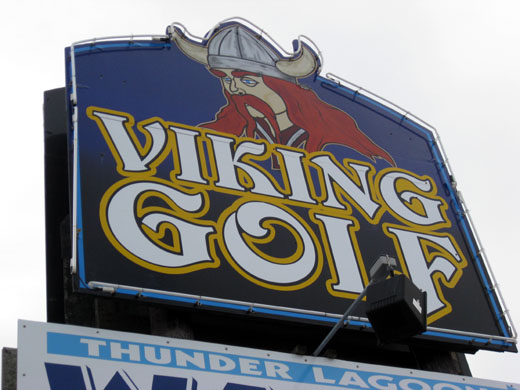
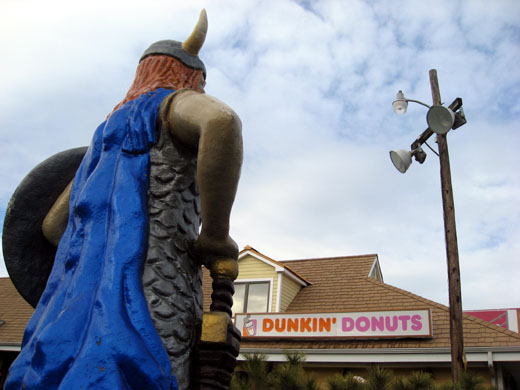
The first day of my winter jaunt revealed a forgotten outpost of Viking activity in Ocean City, Maryland—or, as I’m now calling it, New South Vinland.

When the sun rose on day two, I beheld an even more astonishing sight: Muslims and Christians uniting against a common foe.

On the east side of North Baltimore Avenue is this oasis for weary mujaheddin:

On the west side is a hospice for homesick Crusaders:

These people aren’t fooling around. Their sign bears the coat of arms of the United Kingdom and there’s a crown on the K.

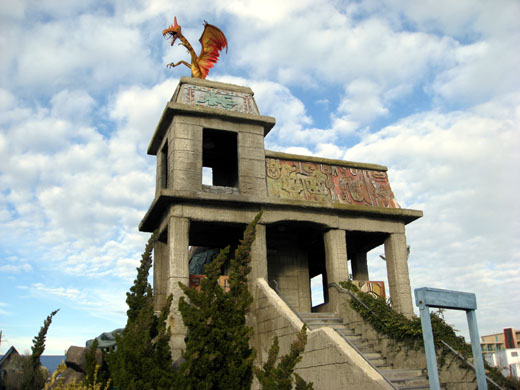
Wait—what’s that structure rising from a nearby parking lot?

A shop that sells string and sealing wax, and other fancy stuff?

No. Sweet Lord, no!

It’s a evil dragon temple!

Why would the high priests of miniature golf build such an unholy structure (apparently from pre-Columbian spolia) and summon these minions of chaos?

“M R dragons.”
“M R not.”
“O S A R. C M wangs?”

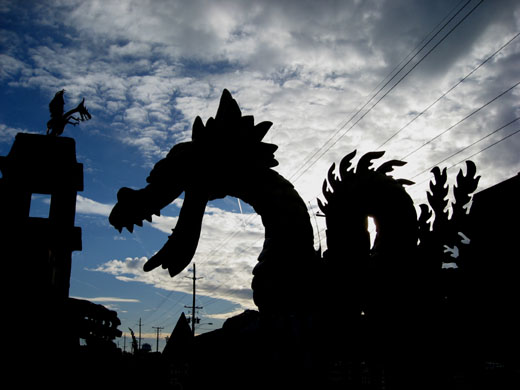
Look: this dragon is so dangerous, the other dragons keep him in a cage.

This dragon lives in fear of the day the other dragons discover he’s really just a snake.

“Uh, guys? I’m actually a beloved symbol of prosperity and good fortune. Guys?”

This dragon is the kind of cringingly un-selfaware monster who declares he’s eager to “have you for dinner,” after which that orange suck-up behind him cackles as if he said something hilarious.

Don’t you agree, Curiously Incongruent Easter Island Head?

Storm-clouds gather. Darkness falls. The last dim battle between dragon and man beginneth here, and the mists of death shall sweep over land and sea.

And then everyone will adjourn to eat non-pareils at the nearest Candy Kitchen…but that’s a much less dramatic story.

“Gunter, glieben, glauten, globen…”

Ocean City, Maryland—desolate in January, and surely a place of respite from medievalism in all its myriad forms.

No way! A hammer-wielding madman! Whither doth he beckon?

Great Odin’s opthamologist!

It’s as if I’ve wandered into sixth-century Norway.

Unlike this coward, I am undeterred, for I behold…

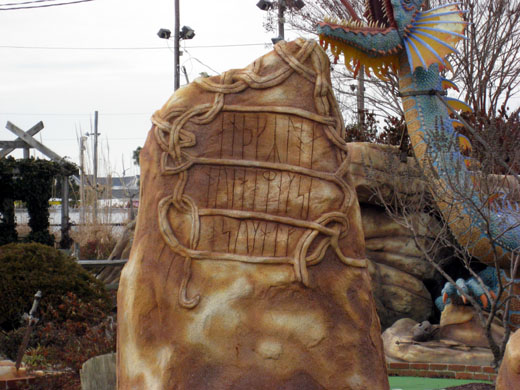
…a runestone! A long-neglected remnant of our distant Viking past!

(Plus the papier-mache skull of a Tyrannosaurus Rex.)

My rune-lore is feeble, but I believe this stone is trying to speak to me. Its approximate message appears to be “anthskloanuijaggnksinsukjtf.”

Meanwhile, the runic message carved into the beam on this this miraculously preserved Viking outhouse warns me, “riflthzwarir.”

Great enchantments surely haunt this place.

No matter. I’ll leave trite riddles to less ambitious colleagues. They’ll all go berserk when I publish this photo, which reveals the real reason Erik the Red journeyed westward.

Endowed professorship at Oxford, here I come!

“She began to wail, jealousies scream…”

Everyone is done talking about the recent Beowulf movie. I thought I was done with it, too, until I saw this comment from Dave Itzkoff at the New York Times blog “Paper Cuts”:

One of my favorite tropes in “Cloverfield,” the new J.J. Abrams-produced monster-destroys-Manhattan movie that made one zillion dollars (give or take) at the box-office last weekend, is that the camera rarely lingers on the giant beastie long enough for audiences to get a clear look at it. What makes the monster so frightening is whatever we viewers project onto it – it’s whatever we think it might be.

If I were teaching this semester, I might ask my students: How come the guy behind television shows like “Alias” and “Lost” knows that this timeworn approach to the monster is guaranteed to work, but nearly every ambitious artiste who tries to adapt Beowulf feels the need to flesh out Grendel, make him visible and sympathetic, and turn him into a fathomable, manageable creature rather than an inexplicable evil half-spawned from the viewer’s own psyche?

The modern-day maker of mass entertainment understands implicitly what some too-clever adapters, with “fresh readings” and pretentious meta-narratives about storytelling, do not: that our scop had it right all along.

“I know it all from Diogenes to the Foucault…”

What, Friday already? Here are a few links for what I hope will be a pleasant and unfretful weekend.

In a post replete with thoughtful connections, Matthew Gabriele considers medieval Europe’s encounters with other cultures within the context of MLK Day.

Steven Hart notes that The Atlantic Monthly has just opened its archive to non-subscribers, so now you can read this mean little story about a medievalist—or take a traveler’s tour of Prince Valiant’s England.

J.J. Cohen responds to an odd call by the Scottish First Minister to repatriate the Lewis Chessmen. (Hat tip: Unlocked Wordhoard.)

Although I’ve mentioned it before, don’t miss Green, Adam Golaski’s quirky new serialized, modernized, creatively remixed translation of Sir Gawain and the Green Knight. The first part is here; the poem continues here.

Finally, Jennifer Lynn Jordan wonders: Is Terry Gilliam cursed?