“Tusk…tusk…”

Years ago, in days of old, I was an aspiring cartoonist. Pathetically, I still nurse vain daydreams about literally going back to the drawing board—so it made my week to learn that I helped inspire, however tangentially, a character in a forthcoming Kid Beowulf graphic novel. Can Charlemagne plush toys be far behind?

Here’s an interview with Kid Beowulf creator Alexis Fajardo, who explains why he chose to develop an all-ages comic in which a 12-year-old Beowulf and his brother, Grendel, romp through the epics of the world:

I was always a bit of a mythology nut when I was a kid so I was familiar with these types of stories. But BEOWULF was the first epic poem I ever read and I remember being struck by the language of it; it was very different from the language of Bulfinch’s or those dreaded “novelizations” of epics that seem crop up. Believe it or not, the poetry really popped: the specificity of the visuals and the characterization of the heroes clicked for me in a way that those other stories didn’t. Epic poetry sounds boring, but it really isn’t, a lot of it depends on the teacher you get and the translation you read, because these heroes are bad-ass and worth reading about.

Fajardo describes his work as “a weird hybrid of the humorous and the heroic,” a worthy combination. It’s no secret that English teachers often inspire cartoonists; it’s neat to see a cartoonist returning the compliment.

“Er war so exaltiert, because er hatte Flair…”

Too few of us are lucky enough to associate the Middle Ages with Newark, Delaware, but I’m glad to know at least one other soul who does: Matthew Gabriele, who returned to the University of Delaware last weekend to deliver the keynote address at the Undergraduate Research Symposium.

Over at Modern Medieval, Matt has posted his entire speech, an accessible and interesting summary of the Crusaders’ use of Charlemagne and the influence of that connection on modern rhetoric. The result is a passionate defense of the study of history, a response to the cries of so what?—”a valid question,” sayeth Matt, “albeit one that scholars too rarely think to ask, let alone answer.”

(I should add that Matt incubated his work at UD in the days when Newark—or, as I like to call it, “the Aachen of I-95″—had only three bars, no coffee shops, and hardly any chain stores. Why, conditions back then were downright barbaric…)

“He koude rooste, and sethe, and broille, and frye…”

Here at the “Quid Plura?” household, it’s beginning to smell a lot like Easter. The cucumbers are sliced, salted, and sweating their immersion in sour cream and dill. The pierogies wait to wallow in bacon fat and onions, the carrots soon will be bobbing in sos beszamelowy, and the green beans are destined to encounter a honey-and-almonds concoction I haven’t quite invented yet. Kielbasa in sweetened beer sauce shall serve as a snack. Lo, I see the line of my people back to the beginning, clawing frantically for defibrillators…

Anyway, what better time to pause from epicurean giddiness and give you an update on Charlemagne in the news?

Looks like activists plan to disrupt the awarding of the Charlemagne Prize to Angela Merkel at Aachen on May 1. I can’t recall similar recent disruptions of the ceremony, but I’m amused by their call to “reject Charlemagne as symbol of Europe.” In many ways, the EU already did that.

Speaking of the EU, they’ve announced the national winners of the Charlemagne Youth Prize. I like the title of the Czech project: “Together we conquer the world.”

News flash: John McCain is not a descendant of Charlemagne. (News flash: Neither am I. Can I have worldwide press coverage too?)

If you live in Maryland, you can now buy a collectible doll of Charlemagne’s daughter Gisela; the doll accompanies a series of books for young girls about medieval life.

Charlemagne’s name also popped up recently in stories about condom sales in Fulda and Macedonian independence, as well as in a Washington City Paper article about, er, our local lost tribe of Israel.

Dziękuję, Google News—bock bock!

“Come down off your throne, and leave your body alone…”

For more than a year now, I’ve written about Charlemagne, talked about Charlemagne, answered questions about Charlemagne, joked about Charlemagne, fielded emails about Charlemagne, translated poems about Charlemagne, and have otherwise come to see the old boy as a sort of ghostly roommate who makes dubious excuses (“dude, I totally left my wallet in my other rodent-fur cloak”) whenever he’s asked to contribute to the rent.

The thing is, there was one Charlemagne-related thing I hadn’t done—specifically, a Charlemagne-related place I hadn’t visited—and I got a little tired of people expressing surprise about that. So, on a whim and sort of at the last minute: greetings from Aachen.

A few lessons for those similarly inclined: Maastrict-Aachen Airport does not, in fact, service the city of Aachen. However, the airport does give you a wonderful opportunity to discover the Dutch language skills you didn’t know you had while you enjoy a crash course on the bus system of provincial Limburg. In the rain. Next to lots of billboards advertising a museum retrospective about Smurfs.

But you know what? As Chaucer’s Friar Hubert famously declared: It beats being in the office.

“I guess I’m always hoping that you’ll end this reign…”

Have you always wanted to follow in the footsteps of the Emperor Charlemagne but couldn’t quite bring yourself to behead Saxons and slog through The City of God? Then you, my friend, are in luck: If you’re an EU citizen between the ages of 16 and 30, you still have time to enter the European Charlemagne Youth Prize Competition. Whether you’re the role model they’re looking for to “promote the European and international understanding” or you just don’t mind faking it to pocket several thousand Euros, you need to get cracking on your proposal. Just be warned that if you do happen to win the Karlspreis für die Jugend, they make you earn it: you have to visit the European Parliament.

For what it’s worth, the “Charlemagne” column of The Economist has already chosen its own European of the Year. Their choice isn’t an obvious one—it’s not a world leader, a cultural figure, an artist, or a politician—but it does provide, as the column asserts, “a striking snapshot of European aspirations, anxieties and foibles.” The magazine’s proposed ambassador for Europe may be a bit plastic, but I will say this for him: he’s always sure to greet you with a smile.

“A villa in France, my own cocktail bar…”

January brings pleasures delayed: you discover a misplaced gift behind a brittle Christmas tree; a long-lost friend sends a welcome New Year’s message; and you wake up to find that your book has been highlighted in The New York Times Sunday Book Review.

I guess it’s no longer a matter of when the Sci-Fi Channel will call, but of which Baldwin brother will play Charlemagne, and which monster, menace, or meteorological phenomenon they’ll expect him to fight. I’ll lobby for the chupacabra, but I won’t balk if they insist on the mansquito. When it comes to CGI abominations, I am eminently flexible.

“My story’s infinite, like the Longines Symphonette…”

Every day, this site receives several hits from folks who are looking for the quip that Sean Connery’s character attributes to Charlemagne in Indiana Jones and the Last Crusade: “Let my armies be the rocks and the trees and the birds in the sky.” In August, I wrote about how strangely untraceable this quotation is—not only in medieval texts, but also in modern storybooks that might have served as its source.

Recently, Merlin DeTardo read my August musings and discovered something neat of his own. Here’s his email, which I quote with his permission:

I just noticed your inquiry into the source of the supposed Charlemagne quote in Indiana Jones and the Last Crusade. As you note, Jeffrey Boam, author of the screenplay, died in 2000 and the story’s co-author, George Lucas, is unlikely to respond to any inquiry, but—not that I would know how to reach him—I wonder if the story’s other co-author, Menno Meyjes, played a part in that quotation. He also wrote the story and screenplay for Lionheart, a 1987 film that I have not seen, but it has a medieval setting: the children’s crusade (about which I only know what I’ve read on wikipedia).

Also, googling some of the words in the Indiana Jones quotation turned up something vaguely similar in Washington Irving’s Chronicle of the Conquest of Granada, Ch. 22, “Foray of the Moorish Alcaydes, and Battle of Lopera” (p. 102):

“Never let the most wary commander fancy himself secure from discovery, for rocks have eyes, and trees have ears, and the birds of the air have tongues, to betray the most secret enterprise.”

It has a military context, and retains the order “rocks… trees… birds”; on the other hand, it has “air” for “sky”, and takes place many hundreds of years later. Still, maybe it was part of the “leaf mould” on which the Indiana Jones’ authors drew.

Source: [Google books link]

Genuine lead or will-o’-the-wisp? The Irving quotation may or may not be relevant, but I’m grateful to Merlin for bringing it to my attention. I’m posting his observations here for the benefit of “Quid Plura?” readers and countless future Googlers, one of whom may, perhaps, use this information to confirm or debunk the best thing old Charlemagne probably never said.

“…but then my homework was never quite like this.”

The holidays are over, and as faculty and students alike march wearily back to the classroom, many of them will surely ask themselves, “Qui a eu cette idée folle un jour d’inventer l’école?”

God bless ’em, the French can tell you: “C’est ce sacré Charlemagne!”

(Note: This video is safe for work, unless your colleagues are offended by cloying melodies, inane French lyrics, or benevolent animated statuary.)

“The check’s in the mail, and I’ll see you in church…”

Someday soon, Karl der Grosse and I will have to part company—but I’m glad that day has not yet come. Otherwise, I’d never find neat stuff like this in my mailbox.

Yep, that’s a Charlemagne stick puppet, made by none other than medievalist and puppeteer Jennifer Lynn Jordan. Thanks, Jen!

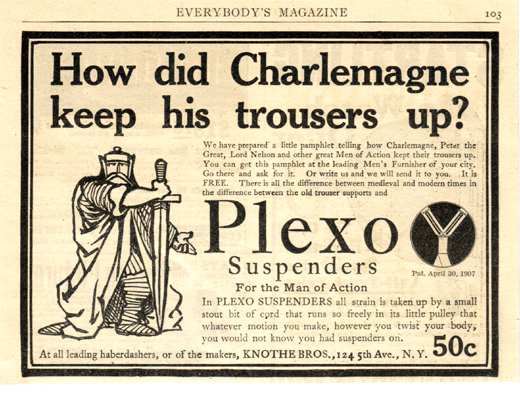
Perhaps Jen’s puppet can help us answer the timeless question posed by something else I recently got in the mail.

Of course, most readers of this blog know that Charlemagne wasn’t exactly renowned for keeping his trousers up in the first place. Alas, this ad doesn’t answer the question it poses; it only promotes a free brochure that does promise an answer. I haven’t yet located a copy of that brochure—but, as another legendary bearded figure once sang, the road goes ever on and on…

“And it takes a knight, and a girl, and a book of this kind…”

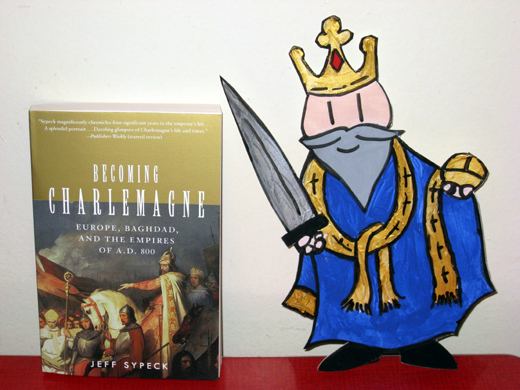
Gaudeamus igitur! I’m pleased to announce that tomorrow, the paperback edition of Becoming Charlemagne will finally hit the shelves. You can pick up a copy at your local bookstore (including Barnes & Noble, which will be hyping the book on its “new releases” tables), or you can easily order it through Amazon.

This trade paperback is the book as I’ve always envisioned it: compact, affordable, and easy to transport. It’ll make a fine last-minute stocking-stuffer for the history buff in your life—or a great way to spend that precious gift card.

While you’re at it, if you’re in a medieval mood, don’t forget to download my free translation of “The Tale of Charlemagne and Ralph the Collier.” Free medieval literature in translation! Not even Santa can promise that.