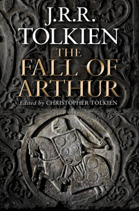
 In the 1990s, I met grad students who dreamed of finding the “real” King Arthur; one would-be archaeologist was sure she’d pry Excalibur from the corner of some forgotten Devon field. Back then, most aspiring medievalists only dimly saw that we were riding multiple waves falling neatly into phase, as decades of “historical Arthur” scholarship drew energy from, but also fed, a pop-culture surge of movies, novels, comics, and games. Now that Arthuriana is waning—it’s overdue for a deep, restorative nap—the ghost of Tolkien comes drifting through to provide its “last assay / of pride and prowess”—or, perhaps, to promise its next reawakening.
Published last week, The Fall of Arthur is an oddity: a 40-page poetic fragment easily lost amid 150 pages of commentary by the author’s son. Tolkien left the poem unfinished in the 1930s, and I’ll be curious to see how his fans greet this book. Having taught Arthurian lit and composed poems that mimic Old English verse forms, I enjoy seeing Tolkien take the Matter of Britain for an original, alliterative spin—but how many readers like me could there be?
The Fall of Arthur follows the daunting rules of Anglo-Saxon verse: A line consists of two half-lines, each of which must be one of five metrical types and must contain two stressed syllables. At least one stressed syllable in the first half-line must alliterate with the first (never the second) stressed syllable in the second half-line. Also, the vowels in the stressed syllables must be long, unless they come before a consonant cluster, or unless you’re letting initial vowels stand in for consonants. If you’re feeling saucy, you can add unstressed syllables in certain positions—but never in others, or an Anglo-Saxon simply wouldn’t hear the line as verse.
Beowulf and nearly all of the surviving 30,000 lines of Old English poetry follow this form, and Tolkien liked to play with it in modern English, well aware that it didn’t always work. “Our language now has become quick-moving (in syllables), and may be very supple and nimble, but it is rather thin in sound and in sense too often diffuse and vague,” he says in a lecture cited in The Fall of Arthur. “The language of our forefathers, especially in verse, was slow, not very nimble, but very sonorous, and was intensely packed and concentrated—or could be in a good poet.”
Is Tolkien such a poet? Sometimes. The surviving 954 lines of The Fall of Arthur set up a story about the last gasp of a doomed world—Arthur, in the autumn of his reign, is “in war with fate”—and Tolkien does a heck of a job conjuring bleak, clammy gloom. As the king and his army ride east across the Rhine, the sound and shape of the poetry emphasize brutality in eerie, alien lands:
Foes before them, flames behind them,
ever east and onward eager rode they,
and folk fled them as the face of God,
till earth was empty, and no eyes saw them,
and no ears heard them in the endless hills,
save bird and beast baleful haunting
the lonely lands. Thus at last came they
to Mirkwood’s margin under mountain-shadows:
waste was behind them, walls before them;
on the houseless hills ever higher mounting
vast, unvanquished, lay the veiled forest.
(I:61-71)
The Fall of Arthur is packed with passages like this: evocations of the wild wastelands beyond the civilized world, scenes of shipwrecks and storm-battered coasts, shadowy foes lurking just out of sight. Tolkien clearly had a blast composing them, and even when his plot is derivative, these moments are original contributions to the Arthurian story in English. They’re also a pleasure to read aloud.
Once in a while, Tolkien serves up scenes that are remarkable for looking nothing like Beowulf. Here’s Lancelot, waking by his window, marveling at songbirds greeting sunrise on the sea:
His heart arose, as were heavy burden
lightly lifted. Alone standing
with the flame of morn in his face burning
the surge he felt of song forgotten
in his heart moving as a harp-music.
There Lancelot, low and softly
to himself singing, the sun greeted,
life from darkness lifted shining
in the dome of heaven by death exalted.
Ever times would change and tides alter,
and o’er hills of morning hope come striding
to awake the weary, while the world lasted.
(III:214-220)
As the Arthurian story demands, Lancelot’s hope fades before Mordred’s far more prescient gloom:
Time is changing;
the West waning; a wind rising
in the waxing East. The world falters.
New tides are running in the narrow waters.
False or faithful, only fearless man
shall ride the rapids from ruin snatching
power and glory. I purpose so.
(II.14-153)
Despite these euphonious examples, Tolkien does struggle to squeeze the bourgeois hand of modern English into the mailed glove of Old English verse. In need of words that alliterate on “f,” he uses “fell” as an adjective with offputting frequency—eight times in the first 153 lines, alongside variations of the verb “to fall”—and meter demands that he flip the order of words more often than even many readers with a patience for archaism are wont to tolerate. “Eager rode they,” “he was for battle eager,” “Ivor him answered”—the seams of this poem are easily frayed.
Christopher Tolkien, who discusses his father’s Arthurian poem as if it were a medieval work, calls it “one of the most grievous of his many abandonments” and suggests that such a slowly built, backward-looking poem “could not withstand the rising of new imaginative horizons.” Although enough notes survive to show that The Fall of Arthur was headed nowhere radical, its final, unwritten scenes might have been deeply revealing. Tolkien adored the language of the Germanic invaders who helped defeat the fictional Arthur, overran much of Britain, and gave England its name; this poem is composed in their style, as if it were sung generations later to honor a worthy foe. Had it shown Tolkien’s appreciation for the world that had to die to make way for the literature and language he loved, the finished Fall of Arthur might have been a memorable, much-quoted read.
When The Legend of Sigurd and Gudrun came out in 2009, I wondered how vast a readership awaited Tolkien’s obscure and scholarly pseudo-medieval verse. The Fall of Arthur likewise makes me wonder how many Tolkien fans will wade through a 49-page essay that places this poem in its medieval Arthurian tradition; whether a 954-line fragment deserves a 50-page overview of the notes and drafts behind it; and whether the 43-page essay linking this poem to the Silmarillion doesn’t seem like padding to people who know Tolkien far better than I do.
On the other hand, The Fall of Arthur is a wonderful rarity for our times: a book that makes gigantic demands of those who pick it up, published by a literary executor who assumes his readers are patient, curious, conversant with medieval traditions, and appreciative of formal verse.
Somewhere, I know, are readers who are baffled by Sigurd and Gudrun or The Fall of Arthur but also haunted by their dim awareness of the vast intellectual realms behind them. Perhaps these readers are on the cusp of cultivating a love of Arthurian stories, an ear for archaic English, or other weird passions that civilize the brain but defy popular taste. In the end, they may not prevail—in good Germanic style, The Fall of Arthur warns them that nothing lasts—but they’ll live and fight and revel in words and think deeply for a time, becoming through Tolkien what Tolkien dubbed Gawain: “defence and fortress of a fallen world.”
[Previous Tolkieniana on this blog: Tolkien und Wagner; hobbits at a beach resort; The Lord of the Rings as Methodist Bible study.]









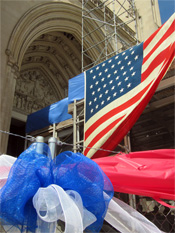 This weekend, commerce and revelry engulfed the National Cathedral at
 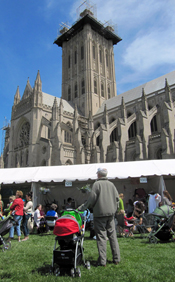 Unlike Wal-Marts and Targets, cathedrals were each architecturally unique. They were shrines where people hoped and prayed but rarely sated their earthly desires. They were religious institutions whose spiritual offerings didn’t cater to market demands. They were political centers overseen by men who wielded far more local power than any store manager. As distinctive hubs of pilgrimage and tourism, they attracted seekers from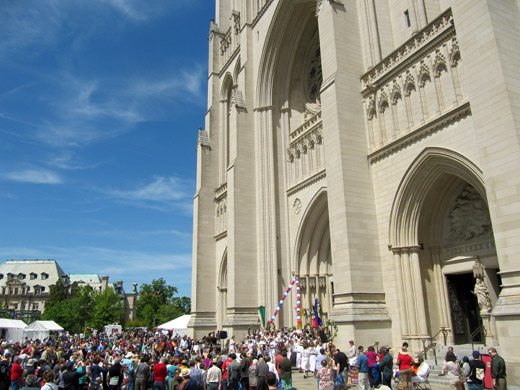
 If you think there ought to be at least one good poem about the horrific life of the tomato hornworm, then you’re going to like Bruce Taylor. In
  I first knew Alan Sullivan through the
  Part Virgil, part
  For half a century,
 Most fantasy fans know Robert E. Howard as the pulp writer who invented Conan the Barbarian, but he was also a prolific poet. Some of his verse served as epigraphs to his own stories, a few poems appeared in magazines like Weird Tales, and most of it was never published at all. Howard’s Collected Poetry is already out of print—






 In 2009, after promoting my