“I bit off more than I can chew, only so much you can do…”

Each year, I notice an uptick in blog visitors on Thanksgiving night and the weekend that follows it, presumably because sated readers lumber to their computers in search of something savory to stuff inside their rested brains.

So here’s what I’ve collected in my mental stock-pot: a jumble of links about books, language, poetry, and art, with nary a turkey in sight.

Nancy Marie Brown sees Iceland’s trolls in Tolkien.

At Lingwë, Jason wonders what Tolkien’s “Esgaroth” means.

Leonore the linguist wonders what’s in her name.

Steve Donoghue reads Washington Irving’s Tales of the Alhambra.

Bibliographing reads Treasure Island!!!

Cynthia Haven reads Proust in Paris.

George reads Inventing the Middle Ages.

Gargoyle Girl finds faces on facades in Prague.

Levi Stahl contemplates Thanksgiving as homecoming.

First Known When Lost reaps poetic misgivings.

Dylan sings of “bent rhyme and feeble reason.”

Pete finds a classy Walgreen’s.

Frederick Turner, the man behind neat epic poems about 24th-century America and the terraforming of Mars, has published a new book on epics.

Kevin at Interpolations wonders why he adores Moby Dick.

Julie K. Rose ponders patronymic patterns.

Photographer Guido Krüger documents his Potomac adventures in front of the Corcoran and on the streets during Hurricane Sandy.

Tim Hyde’s Photoriffs blog commingles beauty and disaster.

Jake Seliger says don’t go to law school and don’t become a doctor.

At last, a blog decrying dumb classroom projects: Wasting Time in School.

University Diaries is thankful for her students.

“A long time ago, we used to be friends…”

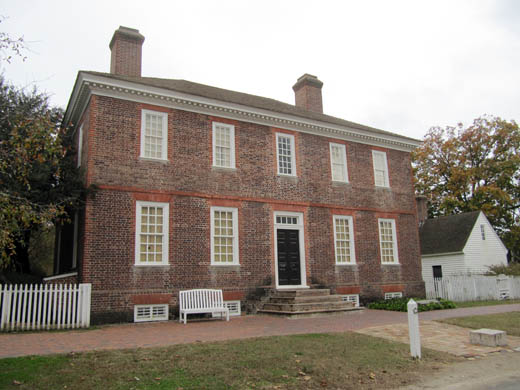
On the day after a national election, it’s bracing to stroll through the blustery streets of Colonial Williamsburg—which, lucky for me, is just footsteps away from a conference I’m attending. I’d hoped to find some trace of American medievalism, and the colonial city did not disappoint: along the green leading to the Governor’s Palace is a house where a Virginia lawyer lit a medieval torch in the mind of a Founding Father.

That’s the home of George Wythe, signer of the Declaration of Independence and delegate to the Constitutional Convention. Fresh out of William and Mary, a young Thomas Jefferson spent five years here as Wythe’s law apprentice and stumbled early into one of his innumerable lifelong hobbies: the study of Old English.

Poring over a 15th-century legal tract, Jefferson encountered a modern preface arguing that a student should learn “Saxon” to understand the essence of English law. Already intrigued by languages, the young man was hooked; Stanley R. Hauer points out (in “Thomas Jefferson and the Anglo-Saxon Language”) that the future third president of the United States collected Old English textbooks, painstakingly copied footnotes in Anglo-Saxon script into a 1778 legal treatise, and made sure that the University of Virginia was the first American institution to offer Anglo-Saxon language courses when it opened in 1825. According to Hauer, Jefferson’s grasp of Anglo-Saxon was weak—often he couldn’t distinguish it from Middle English—but if you’ve studied Old English, or even if you’ve read Beowulf in a college class, its presence was partly Jefferson’s doing.

Jefferson’s obsession with Old English resonated far beyond the English department. During his five years in Wythe’s study, he imaginatively plunged into what historians have dubbed the “Saxon myth,” the common belief among Whigs of his era that the best English institutions—parliament, trial by jury, common law—were the unbroken legacy of freedom-loving Germanic tribes who’d crept into Britain as early as the fifth century. (This idea was itself the legacy of 16th- and 17th-century reformers who’d tried to prove that both the Church of England and Parliament were continuations of ancient, primitive democracy.)

In letters and treatises, Jefferson trumpeted his belief that America had directly inherited liberty from the Anglo-Saxons. His strongest statement on the matter was surely his (unsuccessful) push to decorate the Great Seal of the United States with the figures of Horsa and Hengist, “the Saxon chiefs from whom we claim the honor of being descended, and whose political principles and form of government we have assumed.”

I suppose we are the political heirs of the Anglo-Saxons, since Jefferson believed it to be so when he helped establish our republic. He knew, though, that his contemporaries held conflicting views. “It has ever appeared to me,” he wrote to English political reformer John Cartwright in 1824, “that the difference between the Whig and the Tory of England is, that the Whig deduces his rights from the Anglo-Saxon source, and the Tory from the Norman.” It’s instructive, two centuries later, to see how our predecessors reached into the past for conflicting myths to answer a perennial question: What sort of people are we to be?

“On the back seat of the car, with Joseph and Emily…”

Fleeing a hot, crowded brownstone, Tom built his life on a dead-end lane: some trees, a brook, and extra land to parcel out to kids. For decades, he made the commute to the city, but most of his relatives followed him home. They were charmed by the place where he chose to raise chickens, plant string beans, and tinker with gadgets in peace.

The Piscataway soil will never be known for producing fine wines, but the tangle of vines on the side of the house was Tom’s own little piece of Provence. On the morning he never grew tired of griping about, he was tending his few feeble grapes. The sun was high, and the only sounds were birds and barking dogs. Perhaps he stopped to wipe his brow; he surely snuck a sip of beer and dreamed about the homemade wine to come. Then a stranger slipped into the garden.

Dapper but fat, the stranger was speckled with dust from the road. He fanned his spiny jowls with his hat, introduced himself without a handshake, and eyed the gawky farmer. Uncreative, as all of them are, he asked about the clump of vines. He expressed delight, this bringer of mighty compliments, for who was nearer to God, who better understood the common good, than a man who coaxed life from the earth?

The vines gave the stranger a sudden idea: He knew a nearby farmer whose cows were a sight to behold. Their output, he said, was impressive—no, not impressive: magical. This farmer had worked miracles with manure, and the kicker was, he always had a little dung to spare. Picture it: these grapes here growing and thriving, while neighbors and family toasted each other’s health with the sweetest wine in town. A diligent public servant, he said, might easily procure a bag of this miracle fertilizer and bestow it upon a neighbor in need. Delivery would be quick, and it wouldn’t cost a penny—as long as that public servant knew he could count on a vote or two come November. Speaking of which, was the lady of the house at home?

The two men exchanged promises. Weeks passed, and then months. Only one man kept his promise. Tom remembered; fifty years later, it still made him angry.

By the time we were children, the suburbs had grown up around us, and Chaucerian frauds were sprouting like mushrooms: Combed-over charlatans who failed to hide their disdain as they loped up our porch steps to beg for support. The part-time mayor who never had time for parades or graduations. The priest who crept through the halls at the old folks’ home, buying cheap votes for his patron by handing out kitchen sponges. The sheriff’s sergeant who stole from the pension fund. Judges who snorted cocaine with their staff. Real-estate developers who hand-fed their pet creatures from town hall to Trenton. We were taught to laugh at them; only as an adult did I learn that “freeloader” was not, in fact, a valid civic office.

But sometimes, on a Tuesday, the grown-ups gathered at the kitchen table and unfolded an arcane sheet filled with drawings of dozens of levers. They studied it, they agreed on a time, and then, dressed as if going to church, they herded us into the Pinto. Sometimes we did go to a church; more often, we drove to a school, or the nearby college campus. Old ladies waited in line, as somber as schoolgirls in black-and-white photos, and old men talked in tones we never heard around the house. No one introduced us to any adults—we were small, badly dressed, and invisible—but we knew to behave while our elders, one by one, stepped behind a curtain. When they emerged, looking mostly unchanged, we all drove home, with no speeches about privileges or duties. The whole of the ritual spoke for itself.

The earth never shook, and our street still went unnoticed, and nobody told me which outcome was worse: the leader who promised a sack full of crap or the leader who failed to provide it. But we learned to detect its distinctive bouquet, that whiff of impending election. My grandfather taught me the grown-up response: get up, and go, and vote—but hold your nose.

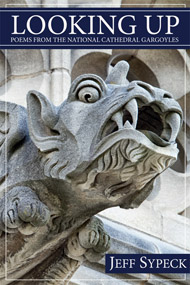
Looking Up: Poems from the National Cathedral Gargoyles

I’m pleased to announce that Looking Up: Poems from the National Cathedral Gargoyles is now available—just in time for Halloween.

This 138-page paperback includes 53 poems accompanied by black-and-white photos of the gargoyles and grotesques. I posted drafts of 51 of these poems on the blog from 2009 to 2012; you’ll find a clickable list of them here. Two of the poems in Looking Up are new to the book. (The cover image is the work of photographer, tour guide, and all-around good guy Chris Budny.)

For the time being, I’m donating 75 percent of the net profits from Looking Up to the National Cathedral, to help repair damage from the 2011 earthquake. It’s my way of saying thank-you for the many quiet afternoons I’ve spent on the cathedral grounds.

I had fun writing these poems, and I’m glad so many of you enjoyed reading them. I’d no idea there was an audience for such unfashionable folly: three years of light, occasionally obscure, medieval-influenced neoformalist verse.

* * *

There are several ways to buy Looking Up:

Order it through Amazon (and its international variants: .de, .es, .fr, .it, .uk), Barnes & Noble (coming soon), Powell’s, or the online retailer of your choice.

Buy a copy at the National Cathedral Store, at the new shop on the ground floor, just off the narthex near the front doors, or the original shop down in the crypt. (You’ll find the book in the gargoyle section.)

Order it from me. Email me: jeffsypeck -at- gmail dot com.

If you buy the book from me, the cost within the United States is $14 (which includes shipping!), more if you’re elsewhere. Each additional copy is only $12, no matter where you live. Printing and shipping are exorbitant these days; I’ve kept the price as low as I can.

(I’m looking into e-book options, but I can either do the tedious line-by-line formatting required to make poetry presentable on some e-book platforms, or distribute a PDF that may misformat on many mobile devices. I don’t like either option. Stay tuned.)

* * *

Some books you plan to write; others simply happen. Looking Up definitely falls into the latter category. It’s a great surprise to me that it even exists; I hope you’ll find something pleasantly surprising in it as well.

“River, I’ve never seen the sea…”

“The evening passed delightfully: we sat out in the moonlight on the piazza, and strolled along the banks of the Patapsco; after which I went to bed, had a sweet night’s sleep, and dreamt I was in Mahomet’s Paradise.”

Washington Irving romanticized his life. In an 1854 letter to his niece, he even found whimsy on the Patapsco River in Maryland, where he stayed at the home of John Pendleton Kennedy: Whig politician, Secretary of the Navy, Maryland Congressman, and a man immersed in the pop-medieval daydreams of his age.

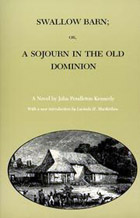
No one reads Kennedy’s 1832 book Swallow Barn anymore, and the author’s own description of it isn’t likely to bring readers back: “There is a rivulet of story wandering through a broad meadow of episode. Or, I might truly say, it is a book of episodes, with an occasional digression into the plot.” Kennedy loved Irving’s Bracebridge Hall, in which an American visitor describes an English manor through a series of character sketches and anecdotes, and he mimics it in Swallow Barn: a northerner visits his cousin’s plantation on the James River in Virginia and describes the place in anecdotal fits and starts. (Swallow Barn so closely resembles Irving’s style that when it was published under the name “Mark Littleton,” the public assumed Irving has simply adopted a coy new nom de plume.)

Medievalism is rampant in Swallow Barn. In his prologue, Kennedy cites the Morte d’Arthur. He likens a miller to a Robin Hood character, an old slave to an ancient crusading knight, and a group of pedantic Virginia lawyers to an Anglo-Saxon “wittanagemote.”

As it turns out, the early 19th-century Virginians of Swallow Barn are as obsessed with the Middle Ages as the narrator is. Here’s Prudence Meriwether, the plantation owner’s sister:

There is a dash of the picturesque in the character of this lady. Towards sunset she is apt to stray forth amongst the old oaks, and to gather small bouquets of wild flowers in the pursuit of which she contrives to get into very pretty attitudes; or she falls into raptures at the shifting tints of the clouds on the western sky, and produces quite a striking pictorial effect by the skillful choice of a position which shows her figure in strong relief against the evening light. And then in her boudoir may be found exquisite sketches from her pencil, of forms of love and beauty, belted and buckled knights, old castles and pensive ladies, Madonnas and cloistered nuns,—the offspring of an artistic imagination heated with romance and devotion.

Next we meet Ned Hazard, a 33-year-old Princeton dropout who stands to inherit Swallow Barn:

A few years ago he was seized with a romantic fever which manifested itself chiefly in a conceit to visit South America, and play knight-errant in the quarrel of the Patriots. It was the most sudden and unaccountable thing in the world; for no one could trace the infection to any probable cause;—still, it grew upon Ned’s fancy, and appeared in so many brilliant phrases, that there was no getting it out of his brain . . . However, he came home the most disquixotted cavalier that ever hung up his shield at the end of a scurvy crusade…

“His mind,” Kennedy insists, “is still a fairy land, inhabited by pleasant and conceited images, winged charmers, laughing phantoms, and mellow spectres of frolic.”

The object of Ned Hazard’s chivalrous amour is Bel Tracy, who’s so obsessed with Sir Walter Scott that she uses his novels to try to teach herself hawking:

In her pursuit of this object she had picked up some gleanings of the ancient lore that belonged to the art; and, fantastic as it may seem, began to think that her unskillful efforts would be attended with success . . . A silver ring, or varvel, was fitted to one leg, and on it was engraved the name of her favorite, copied from some old tale, ‘Fairbourne,’ with the legend attached, ‘I live in my lady’s grace.’ I know not what other foppery was expended upon her minion; but I will warrant he went forth in as conceited array as his ‘lady’s grace’ could devise for him. A lady’s favorite is not apt to want gauds and jewels.

By the time Swallow Barn winds down and “Mark Littleton” heads north, Ned Hazard survives a chivalric duel (a fistfight); slaves decked out to resemble “troubadours and minnesingers” tell ghost stories about nearby Goblin Swamp; and the narrator likens himself to Gregory of Tours and William of Malmesbury and quotes Chaucer’s “Knight’s Tale.”

In an introduction to the most recent reprinting of Swallow Barn, Lucinda H. MacKethan writes that Kennedy “manages merrily both to revere and to ridicule almost all of the Old South’s icons,” adding that reviewers disagreed on whether the book was a faithful depiction of Southern plantation life or blatant satire. I think it’s both: Swallow Barn shows a South in which overprivileged plantation-dwellers are so immersed in chivalric tales that they come to inhabit a shared medieval delusion.

When Washington Irving visited John Pendelton Kennedy in Maryland in 1854, life had been good to both authors, but especially to Kennedy. He had married Elizabeth Gray, daughter of textile baron Edward Gray, and moved into the Gray mansion. Gray liked to see himself as a feudal lord as he surveyed his factories on the Patapsco, a fancy Irving apparently shared.

In an 1854 letter to Elizabeth Gray Kennedy after returning home to Tarrytown, Irving let his inner medievalist romp:

 I envy Kennedy the job of building that tower, if he has half the relish that I have for castle building—air castles, or any other. I should like nothing better than to have plenty of money to squander on stone and mortar, and to build chateaux along the beautiful Patapsco with the noble stone which abounds there; but I would first blow up all the cotton mills (your father’s among the number), and make picturesque ruins of them; and I would utterly destroy the railroad; and all of the cotton lords should live in baronial castles on the cliffs, and the cotton spinners should be virtuous peasantry of both sexes, in silk skirts and small clothes and straw hats, with long ribbands, and should do nothing but sing songs and choruses, and dance on the margin of the river.

Only Washington Irving could look past textile mills and see a medieval peasant fantasy—but as Paul J. Travers points out in The Patapsco: Baltimore’s River of History, “Irving’s words were prophetic”: A great flood in 1868 washed away part of the Gray mansion, Kennedy’s personal library was ruined, and the family was forced to move. (Elizabeth Kennedy kept the factory going for 20 more years—until another devastating flood.)

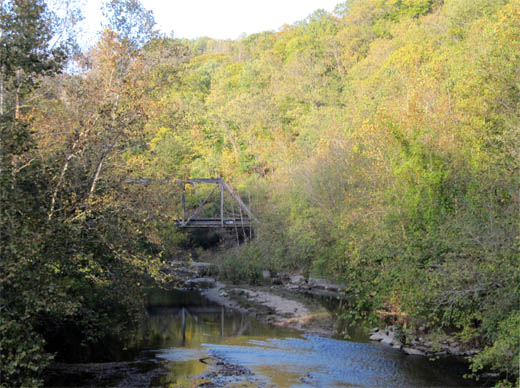
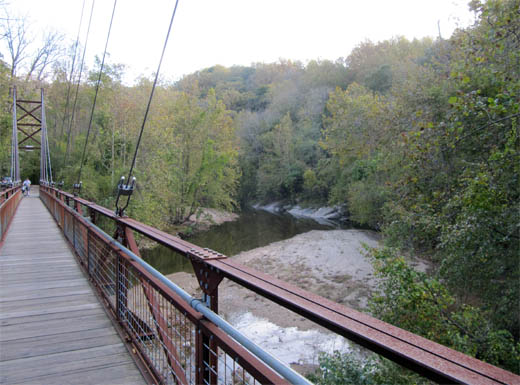
Today, if you hack through the weeds between down Ellicott City and Patapsco State Park, you can walk in the footsteps of a wide-eyed Washington Irving…

…and spot the “picturesque ruins” Irving joked that he wanted to see. They’re now monuments to a forgotten writer and a half-remembered natural disaster.

Nearby, you’ll find more recent wrecks that put Irving’s romanticism in perspective.

Shops on Main Street in Ellicott City now sell plastic swords, pirate gear, and Viking hats alongside antique shops that burnish the relics of Irving and Kennedy’s age. On the outskirts of town, Marylanders hike and bike; some latter-day rustics fish along the river’s edge. Whether you see timeless fantasies here, as Irving did, depends on your affinity with Swallow Barn’s Bel Tracy, who found “something pleasant in the idea of moated castles, and gay knights, and border feuds, and roundelays under one’s window, and lighted halls.”

Mark Twain saw something else in Southern medievalism: a sort of mass insanity, a “maudlin Middle-Age romanticism” that’s still more tenacious in America than he ever foresaw. Even now, many Americans would answer Twain in the same tone Bel Tracy uses to scold her cousin: “Pshaw!…You haven’t one spark of genuine romance in your whole composition.” When a 19th-century New Yorker can find Virginia medievalism on the banks of a Maryland river, I’m not sure both notions aren’t right.

“The stairs creak as you sleep, it’s keeping me awake…”

“How solemn and thrilling the scene as we anchored at night at the foot of those mountains, clothed with overhanging forests; and every thing grew dark and mysterious…”

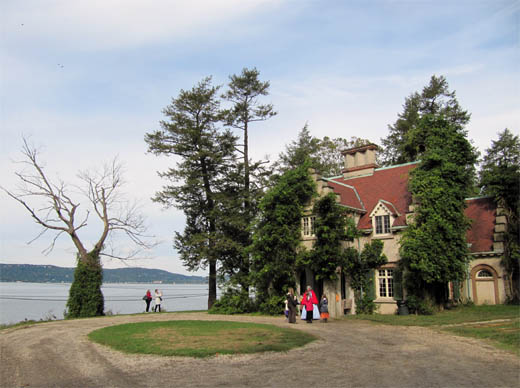
So wrote an awed teenaged Manhattanite in 1800 about his first voyage up the Hudson River. If you ever find yourself in Tarrytown, New York, and if you can find (as I did this morning) a brief break in your business there, stroll down the street and visit Sunnyside, the late-life home of the wide-eyed mythologist who likened the Hudson to the Rhine: Washington Irving, one of America’s great unacknowledged medievalists.

It’s fitting to poke around Sunnyside on Columbus Day. Biographer Andrew Burstein notes that Irving’s A History of the Life and Voyages of Columbus went through 175 editions between 1828 and 1900, and that “[a]ccording to a recent survey of the contents of American libraries, rural and urban alike, in the mid-nineteenth century, Irving’s Columbus was the most commonly owned book. It undeniably influenced how American schoolchildren were taught their country’s origins for the balance of the nineteenth century.” As Nancy Marie Brown recently mentioned, Irving’s book almost certainly popularized the misperception that medieval people believed the world was flat.

Washington Irving loved the Middle Ages. In 1804, at 21, he admired Gothic architecture in France, and he was apparently so enamored of St. Agatha’s Cathedral in Sicily that while he gaped at the place, someone picked his pocket. He later included references to Charlemagne in his satirical “Knickerbocker History” of New York City, and he also whipped up a scene where one of his Dutch forefathers, Oloffe, has a medieval-style dream vision of Saint Nicholas, the city’s patron.

Irving’s Sketch-Book (most famous today for the German-inspired “Rip Van Winkle” and “The Legend of Sleepy Hollow”) also features a dream vision in which Irving’s alter ego, Geoffrey Crayon, visits the library at Westminster Abbey, where medieval books literally speak to him. Irving’s 1821 novel Bracebridge Hall, with its character sketches of squires, old yeomen, and romantic lovers, teems with a love of medieval tradition and even includes a chivalric digression: “The Student of Salamanca.” Irving also adored medieval Spain, romanticizing history and legend in Tales of the Alhambra and Chronicle of the Conquest of Granada.

I don’t think it’s unreasonable to call Washington Irving one of America’s first pop-medievalists—although interestingly, he didn’t use the word “medieval.”

In “Medievalism: Its Linguistic History in Nineteenth Century Britain,” Clare A. Simmons notes that Washington Irving avoided the term “Middle Ages,” probably because it was then associated with Roman Catholicism—but the word “medieval” never leaks from Irving’s pen either. Instead, he opts for phrases like “olden times,” “days of yore,” and “the age of chivalry.” The word “medieval” was in currency in England at least as early as 1827, but if Irving heard it during his extensive time abroad, he doesn’t seem to have brought it home with him.

Irving bought and moved to Sunnyside in 1835. Around that time, he abandoned medieval subjects and wrote books about America: A Tour of the Prairies; the Western novel Astoria; the romance The Adventures of Captain Bonneville; and a five-volume biography of George Washington.

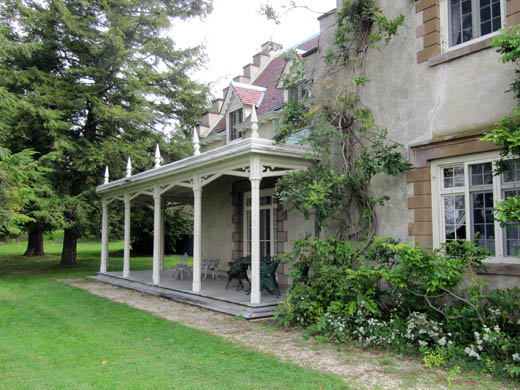
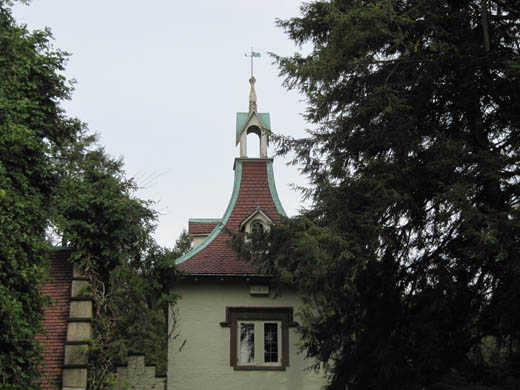
Still, Sunnyside reflects Irving’s continued interest in a romanticized Middle Ages, from its “Italian Gothic” piazza…

…to the “Spanish Tower,” which I image Irving found very olden-timey…

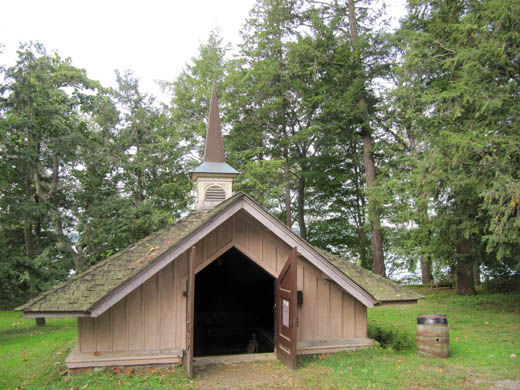
…to the ice house, designed by Irving himself in what a placard calls “a whimsical fashion conveying the look of a small Gothic chapel.”

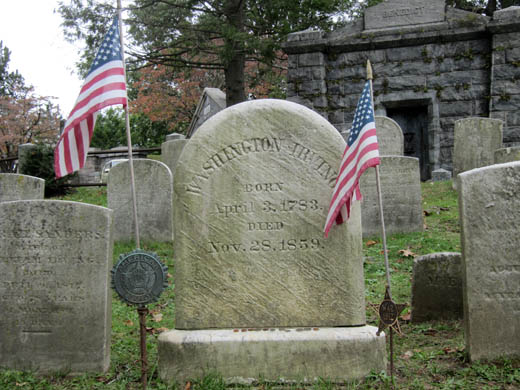
Irving died in 1859, late enough to see the early medievalization of the Hudson Valley at nearby estates such as Lyndhurst but too soon to see just how nuts Americans would get about Gothic architecture. Many castle-like estates loom over the Hudson, including one built in Tarrytown between 1897 and 1910, just three miles from Irving’s home. Some of them have fallen into disrepair.

Irving would have enjoyed seeing medievalist follies sprout like mushrooms from New York cliffsides, but as his lively era recedes into obscurity, I wonder what he would have thought of his own reputation, if not his influence, becoming as much a part of “days of yore” and “olden times” as the real Middle Ages themselves.

Or maybe the era he never named helped prepare him for that: “And all for what? to occupy an inch of dusty shelf—to have the title of their works read now and then in a future age, by some drowsy churchman or casual straggler like myself; and in another age to be lost, even to remembrance. Such is the amount of this boasted immortality.”

“Won’t you fly across that ocean, take a train on down…”

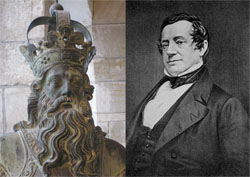
“The origin of our city will be buried in eternal oblivion,” wrote Washington Irving in his satirical History of New York, the 1809 book that made the 26-year-old Manhattanite one of America’s first literary celebs. Two centuries later, Irving’s “Knickerbocker History” is by turns funny, baffling, and obscure, but what intrigued me was how full of Charlemagne it is:

The origin of our city will be buried in eternal oblivion, and even the names and achievements of Wouter Van Twiller, Wilhelmus Kleft, and Peter Stuyvesant, be enveloped in doubt and fiction, like those of Romulus and Remus, of Charlemagne, King Arthur, Rinaldo, and Godfrey of Bologne.

As it turns out, Irving was a bit of a Charlemagne buff. Elsewhere in the History, his alter ego Diedrich Knickerbocker looks to the Carolingians to explain why New York City’s “ancient magistrates” were chosen, naturally, by weight:

As a board of magistrates, formed on this model, think but very little, they are the less likely to differ and wrangle about favourite opinions—and as they generally transact business upon a hearty dinner, they are naturally disposed to be lenient and indulgent in the administration of their duties. Charlemagne was conscious of this, and therefore (a pitiful measure, for which I can never forgive him) ordered in his cartularies, that no judge should hold a court of justice, except in the morning, on an empty stomach—a rule, which, I warrant, bore hard upon all the poor culprits in his kingdom. The more enlightened and humane generation of the present day have taken an opposite course…

Jolly old Diedrich Knickerbocker also trots out several mock-heroic references to Roland, the “Orlando” of romance. Two of them occur in battles between Dutchmen and Swedes, while the third anchors a preposterous yarn about the death of trumpeter Antony Von Corlear, whose race to aid his fellow Dutchmen is stymied when a devil drags him to the bottom of the Harlem River:

Luckless Antony! scarce had he buffeted half way over, when he was observed to struggle most violently as if battling with the spirit of the waters—instinctively he put his trumpet to his mouth and giving a vehement blast—sunk forever to the bottom!

The potent clangour of his trumpet, like the ivory horn of the renowed Paladin Orlando, when expiring in the glorious field of Roncesvalles, rung far and wide in through the country, alarming the neighbors round, who hurried in amazement to the spot…

Irving later visited relatives in England (where he wrote two of his most famous stories, “Rip Van Winkle” and “The Legend of Sleepy Hollow”) and spent 17 years wandering Europe. He had mined German folklore for two of his biggest hits and expected further inspiration. “I mean to get into the confidence of every old woman I meet with in Germany,” he told a friend, “and get from her, her budget of wonderful stories.”

The romantic New Yorker, pushing 40, soon met the drab reality of history. Visiting Aachen in 1822, he noted in his journal that he had seen the “fountain with bronze statue of Charlemagne” and “Charlemagne’s Chair in Town Hall,” both of which are still tourist landmarks, but he saved his grousing for a darkly amusing letter to his sister:

I am disappointed in Aix-la-Chapelle. To me it is a very dull place, and I do not find that others seem more pleased with it.

[. . .]

This is the birthplace, and was once the seat of empire of Charlemagne, that monarch so renowned in history and song. His tomb is in the cathedral, and is only marked by a broad slab of black marble, on which is the inscription, Carolo Magno. The Cathedral is an extremely ancient, venerable-looking pile. Every night I hear the hours chimed on its bells; and the midnight hours announced by the watchman from its tower. The Germans are full of old customs and usages, which are obsolete in other parts of the world . . .

The people have an antiquated look, particularly the lower orders. The women dress in peculiar costumes. As to the company at the hotels and public saloons, it is composed of all nations, but particularly northern nations: Russians, Prussians, Germans, Dutch, &c. Everywhere you see military characters, in fierce moustaches and jingling spurs, with ribbons and various orders at their button-holes. Still, though there are many personages of rank here, the place is not considered the most fashionable, and there are many rough characters in the crowds that throng the saloons. Indeed it is somewhat difficult to distinguish a gentleman from a common man among these northern people; there is great slovenliness of dress and coarseness of appearance among them; they all smoke; and I have often been surprised to hear a coarse-looking man, whom I had set down for some common tradesman, addressed as Monsieur the Count or the Baron. The weather has been very bad for several days past.

A recent biographer points out that Irving was suffering from an illness, perhaps the gout, which the famous waters of Aix-la-Chapelle failed to cure—but he wasn’t the last tourist to find Aachen underwhelming. A 2003 Rick Steves guidebook dismisses “unassuming Aachen” near the “unromantic Rhine,” and when I sat in Aachen Cathedral on a frigid February weekend in 2008, I heard tourists mumble that the place was too small to have been worth the trip.

Despite their gripes, I found that the “concentrated magnificence” of the octagonal chapel at Aachen repays real contemplation, and trying to see it backwards across a 1,200-year gulf is a worthy (if futile) ambition. Tourists to Aachen wish for eighth-century streets; if Washington Irving’s imagination failed him in Charlemagne’s town, what hope can their be for the Lonely Planet crowd?

Two years after sulking in Aachen, Irving wrote in Tales of a Traveller: “The land of literature is a fairy land to those who view it from a distance, but like all other landscapes, the charm fades on a nearer approach, and the thorns and briars become visible.” He later found his European dreamworld in Spain, especially Granada, where he briefly lived and wrote at the Alhambra. As the author of the most popular 19th-century book about Christopher Columbus, Irving convinced Americans, wrongly, that medieval people believed the world was flat. It’s tempting to wonder what myths he might have spun about Charlemagne if he’d just passed through Aachen in sunnier health. Generations of teachers perhaps can be glad he did not.

(Photo of Aachen taken in February 2008.)

“When I was their age, all the lights went out…”

If you’ve barreled through Georgia on I-95, you may have noticed a strange sight on the east side of the highway: a B-47 Stratojet bomber in front of what appears to be a medieval English church. Rejected cover art for A Canticle for Liebowitz?

Not hardly. You’re catching a glimpse of the Mighty Eighth Air Force Museum. The 8th Air Force was activated in Savannah in 1942 before being sent to England to join the RAF in bombing runs over Germany. The museum, just outside Savannah in Pooler, tells the Mighty 8th’s story in the context of the air war in Europe.

Inside, thoughtful and thorough exhibitions give you a harrowing sense of what life as a bomber crewman was like, especially when you turn a corner and behold a B-17 being painstakingly restored by volunteers.

On the grounds, countless plaques and monuments are sobering reminders of the dead. Among them stands an unlikely medievalist sight.

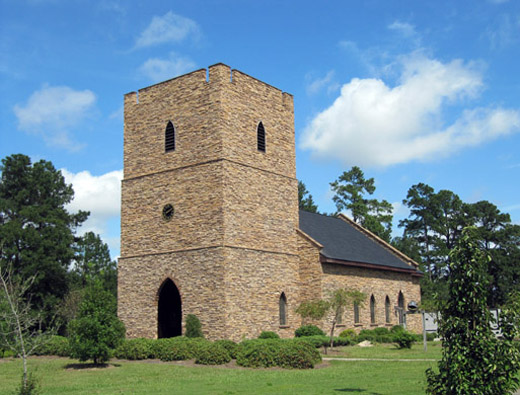
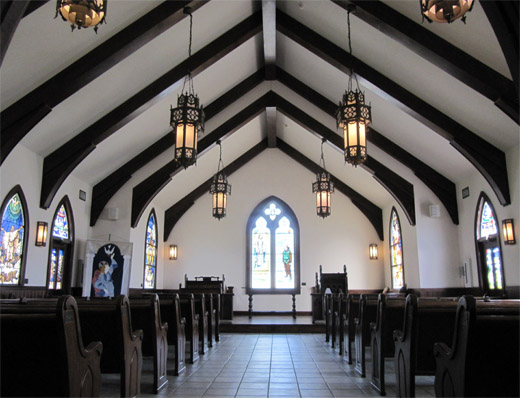
The American vogue for neo-medieval churches faded in the early 20th century, so I was surprised (and delighted) by how recently the Chapel of the Fallen Eagles was dedicated: May 2002. According to the firm that built it, the chapel is based on no one church but generally evokes medieval English styles:

The design for the non-denominational chapel is based on English parish church architecture, which generally developed between the fifth and sixteenth centuries. The design reflects both the traditional site orientation and building elements consisting of a west facing tower, central nave, and east facing chancel. The stonework and interior finishes are typical of country churches as they evolved through the centuries.

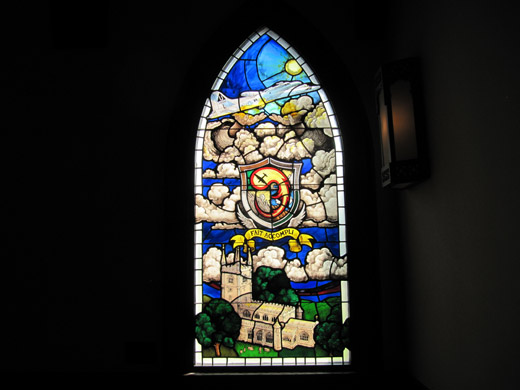
I’d like to imagine that Gothic window tracery left a vivid impression on the men of the 8th Air Force, but the chapel’s stained-glass tribute to All Saints Church in the Cambridgeshire village of Conington hints at more pressing concerns.

According to a Conington-area historical society, “a red light was installed on one of the pinnacles of the Church tower to help guide the planes back from their missions during World War II.” Appropriately, the village sign at Conington shows the church tower beneath the silhouette of a B-17.

After all these years of chasing down medievalism in America, I shouldn’t have been surprised to find a pseudo-medieval chapel on a Georgia interstate—but I was. Yes, medievalism is everywhere, but the Chapel of the Fallen Eagles represents a use for it we don’t often see. Unlike many of their countrymen, the vets of the 8th Air Force weren’t dreaming of castles and chivalric frills. Instead, they imagined, and sanctioned in stone, a monument to Anglo-American friendship.

“Quoting God as you discuss what is right or wrong for us…”

In 1993, a clownish remnant of the Klan marched down Main Street in my college town. The authorities bussed the marchers across state lines and kept them safe from attacks. Jeering locals lined the street, and community groups held a more positive party a few blocks away. The march was pathetic, but it was heartening to see liberal American ideals put into action. No one believed that a few scruffy losers said anything worth hearing, but everyone made sure they were able to speak their minds.

“Quid Plura?” is not a blog about current affairs. It chronicles medievalism in the modern world, and occasionally there are posts about books, photos of pseudo-medieval places, and a little light, gargoyle-inspired verse. I don’t write about politics. I don’t care how you vote. I don’t light my torch and wave it for the new moon on Monday. I’m John Denver at the PMRC hearings. For cripes’ sake, unless it’s in a quotation, you won’t even find profanity on this blog.

However, I wrote a book in which Muslims guzzle wine, Jews own slaves, and Christians kill in the name of religion—so even when the spotlight is on some inept, ne’er-do-well “filmmaker” and a loony pastor, I don’t find it hard to imagine myself in their shoes. As I wrote in 2010: “If doodles can incite worldwide riots, how can I know that my 20-page depiction of a liberal, even libertine, Baghdad won’t light a madman’s fuse?”

Should that happen, I hope I won’t be condemned by diplomats, denounced by the Secretary of State, investigated by the Department of Justice, or blamed by the White House. I hope the government won’t ask publishers and distributors of my work to consider shutting me down. I hope my supporters won’t get phone calls from generals. I hope I won’t be encouraged to hide. I hope artists, writers, and scholars will realize it could be them next.

After the 1993 Klan march, everyone wondered whether the government had provided too much protection. That’s a debate I wish we were having now. As it stands, the message I’m hearing is this: If you say, write, or draw something that riles up the wrong people, you’re on your own. That’s disturbing, but I guess it’s useful to know.

“I had riches too great to count, could boast of a high ancestral name…”

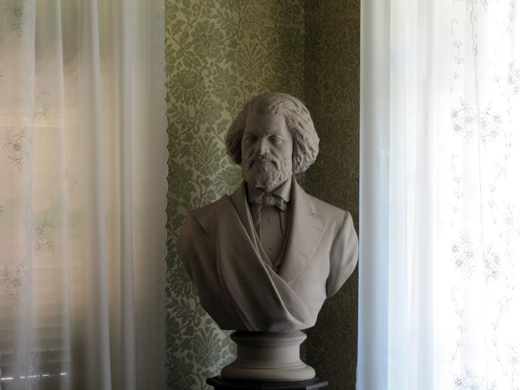
On a sunny September day in 1838, Frederick Douglass escaped slavery in Maryland to become a free man (and one of the most fascinating and indefatigable Americans of his time), so yesterday seemed like as good a day as any to visit Cedar Hill, the Frederick Douglass National Historic Site—and to seek medievalism in this most unlikely place.

High atop a terraced hill in the Anacostia neighborhood of Southeast D.C., the house was Douglass’s home from 1877 until his death in 1895. The front—parlor, office, dining room—is furnished almost exactly as it was when Douglass was alive, and Cedar Hill is still an impressive home with a panoramic view of downtown Washington.

Many of the decorations in Cedar Hill are neoclassical doodads, but there’s a medievalist gleam or two in Douglass’s life, as long as you know where to look.
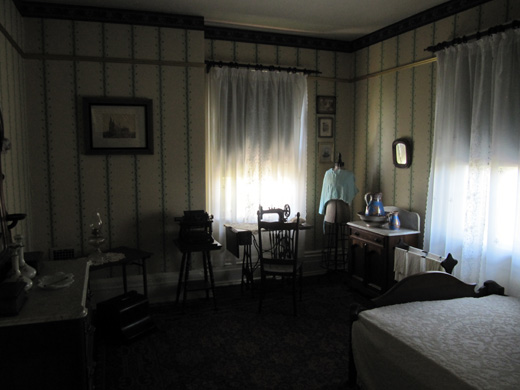
That’s the bedroom of Helen Pitts, Douglass’s longtime secretary and second wife. Their interracial marriage shocked her white abolitionist family and Douglass’s black children, but since I’m me and it’s 2012, I was more surprised by what I saw on the back wall: an engraving of Cologne Cathedral.
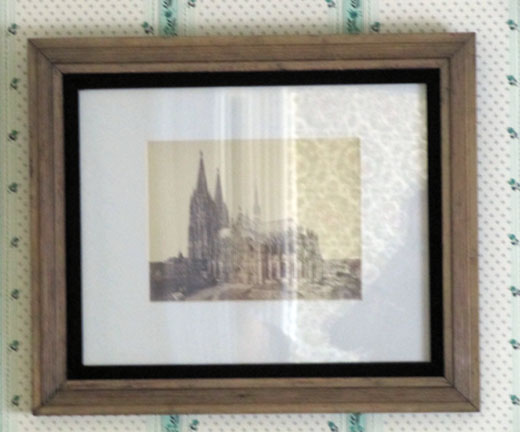
Although Douglass traveled in Europe, he doesn’t appear to have visited Germany, so the engraving was likely a gift from German writer and abolitionist Ottilie Assing. She taught Douglass German, spent 22 summers in his home, and apparently had a long affair with him. The presence of this print in the bedroom of the woman who won out over Assing for Douglass’s final affections is either a curatorial snafu or a memento of profound awkwardness.

More interesting is Frederick Douglass’s medievalist name.

Born a slave in Talbot County, Maryland, around 1818, young Fred was saddled with a moniker that suggested a grand, impossible destiny. “The name given me by my beloved mother,” he wrote, “was no less pretentious than “Frederick Augustus Washington Bailey.'” In 1838, after being moved back and forth between the Eastern Shore of Maryland and downtown Baltimore, he made one heck of an escape: He disguised himself as a sailor, boarded a train, and journeyed from Wilmington, to Philadelphia, to New York City, and finally to New Bedford, Massachusetts.

In New Bedford, “initiated into the new life of freedom,” Frederick Bailey needed a safer surname. He found himself in the home of Nathan and Mary Johnson, a prosperous black couple who harbored escaped slaves. As he explained in 1855, taking their name was out of the question:

“Johnson” had been assumed by nearly every slave who had arrived in New Bedford from Maryland, and this, much to the annoyance of the original “Johnsons” (of whom there were many) in that place.

Down with the pop-culture trends of the day, Nathan Johnson suggested the name “Douglass”:

Mine host, unwilling to have another of his own name added to the community in this unauthorized way, after I spent a night and a day at his house, gave me my present name. He had been reading the “Lady of the Lake,” and was pleased to regard me as a suitable person to wear this, one of Scotland’s many famous names. Considering the noble hospitality and manly character of Nathan Johnson, I have felt that he, better than I, illustrated the virtues of the great Scottish chief. Sure I am, that had any slave-catcher entered his domicile, with a view to molest any one of his household, he would have shown himself like him of the “stalwart hand.”

Once absurdly popular and always unbearably long (and, despite its title, not Arthurian), The Lady of the Lake is an 1810 poem by Sir Walter Scott that tells the story of a rift between King James V of Scotland and James Douglas, his former mentor and protector, as tension mounts between the king and the Highland clans, roused to rebellion by Roderick Dhu.

I’ve never been able to get through the whole miserable poem, but the fact that Frederick Douglass is named after a fictionalized late-medieval earl is truly wonderful. It’s a testament to 19th-century America’s obsession with Scott’s chivalric adventures—and it’s a bit ironic.

Southern slaveowners hung on Sir Walter Scott’s every word, and they saw themselves as his chivalric heirs. Here’s Vernon Parrington in Main Currents in American Thought, Volume II:

The Lay of the Last Minstrel and The Lady of the Lake stirred Southern men to think of themselves as proud knights ready to do or die for some romantic ideal; and the long list of novels . . . seemed to reflect anew the old ideals of fine lords and fair ladies whom Southerners now set themselves to imitate.

“While the rest of America read Scott with enthusiasm,” writes Rollin Osterweis in Romanticism and Nationalism in the Old South, “the South assimilated his works into its very being.” Osterweis points out that plantation bookshelves were packed with Scott’s works; Southerners loved his terms “Southron” and “aristocratical” and ran with them; plantations took their names from his Waverley novels; and steamboats, barges, and stagecoaches in the back country of Louisiana, Tennessee, and beyond often bore names from his books.

In Life on the Mississippi, Mark Twain even blames Scott for the American Civil War:

The South has not yet recovered from the debilitating influence of his books. Admiration of his fantastic heroes and their grotesque “chivalry” doings and romantic juvenilities still survives here, in an atmosphere in which is already perceptible the wholesome and practical nineteenth-century smell of cotton-factories and locomotives; and traces of its inflated language and other windy humbuggeries survive along with it.

It’s amusing to imagine the few Southerners who may have read Douglass’s autobiography sputtering over such blasphemous misuse of their dear Walter Scott.

Delightfully, the black American named for a medieval earl really did rally the Scots. In 1845, Douglass fled to Great Britain to avoid recapture and stayed until 1847. His speeches in Scotland echoed the concerns of British abolitionists that the Free Church of Scotland was funded by slave-holders and slave-traders. In My Bondage and My Freedom, Douglass casts himself as the voice of the man on the Edinburgh street:

“SEND BACK THE MONEY!” stared at us from every street corner; “SEND BACK THE MONEY!” in large capitals, adorned the broad flags of the pavement; “SEND BACK THE MONEY!” was the chorus of the popular street songs; “SEND BACK THE MONEY!” was the heading of leading editorials in the daily newspapers.

The modern Douglass did not prevail:

The deed was done, however; the pillars of the church—the proud, Free Church of Scotland—were committed and the humility of repentance was absent. The Free Church held on to the blood-stained money, and continued to justify itself in its position—and of course to apologize for slavery—and does so till this day. She lost a glorious opportunity for giving her voice, her vote, and her example to the cause of humanity; and to-day she is staggering under the curse of the enslaved, whose blood is in her skirts. The people of Scotland are, to this day, deeply grieved at the course pursued by the Free Church, and would hail, as a relief from a deep and blighting shame, the “sending back the money” to the slaveholders from whom it was gathered.

In his 1899 bio of Douglass, Charles Chesnutt notes that “[i]n Scotland they called him the ‘black Douglass,’ after his prototype in The Lady of the Lake, because of his fìre and vigor.” Chesnutt knew when to strum that mythic chord:

[H]e fell in with the suggestion of his host, who had been reading Scott’s Lady of the Lake, and traced an analogy between the runaway slave and the fugitive chieftain, that the new freeman should call himself Douglass, after the noble Scot of that name. The choice proved not inappropriate, for this modern Douglass fought as valiantly in his own cause and with his own weapons as ever any Douglass fought with flashing steel in border foray.

Although Frederick Douglass was a passionate man, I was sure he was immune to the charms of the phony, romanticized Middle Ages that gave him his name. Nope! According to the National Park Service (PDF here), Douglass owned 18 volumes of Sir Walter Scott.

In his writings and speeches, Douglass had more to say about Dred Scott than Walter Scott, so I’m hesitant to dub him a medievalist, but it says something about America’s weird medievalist undercurrents that they were too strong to escape his notice. They didn’t ebb: In an 1895 eulogy, one poet was quick to cast Douglass in medieval terms. “A hush is over all the teeming lists,” sang Paul Laurence Dunbar, making him the knight the man who named him hoped he’d be: “He died in action with his armor on.”