“And there’s talk in the houses, and people dancing in rings…”

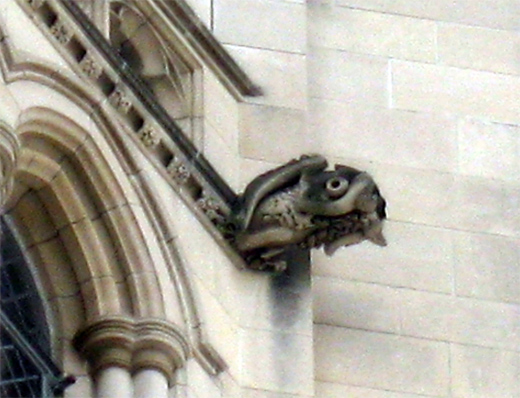
This week, we had three beautiful days of unseasonable sunshine and warmth, prompting overeager bulbs to break the soil at the edges of my garden. Meanwhile, at the cathedral, a nightmare of feathers, wings, and horns perched above the Bishop’s Garden watches, waits, and warns.

FEBRUARY
(PSEUDOTHALAMION)

The golden groom dismounts; the war is done.
The persephonic matrons, long withdrawn,
Betray the bride, let fly their veils as one,
and race like reckless robins round the lawn.
The bulbs trod under boot cry out: oh run
oh praise him raise him high hymenaeon
So spring steals in, the beaming, spendthrift son
who flatters us, and slinks away by dawn.

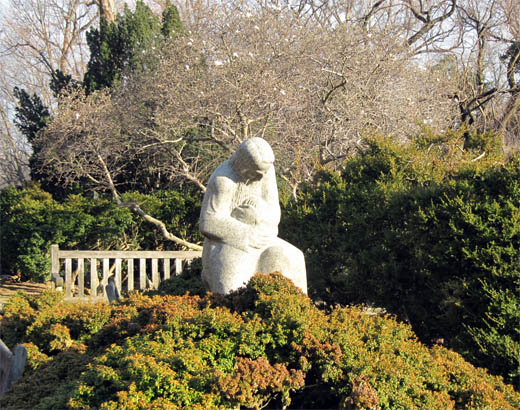
Heinz Warneke, “The Prodigal Son,” dedicated in the Bishop’s Garden in 1961.

(For all the entries in this series, hit the “looking up” tab, or read the gargoyle FAQ.)

“Look up, look down, there’s a crazy world outside…”

You can walk past buildings for years and never see the faces glaring down at you—until one day, you stop and look up.

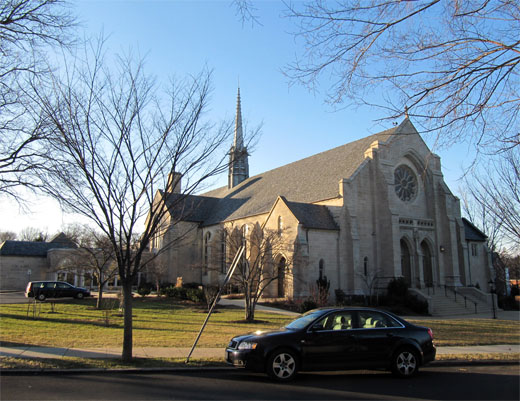
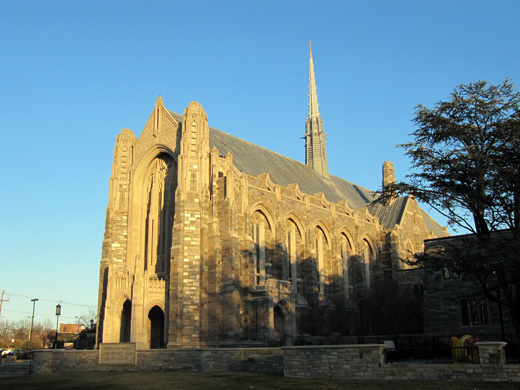
St. Paul’s Lutheran Church (here in D.C., near the corner of Connecticut Avenue and Ellicott Street NW) was begun in 1930 and finished in 1958.

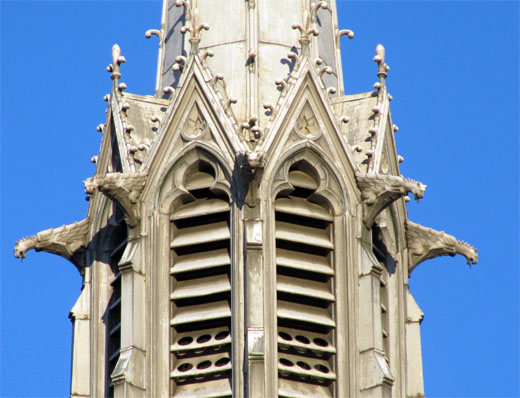
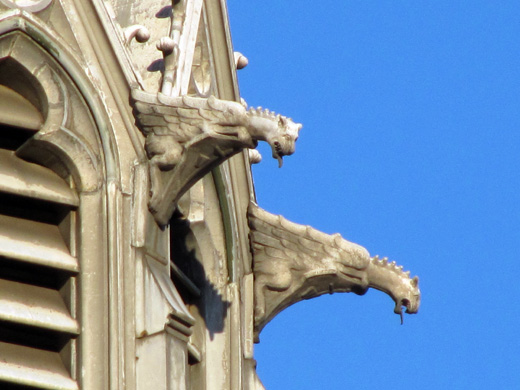
By then, its spire was unfashionably neo-medieval….

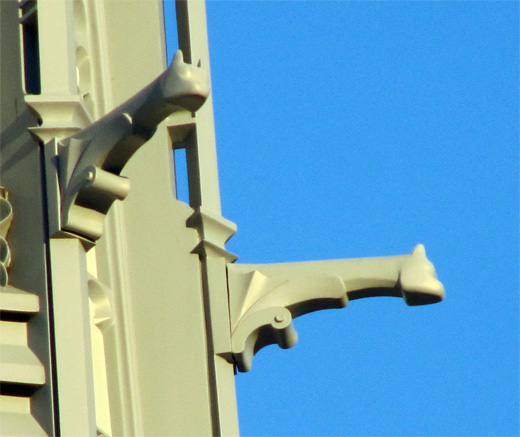
…ringed as it is with winged lions right out of illuminated manuscripts.

Two miles away, the folks at Metropolitan Memorial United Methodist Church (across the street from American University) began building their new church in 1932.

A prominent spire promises similar beasties…

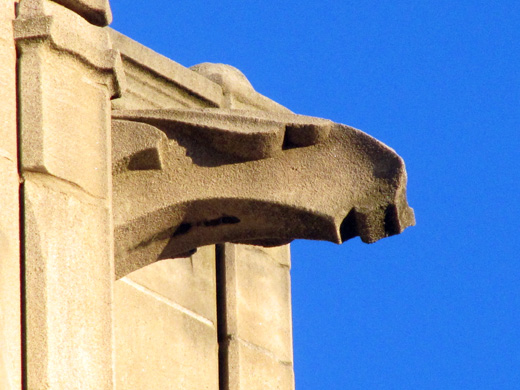
…but two waterspouts near the front of the church are barely zoomorphic…

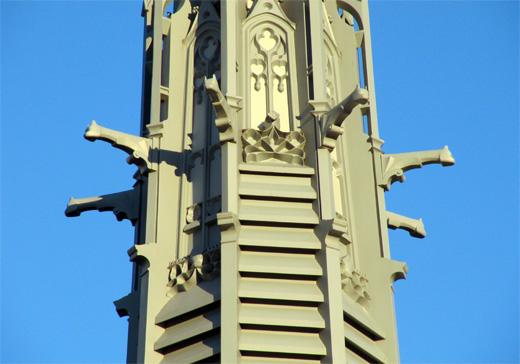
…while the spire itself sports not gargoyles, not grotesques…

….but faux-tesques!

“Though the interstate is choking under salt and dirty sand…”

The sprouts of spring are many weeks away—but let these literary links break through the frost-encrusted soil of your mind.

Michael Drout is amused by the Nobel Tolkien snub, but he also takes it seriously.

Richard Utz finds evidence for the “unique continuity” of medievalism.

The inimitable Dr. Beachcoming reads up on medieval dog-heads.

“From imperial representation to barbarian fortress”: Lost Fort visits Trier.

Sadly, the Ozark Medieval Fortress will likely go un-built.

Brian Murphy seeks the starting line of fantasy.

Bill Peschel reads a much-praised fantasist and wonders what the fuss is all about.

The Sliver Key learns how to stop worrying and appreciate Peter Jackson.

Jason Fisher asks: Is “alright” all right?

(Jason’s Tolkien and the Study of His Sources is also now available for the Kindle.)

Dylan plays familiar verses: “American Pied Beauty.”

University Diaries seeks “verbal consciousness” in poetry.

Clive James praises poetry’s technicians.

First Known When Lost looks for poems about ice skating.

My friend Ephemeral New York discovers a gorgeous mosaic dome.

Patrick Kurp picks poems at a yard sale.

Steve Donoghue travels with Penguins.

Jake Seliger writes about trolls, and attracts them.

The terrific Poetry News in Review has a new home on the Web.

Hats & Rabbits proffers a parable.

Writer Beware advises iBook users to study the fine print.

Bibliographing imagines Tolstoy’s A Christmas Carol.

Steven Riddle reviews The Sharper the Knife, the Less You Cry.

The Book Haven sees senescence in Stevens, Eliot, and Miłosz.

“Mountain passes slipping into stones…”

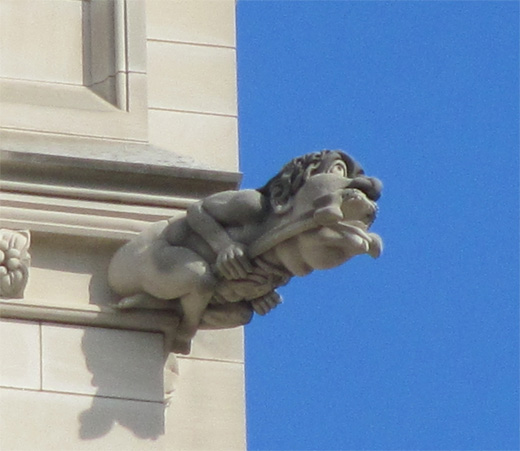
Facing away from the cavewoman pietà, this bone-wielding caveman tears open his own abdomen, but he’s less brutal than he seems. Candor sometimes demands that you de-form yourself a bit.

THREE SEASONS

Panting at twilight
the fox halts, and bends his neck:
“one white bone is yours.”
You shook me half awake look!
with cold, open, empty hands

* * *

Beneath your mirror,
light, scarf, gloves, clock, sonnet book,
a deer tibia—
you beam, and gaze into it

Lose her to God for a while

* * *

Four trees fell.
She swings
through fresh-mown sunshine, smiling
over fitful seeds
slight as a hummingbird skull
light as a hummingbird dream

(For all the entries in this series, hit the “looking up” tab, or read the gargoyle FAQ.)

“Throw the world off your shoulders tonight, Mr. Smith…”

Silly and serious, profane and sacred, the gargoyles at the National Cathedral have become tourist attractions all their own. You can buy a book about them, the cathedral offers special tours, and I hear some strange neighbor is even writing gargoyle-themed poems.

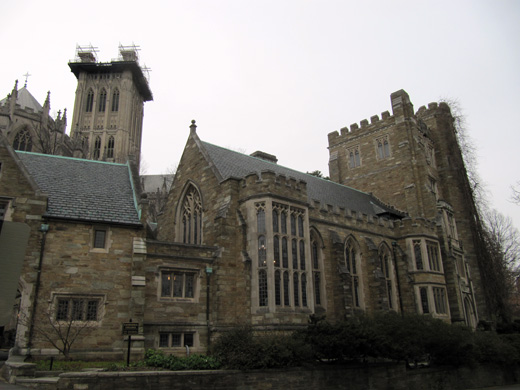
They’re not, however, the only gargoyles and grotesques in town, or even on the cathedral grounds. Turn northeast and stroll a few steps and you’ll bump into Cathedral College (formerly the College of Preachers), dedicated in 1928 just as American neo-Gothic church building was waning and collegiate Gothic was on the rise.

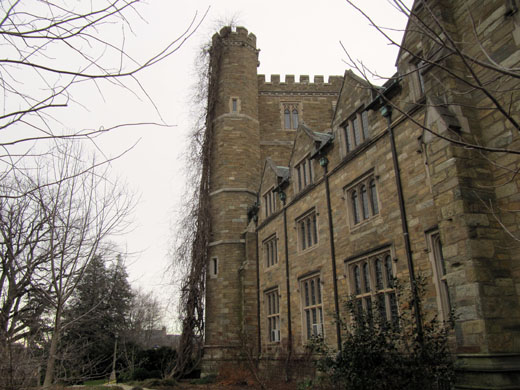
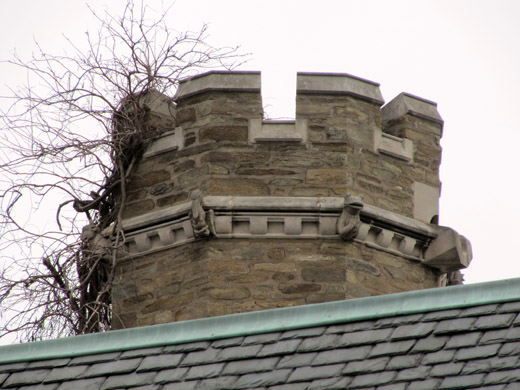
Mostly Anglophilic neo-Gothic with Tudor-ish outbuildings and annexes, Cathedral College closed for budgetary reasons in 2009, but gray winter is a fine time to peep through leafless vines and trees…

…to see the grotesques on the large corner tower.


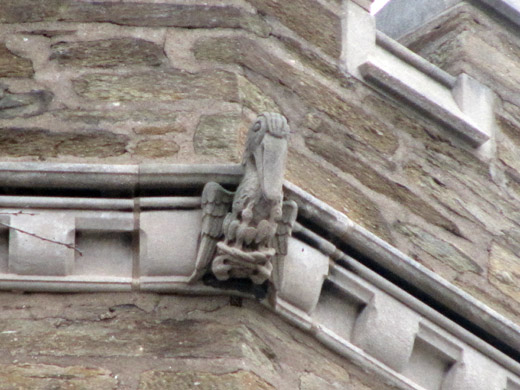
First up: a pelican feeding her young with the blood of her breast, a medieval Christian symbol of self-sacrifice that’s hardly unknown in the American South.

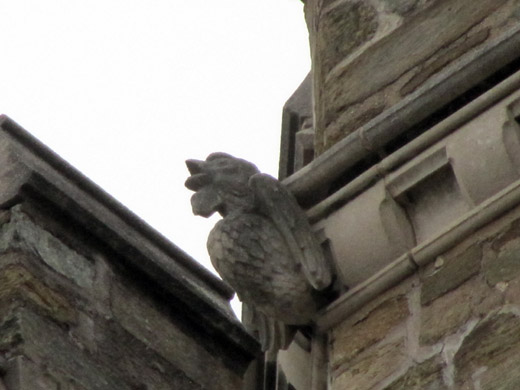
Harder to see: a rooster, medieval symbol of (among other things) vigilance.

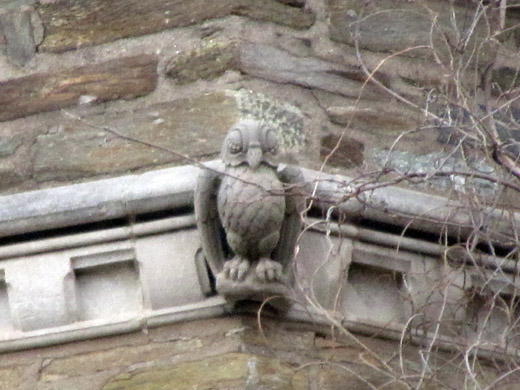
This owl’s shut eyes may suggest modesty, or sinners refusing to see and do the good, or, not inconceivably, Jews rejecting Christianity.

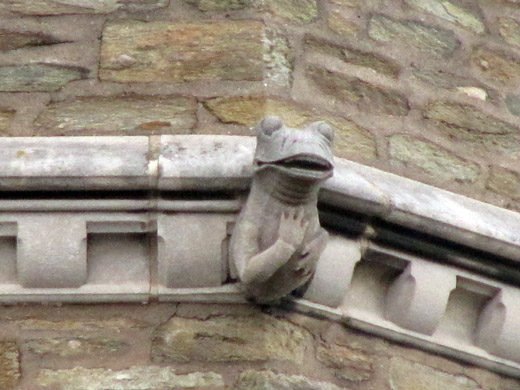
Everyone knows that in the Middle Ages, anthropomorphized frogs gesturing sincerely symbolized…um…

Exposed only in winter, this embrambled goat-devil is suitably eerie.

The College of Preachers was built by Frohman, Robb, and Little, one of several firms that made America look a little more medieval: Philip Frohman designed more than 50 American churches, and FR&L gave Trinity College Chapel in Hartford its neo-Gothic air. Frohman himself is best known for stepping in to re-design the National Cathedral in 1919. To a large extent, the building is “his”; he reportedly still climbed the scaffolding to oversee construction until his retirement in 1971. (Like many Episcopalian medievalists of his generation, Frohman was drawn to Catholicism; unlike most, he eventually converted.)

If Frohman, his partners, and their stonemasons intended the grotesques on Cathedral College to tell an obvious story, then I’m missing their meaning—beyond, perhaps, “please decorate the tower drainage system.”

“Ne can Ich eu namore telle. / Her nis namore of þis spelle”—but I’m open to generous and creative interpretations, even wild ones, of this medieval-ish menagerie that countless Washingtonians stomp past every day without ever stopping to see.

“She shouldn’t oughta try to be that way…”

“She would rise before us then, a vision to win us, not repel: a lithe young slender figure, instinct with ‘the unbought grace of youth,’ dear and bonny and lovable, the face beautiful, and transfigured with the light of that lustrous intellect and the fires of that unquenchable spirit.”

So wrote Mark Twain about Joan of Arc, the sole figure who could make him mute his famous disdain for medievalism. “[S]he is easily and by far,” he swooned, “the most extraordinary person the human race has ever produced.” (Twain considered Personal Recollections of Joan of Arc his favorite of his own books; his heroine’s penchant for mottos—”Work! Stick to it!”—prompted Shaw to brand her “an American school teacher in armor.”)

It’s hard to overstate what a big deal Joan of Arc was in America at the dawn of the 20th century—but like most spirited forms of medievalism, Joanolatry first rose overseas. In 1870, when the French lost Alsace-Lorraine to the Prussians, humiliated nationalists—when Europeans rouse medieval heroes from their graves, nationalism is usually the reason—made a symbol of the Maid of Orleans. American writers as early as John Daly Burk in 1798 cast Joan as an emblem of patriotism and pre-modern innocence, but by the late 19th century, European-influenced children’s books and chivalric romances about female heroes fired up men and women alike, as T.J. Jackson Lears points out:

The life of the chivalric warrior, male or female, ranged far outside the realm of reading circles and parlor chitchat. “Oh, to be a wild Kossack!” Emily Greene Balch wrote in her commonplace book after reading Taras Bulba. “Fight hard and drink hard and ride hard . . . Our clothes grow strait. Oh, for a horse between the knees, my blood boils, I want to fight, strain, wrestle, strike . . . To be brave and have it all known, to surpass and be proud, oh the splendor of it.”

Lears further argues that the American Cult of Joan was about more than escapism. For late 19th-century Americans, saints also “embodied instinctive communion with nature, simple faith unhampered by learning, and sexual purity. Personifying shibboleths of romantic liberal Protestantism, they entered the pantheon of the genteel tradition.”

World War I only gouged Joan further into American culture: She was immortalized on the Hudson in 1915, beloved by readers of Lucy Foster Madison’s 1918 novel (with its gorgeous Frank Schoonover illustrations), and brought to the screen by Cecil B. DeMille. Decades later, Joan was still sufficiently famous that OMD could write not one but two songs about her, while the Smiths could mention her and know that the image would stick.

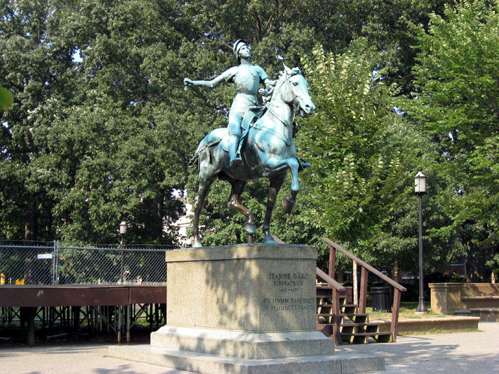
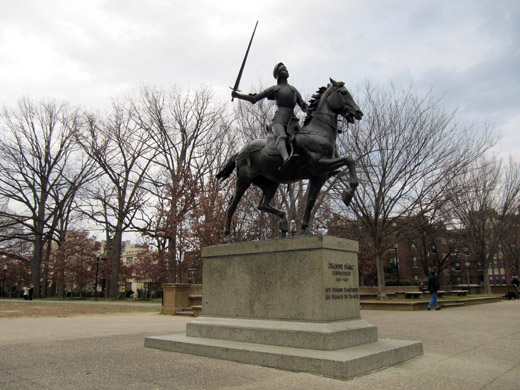
According to the Book Haven, yesterday was the 600th birthday of Joan of Arc. Fortuitously, I learned this morning via D.C. neighbor and blogger George that the Joan of Arc statue in Meridian Hill Park, dedicated by President Harding on the saint’s birthday in 1922

…but (as this 2007 photo shows) disarmed for decades…

got her sword back just last month! (And got a full body scrub too.)

Congrats to locals, who reportedly lobbied the Park Service for two years to make this happen, and happy 600th to Miss of Arc, who was, as one of history’s greatest thinkers put it, “a most bodacious soldier and general.

“Wheel in a wheel, way in the middle of the air…”

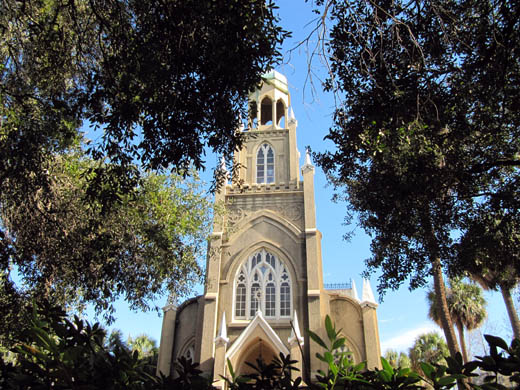
Savannah is famous for its gorgeous and walkable squares. One in particular, Monterey Square, was the site of drama in Midnight in the Garden of Good and Evil—but when I tromped through the square during Christmas week, I was drawn instead to a Gothic Revival church…

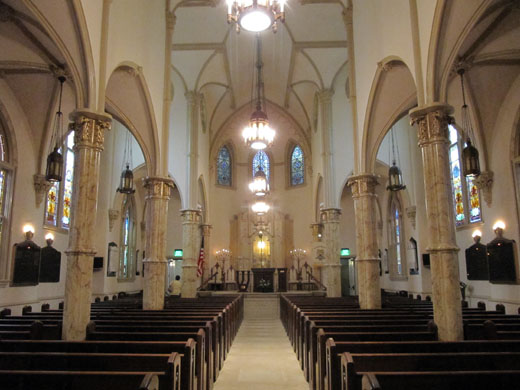
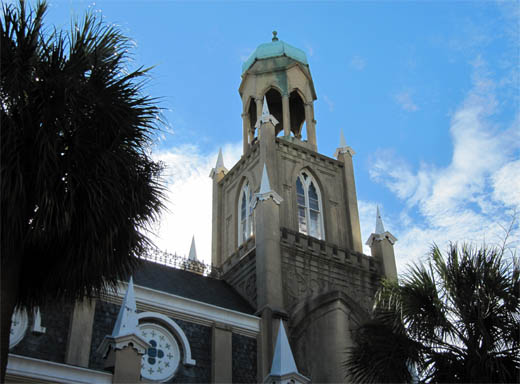
…that’s not, in fact, a church. Behold: Temple Mickve Israel! Dedicated in 1878, it’s the third home of a congregation founded in 1733 when 41 Jewish colonists, most of them Sephardic, sailed to Georgia (where Catholicism was illegal, but Judaism wasn’t) with the support of Jews in London.

Last week, I heard a passing tour guide announce that the congregation chose the Gothic Revival style to honor the cathedrals of their Spanish and Portuguese hometowns. That claim is specious; this building was dedicated nearly 150 years after the colonists arrived. According to the docents, the 19th-century Jewish congregants, like their Christian neighbors, simply got caught up in the Gothic Revival craze. Boy, did they ever.

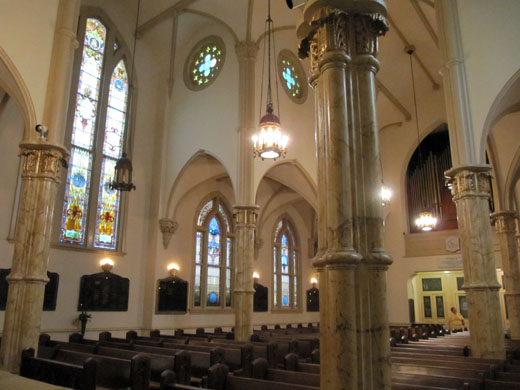
For a synagogue, Mickve Israel is a weirdly pure model of a neo-Gothic church. It was designed by English-born Henry G. Harrison, a renowned Episcopalian church architect and a disciple of Gothic Revival master A.W.N. Pugin. Harrison’s background shows: Mickve Israel has a basic cruciform shape with a nave and transept; pointed arches; stained-glass windows with tracery; quatrefoil designs everywhere; buttresses; pinnacles; and a castellated multi-story tower. The ark is also neo-Gothic, as are the chairs alongside it.

The big difference, of course, is the swapping-out of a steeple with what the authors of Synagogue Architecture in America call “a Middle Eastern element hinting at the true Jewish nature of the building.”

I’d say it does far more than hint. That cupola insists, with confidence and grace, “Our roots are European, the Gothic style is ours to use—but we’ll top it off with a sign of our deeper origins and our present difference.”

A surprising schmeer of myth adheres to this synagogue: that the Jewish congregation bought it from the local bishop; that it’s based on a specific Spanish or Portuguese cathedral; and that the choir loft was once segregated seating for women.

Those tales aren’t true—but it is true that while other Gothic Revival synagogues used to exist, and while others still standing can boast neo-Gothic doodads, Mickve Israel is (as far as I can tell) the only remaining full-on Gothic Revival synagogue in America.

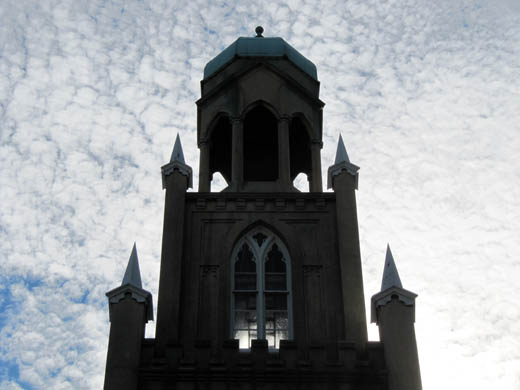
Today, this 200-family congregation reveres its medievalist gem, a building that bravely (but not brashly) asserted that Judaism belonged in a Southern city in the 19th-century—and well beyond. In 1927, when a fire destroyed the tower, the people of Mickve Israel rebuilt it…

…just as it was, and probably always will be: Gothic reverie, Middle Eastern memory, persistent American dream.

“Meeting as the tall ships do, passing in the channel…”

When you update a blog only sporadically, you never know who’s reading, or if anyone’s reading—but to my amazement, people kept popping back here throughout 2011 to see what was new.

Whether you’re a new reader, an old-timer, or just looking for something to read during a slow week, here are the “Quid Plura?” highlights from the year that was.

We are starburst, we are golden: medieval poets get us back to the garden.

Ghosts, violence, family grudges: “All My Children” was a true Icelandic saga.

The August earthquake shook up thoughts on wobbly English cathedrals.

Meet Ralph Adams Cram, the architect who implored us to move into medieval towns.

Biiiiirds fly…or not: the medievalism of dead Arkansas blackbirds.

Poets who spit blood: Christopher Logue’s “War Music” on stage in New York.

Boys, barbarians, verse: Robert E. Howard, creator of Conan, was one prolific poet.

Women loathe fantasyor so claimed the New York Times.

No, “everything” isn’t online: What we throw away when we rush to go all-digital.

In Virginia, you may glimpse “medieval” Richmond.

In Louisiana, explore the castle Mark Twain loathed…

…or chase saints and monsters in New Orleans…

…or tailgate at a Cajun ring-joust.

You’ll find medievalism squarely in Savannah, if you wander long enough.

Something in the water? Gargoyles stalk Princeton and Perth Amboy.

In 2011, reviews of Lloyd Alexander’s non-Prydain books rolled jauntily along…

And Let the Credit Go
The Drackenberg Adventure
The Jedera Adventure
The Xanadu Adventure
The Philadelphia Adventure

…while “Looking Up,” the series of poems about the National Cathedral gargoyles, continued:

A goat’s canticle for Walafrid.
The lullaby of a skeletal horse.
The mad song of Cerberus.
An unhappy insect sentinel.
A Rilke’d raccoon.
A hamster at the museum.
A snake with an Anglo-Saxon appetite for hare.
A Mardi gras gator.
A Good Friday memento mori.
An administrator, fooled by façades.
A tiger mother singing of Midsummer goblins.
A dog on the trail of a thief.
The Nordic boast of a bowing, beheaded bat.
A monster, desperate for silence.
A homesick Jersey devil.
Bunnies at odds over gratitude.
A dragon and bird, doomed to dance.

Thank you for reading, browsing, commenting, linking, and emailing me throughout 2011! I’ll be here in 2012; hope you’ll be as well.

“If you want to tell me something new, I might stick around…”

The Internet is an overwhelming source of wonderful reads—so much so that in the past year, you may have overlooked these articles and posts by bloggers, journalists, scholars, writers, and poets. In the relative peace between Christmas and New Year’s Eve, click a link or two; perhaps you’ll find something terrific you’d hate to have missed.

What did the Norse call Constantinople? The Ruminate expounded.

Jonathan Jarrett explored what it meant to call yourself a “Goth” in tenth-century Spain.

Lingwë wondered what Samwise Gamgee meant by “neekerbreekers” and looked at a Hogwarts professor’s curious name.

Cynthia Haven asked if visual clichés affect how we write and noted the “bland endeavor” of National Poetry Month.

Michael Livingston showed you what it’s like to edit a medieval text. (He continued his lesson in part two.)

The enigmatic Withywindle imagined Ernie Pyle remembering Clark Kent.

As a Linguist painted a portrait of a polyglot and remembered expat life in Istanbul.

Classical Bookworm discovered a forgotten Hungarian polyglot. Sixteen languages?

“But above all, One Who Walked Alone is brave.” The Silver Key reviewed Novalyne Price’s memoir about Robert E. Howard.

“Inside,” said Hats & Rabbits, “we are all great pipe organs waiting for the right wind to bring us alive. But it seems to me that, often, the delicate pipes go unused until they rust and fall into disrepair.” Chris later weighed the darkness without, rode a roller coaster arabesque, and overheard what kids say about their parents.

ZMKC recalled childhood loneliness.

Ruff Notes showed us what Washington National Cathedral almost looked like.

Dr. Beachcombing dug up the Zambian space program.

Anna Tambour charted a parrot confidence course.

Flavia asked why there isn’t more Protestantism on American television. She also contemplated grief, mourning, and the elusiveness of “closure.”

What do a Pakistani-American fourth-grader and Isaac Bashevis Singer have in common? Anecdotal Evidence explained.

“The literature of the Holocaust is so vast that newcomers to the subject are disheartened from beginning,” said D.G. Myers, who offered an annotated list.

Thinking about the lack of novels about work, Bibliographing revisited “Office Space.”

Jake Seliger pondered imaginative career paths and writing in terms of computer programming.

At Interpolations, a philosopher-in-training met an owl.

Dame Nora blogged “quince week” with some quince history, thoughts on quince marmalade, and a recipe.

Overthinking It explored the political economy of My Little Pony.

Kij Johnson penned a creepy fantasy tale about girldom: “Ponies.”

Debate time! James Gurney (whom I like) versus Frank Gehry (whom I don’t).

Prof Mondo read Gardner’s On Moral Fiction in light of young-adult lit.

Frank Wilson penned an earthquake poem.

First Known When Lost hailed the “Dance of the Macabre Mice.”

University Diaries led us through “Sublunary,” a poem by A.E. Stallings.

Michael Lista heard his heartbreak echoed in a villanelle.

Dylan composed a Christian triolet and wondered, “how would Smiths lyrics sound from the pen of Gerard Manley Hopkins?

If you haven’t yet read the first part of Adam Golaski’s funky new translation of “Sir Gawain,” what are you waiting for?

Paul Laurence Dunbar would have liked this recitation of “Sympathy.”

Edwin Arlington Robinson would have liked this recitation of “Miniver Cheevy.”

I liked this bluegrass cover of “Walk Like an Egyptian.”

“I can hear people singing, it must be Christmastime…”

Medievalism is intertwined with the history of the American South. In cities like Richmond and New Orleans, where magazines helped popularize Sir Walter Scott novels and promote chivalric virtues, Gothic revival architecture felt right—but Savannah, where I’m spending Christmas, went its own wonderful way. Here, in a city with countless monuments but surprisingly few statues, you’re more likely to find Georgian, Italian, Federal, and Colonial styles, intermingled but insistently American beneath layers of picturesque moss.

So when you’re the new guy in Savannah, exploring the city’s public squares on foot on Christmas Eve, the search for medievalism seems downright futile…
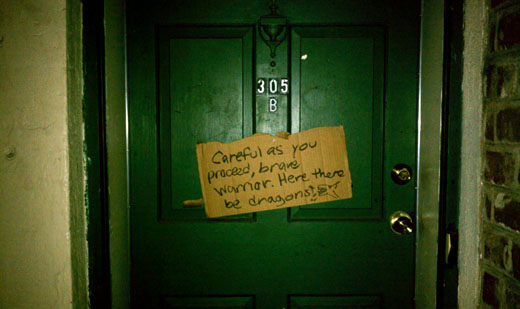
…but after all these years, I know when to heed the signs. They’re rarely as obvious as this one on Liberty Street.
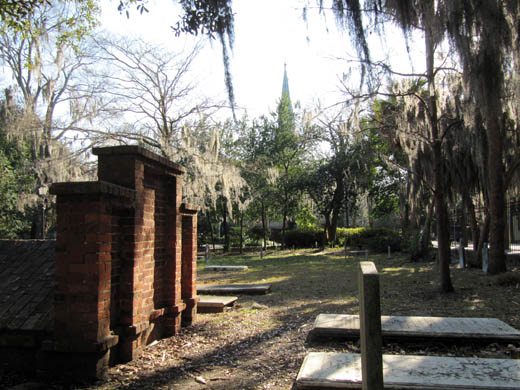
And so we trudge from moss-bedecked square to moss-bedecked square, wondering as we wander…
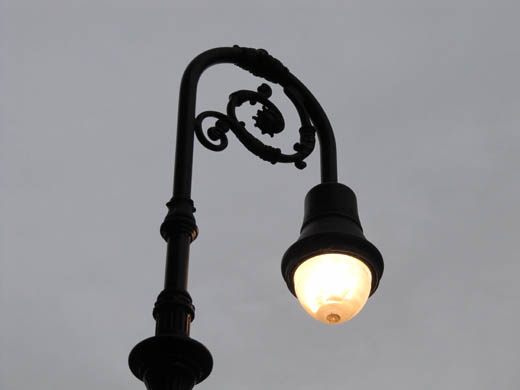

Is a lamppost resembling a bishop’s crozier the most medievalism the streets of Savannah can offer?
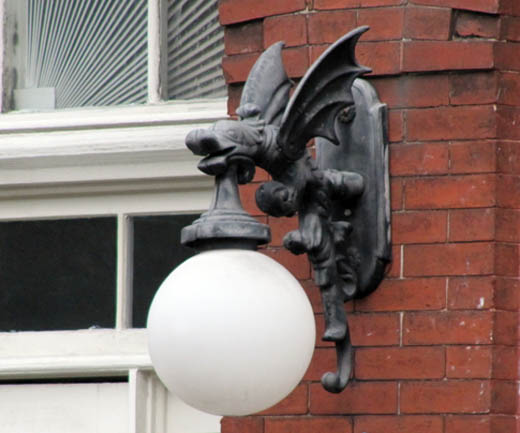
“No,” says a monstrous sconce on Bay Street. “Look lower, fool!”
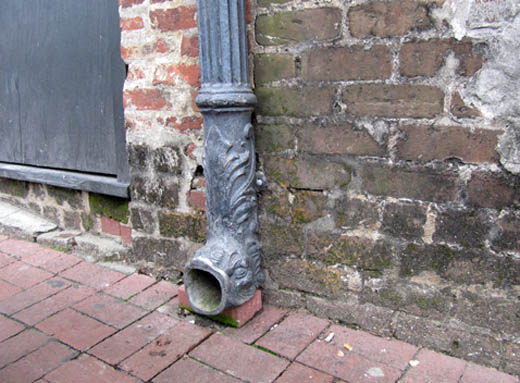
Any Jesuit will tell you this totally counts as a gargoyle…
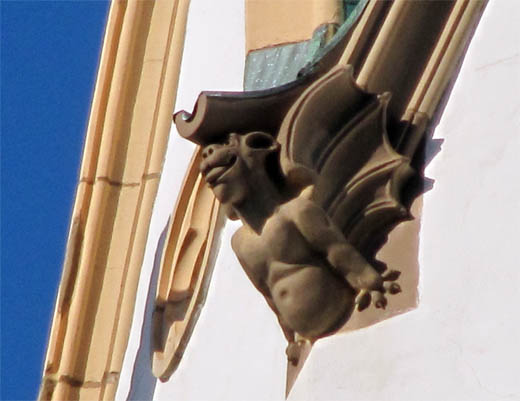
…as does this Seussian goof on the Cathedral of St. John the Baptist, though his architect spared him the spitting.

But what’s that in nearby Troup Square?
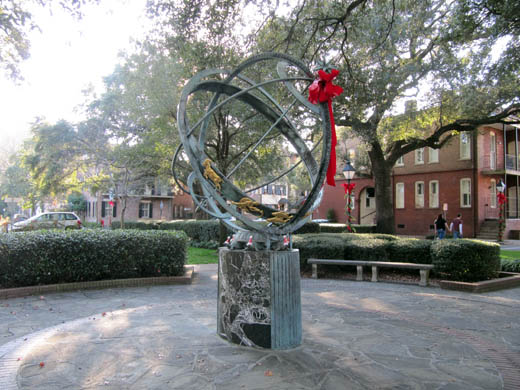
A neoclassical armillary sphere!? Isn’t there anyone in Savannah who knows what medievalism is all about?
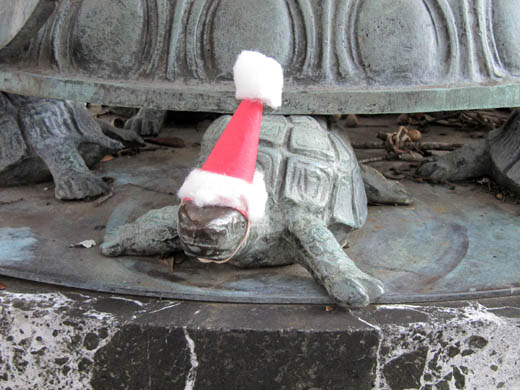
“Sure, Charlie Brown,” says one of six bronze turtles in tiny Santa caps, “I can tell you what medievalism is all about.”
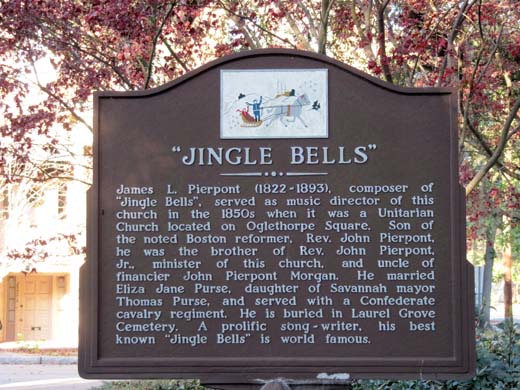
Yep, along this square is the Unitarian church where J.P. Morgan’s uncle served as minister when he published “Jingle Bells.” (Until today, it had never occurred to me that anyone had actually written “Jingle Bells,” or that controversy would attend upon its provenance.)

Amusingly, in the 1850s, Pierpont’s church wasn’t in this square, but a few blocks away. During a low point for Savannah Unitarians, the building was bought by African-American Episcopalians, who industriously rolled it away and set it down here.

So yes, it’s a cosmic treat to stumble around Savannah on Christmas Eve and find a neoclassical Christmas turtle that points you to the relocated church whose minister composed “Jingle Bells”—but what’s medieval-ish about an overplayed ode to the secular sleighing culture of 19th-century New England?
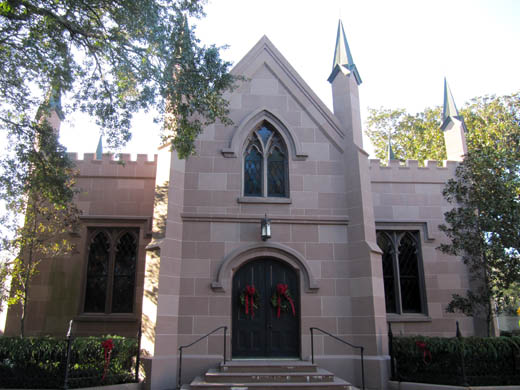
Aha! The composer’s church itself—castellated, Americanized neo-Gothic! Its discovery is hardly a miracle, but the sight of it is fitting end to a charming quest—and a fine way to wish “Quid Plura?” readers a merry (and hopeful, and gargoyle-rich) Christmas.