“I was dreaming like a Texan girl…”

Oh ring, ring the yule log
   And sound the holly wreath!
Open up the missile, too,
   And trim your crispness treeth.

— Walt Kelly, The Stepmother Goose (1954)

Whether you’re itching from tinsel or scouring tree sap from your coat and gloves, here’s a set of glittering links to ornament the Douglas fir in the Rockefeller Center of your mind.

“Do ye nae see that great writing–prose or poetry–is not the shriek, but the shriek mediated by consciousness?” University Diaries shows why writing is a cool medium.

“But what struck me most on the personal tour is how William Nicholson’s play and subsequent film misrepresented a life that was not a passionless, solitary bachelorhood, but crowded with people and noise and human obligations.” Cynthia Haven visits the home of C.S. Lewis in Oxford.

“Amazing, isn’t it, the things you notice when you hold a map up to the light!” Jason at Lingwë teases Old Norse out of a Tolkien manuscript.

“I guess no translation will ever satisfy every reader; that’s why we should all translate the Edda for ourselves!” Old Norse News looks at two new published translations.

“Hodel’s last comment might be the finest expression of a grown child’s need to lead an independent life, and a parent’s need to let the child go, that I’ve ever seen.” Pete finds a nice passage in Sholom Aleichem.

“For the most part, it seemed, the faculty studying higher education were proceeding with their fairly narrow-gauged research as if Rome were not burning.” The enigmatic Fenster Moop attends a scholarly conference.

“Copper had its place in classical civilization, alloyed to make bronze, and as currency, but evidently one didn’t make pipes of it.” George plumbs the etymology of “plumber.”

“Despite her utter failure as an author, screenwriter, and publisher, she has the chutzpah to peddle a book that she’s written.” Lee Goldberg notes an inept scam publisher rising from the dead.

“The question Conrad asks and never answers is, can one person love both composers?” Tom Glenn reviews Verdi and/or Wagner.

“[P]art of the problem is that ‘plagiarist,’ like ‘racist,’ is a term that doesn’t allow for gradation or nuance, and no one believes he can be that thing.” Flavia reminds herself that plagiarists are people too.

“Sassoon speculates often on what death is like, and though he has several reuseable phrases at hand to euphemise it—’gone out patrolling in the dark’, ‘beyond the wire’, ‘gone West’—even these are poignant and not (yet?) cliché.” Bibliographing is reading the literature of World War I.

“Is this just luck or is the stuff disappearing invisibly, draining away somehow, like sand?” ZMCK wonders what becomes of the chunks of debris that fall off Eastern European buildings.

“Parents in my neighborhood banned their kids from playing at my house because they always came home with their pockets full of dirt.” James Gurney unearths the roots of Dinotopia.

“[A]s a lover of the idea of shaking hands with the past, I could think of no better way of doing so than by drinking a drink cherished by my predecessors.” Hats & Rabbits thirsts for the lost pages of an 18th-century magazine.

“Nkoloso was, in short, one of those wonderful eccentrics who usually only appear after three or four generations of middle class parliamentary democracy.” Dr. Beachcombing rediscovers the Zambian space program.

“And you know you cannot leave her, for you touched the distant sands…”

[Poet Christopher Logue died on Friday, December 2. The Guardian has a full obituary that nicely sums up his petulance and eccentricity, but it fails to capture the force of his actual work. Here’s a piece I wrote about a performance of Logue’s “War Music” in New York earlier this year.]

For half a century, autodidact and occasional actor Christopher Logue has rallied all the gimmicks of modern poetry to craft a loose, idiomatic version of Homer’s Iliad. “[I]t’s some of the best poetry being written in English today,” wrote Jim Lewis at Slate in 2003, “and it should be read widely and with great pleasure by anyone still interested in the art of verse.” For a few more days, New Yorkers have a rare chance to see Logue’s Homer come to life: With the poet’s approval, director Jim Milton has adapted the first 70 pages, “Kings,” for two actors on a mostly-bare stage. The production, at the Workshop Theater through April 3, is a wild, addictive hour that does remarkable justice to its source.

Literally irreverent, Logue frees himself from the tyranny of the Homeric text through one curious advantage: his ignorance of ancient Greek. Instead, he’s basing his still-unfinished poem on English translations published between 1720 and 1950. His Homer—currently collected in three separate volumes—includes scenes that aren’t in the Iliad; at one point, he cribs a passage from Paradise Lost. Sensitive to the distinction between scholarship and artistry, Logue calls what he’s doing an “account,” not a translation—and if that makes classicists cringe, they’re missing the point.

Known for his gleeful use of anachronism—like his description of Ajax, often cited by reviewers, as “[g]rim underneath his tan as Rommel after ‘Alamein”—Logue deploys evocative modern language to create quick, crisp snapshots. Here’s Agamemnon’s line-up of champions from All Day Permanent Red, a slim volume of battle poetry published in 2003 with a title nicked from a Revlon ad:

Nestor, his evening star.
Ajax, his silent fortress. Good—even on soft sand.
Odysseus (you know him), small but big.
Fourth—grizzled and hook-tap nosed—the king of Crete,
Idomeneo, who:
“Come on!”
Would sign a five-war-contract on the nod.

Logue’s Homer resounds with cries of war, but he also crafts domestic scenes with a deftness that other poets should envy. In “The Husbands,” an exchange between Zeus and a petulant Athena neatly reveals the condescension that defines their relationship:

The armies wait.

“Dearest Pa-pa, the oath said one should die.
The Trojan was about to die. He did not die.
Nobody died. Therefore the oath is dead.
Killed by a Trojan. Therefore Troy goes down.”

Drivers conducting underbody maintenance.

“Father, You must act.
Side with the Trojans, Greece will say,
Were we fools to believe in His thunder?
Why serve a God who will not serve His own?”

And giving her a kiss, He said:

“Child, I am God,
Please do not bother me with practicalities.”

When battle calls, Logue can craft a scene as thrilling as anything in 300, combining heroic deeds with colloquial diction while never undercutting the tone, as in this passage from “Patroclea”:

The air near Ajax was so thick with arrows, that,
As they came, their shanks tickered against each other;
And under them the Trojans swarmed so thick
Ajax outspread his arms, turned his spear flat,
And simply pushed. Yet they came clamouring back until
So many Trojans had a go at him
The iron chaps of Ajax’ helmet slapped his cheeks
To soft red pulp, and his head reached back and forth
Like a clapper inside a bell made out of sword blades.
Maybe, even with no breath left,
Big Ajax might have stood it yet; yet
Big and all as he was, Prince Hector meant to burn that ship:
And God was pleased to let him.

Now either you like this sort of thing or you don’t. I happen to love Logue’s knack for trotting out modern gimmickry not for its own sake, but in the service of narrative— and while Logue finds humor in his ancient source, he never treats Homer like a joke. Both Homer and Logue understand, from different angles, the maddening mindset of warriors. Jim Milton concedes its relevance, too; it’s why his adaptation of “Kings” is so good.

Milton is also lucky to have two nimble actors on his stage. Dana Watkins switches effortlessly between Zeus, Odysseus, Hector, and even a hammy Hephaestus, but he’s at his best as a furious, choked-up Achilles who’s never more than half a slight away from homicide. J. Eric Cook is funny as a shrill Hera and a rash, tipsy Thersites, but he’s also weirdly touching as Thetis, Achilles’ mother. His Agamemnon is unremarkable, but perhaps deliberately so, as Logue’s text renders him a slick politician before his homesick army:

“Thank you, Greece.
As is so often true,
Silence has won the argument.
Achilles speaks as if I found you on a vase.
So leave his stone-age values to the sky.”

Although Cook doesn’t look like a warrior king, he imbues the character with the smiling certainty of a psychopath. Logue’s text helps. As the Trojan Anchises later asks, “Indeed, what sort of king excepting theirs / Would slit his daughter’s throat to start a war?”

Seeing Logue’s Homer performed by two Americans makes clear that the text might be better declaimed by actors with droll British diction; once or twice, Cook and Watkins seemed too busy recalling Logue’s lines to give them their full weight. Still, both actors possess powerful, well-trained voices, and they and the director draw from a deep well of vocal tricks and physical gestures to make this production brilliantly audience-friendly. Before Thursday night’s performance, I heard a couple in front of me whisper that they had no idea what they’d gotten themselves into, but as soon as Watkins and Cook took the stage, they were beguiled. As Logue himself put it, “[i]t was so quiet in Heaven that you could hear / The north wind pluck a chicken in Australia.”

Unfortunately, “Kings” is tantalizingly brief. The show, which clocks in at 75 minutes, ends with howls of war just as the audience is dying to see (even though they know) how it all plays out. I hope the empty seats in the tiny Workshop Theater don’t dissuade director Jim Milton from further adapting Logue. Drearily, the Poetry Foundation can use its $185 million boon to build a $21 million headquarters and publish reams of mediocre verse, but a staging of Logue can’t fill 65 seats in midtown Manhattan. That says less about Logue than it does about the mannered insider-ism of the poetry scene, and Logue himself knows it.

“[N]one of my contemporaries seem to be interested in the things that interest me, such as fast, clear, several-stranded narrative, action, character, violence,” Logue told the Paris Review in 1993. His contemporaries are missing out. If you’re near New York, you have nine days to get to the Workshop Theater, see “Kings,” and hear how poetry sounds with a mouth full of blood.

“Funny how my memory skips while looking over manuscripts…”

With unlikely conviction, my garden has thrived well into November. Last week I dug up a little white-orange carrot still stubbornly finding its form. It smelled wonderful: fragrant, persistent, alive, a deep-rooted argument against autumn gloom. It stirred up two rabbits, long out of season.

THANKSGIVING

i.

“Senses are quickened by subtile forebodings.”
So sops the chorist by shadow-cold doors.
Blackening leafmeal bletts into mulch,
The cinders spelt from summer pyres
Blaze low before us, blow themselves out.
The wormeled looms, woven blindly,
Fate unpatterning, feast on the ash.
From these I spair my spirit shrinking:
In winter’s wane and withring dark
No thing endures. I thank no one.

ii.

Ah. Songs missung spiel but seasonal doom.
Finding their form, fetal hornroots
Clot the bodden; now clawing one free
We breathe, haling brawn and carrick,
Sweaty scrafings, the sweetest persistence,
No lesser life from leafmeal spurned,
And we know: Something censes in gardens
In alway above eyesores and brume-song
That nurtures a savor not known here before.
Craving to taste, we partake, and give thanks.

(For all the entries in this series, hit the “looking up” tab, or read the gargoyle FAQ.)

“…and the little ones chewed on the bones-o….”

Unfortunately, I got smothered by autumn leaves before I could offer “Quid Plura?” readers the annual Thanksgiving exercise in applied paleobromatology, such as last year’s medieval Islamic carrot jam, or candied Baghdad lamb, or medieval hogdepodge duck gone awry, or that much-googled classic, galangal ale.

Still, I’m grateful for those of you who stop by, and I’m equally thankful to the people who make the Internet a perpetual buffet of tidbits about art, books, history, and life. Settle in with a plate of leftovers—and these links—and stuff the cornucopia of your mind.

The Washington Independent Review reads Kimberly Cutter’s new Joan of Arc novel.

Weirdly, late medieval paintings of martyrs have become a hot commodity.

At the British Library, Book Haven browses royal manuscripts.

Steve Donoghue (whose reading time I envy) explores The Age of Bede.

Steve also wonders: Will we ever see a King Charles III?

I may need to check out Creole Medievalism: Colonial France and Joseph Bédier’s Middle Ages.

Patricia Emison remembers the Renaissance, and wants you to do the same.

Dr. Beachcomber seeks big bones in churches.

Anecdotal Evidence praises the worth of the hunt.

First Known When Lost finds Herrick in the teriyaki.

The Silver Key remembers pulp writer Harold Lamb.

Dylan pens “Viva Voce,” a nonsense rhyme that makes sense to me.

Lingwë wonders what Samwise Gamgee meant by “neekerbreekers.”

Collected Miscellany asks: Are All the Giants Dead?

Classical Bookworm hops the Bulgarian book bus.

Laudator Temporis Acti meets the First Earl of Balfour, bibliophile.

Wuthering Expectations hosts those two German horrors, Max und Moritz.

Adrian Murdoch likes a review of an Elagabalus biography.

For a police thriller with a Garden State twist, check out Steven Hart’s We All Fall Down.

A Momentary Taste reviews The Revisionists.

Thinking about the lack of novels about work, Bibliographing revisits “Office Space.”

Jake Seliger thinks too few students think thoughts of their own.

Lee Goldberg notes a spy writer who plagiarized damn near everything.

Cinerati suggests interesting kids in myth and history with Badass of the Week.

ZMKC jogs ’round Gellert Hill in Budapest.

Gabriele at Lost Fort tours castles in Thuringia.

As a Linguist paints a portrait of a polyglot.

Pete Lit links to a basketball sonnet.

Intelligent Life weighs up Warhol.

Philip A. Lobo reviews the game Bastion.

Ephemeral New York spots sheep heads on East 13th.

“Some people dance cheek to cheek…”

Although I’ve found this beast atop the northwest tower difficult to photograph, I’ve long wondered why he—she? it?—holds such a savage grip on a mere bird. Then I realized: From a monster’s point of view, they’re dancing.

INTERMEZZO
(after Edgar Degas, “Four Dancers,” c.1899, National Gallery of Art)

In the wings, a measured rest.
Four as one in florid fits

Flitter in. The wald submits.
Autumns rise upon the scene:

In a rush of salmoned green
Tender tressings flip, exchanged,

Battened fast, or rearranged.
Trellising her arm, the first

Honors artifice reversed:
“Wasted branches bow, and then

Painted planklings bough again.”
Half as daft, the second sets

Flambent straps, but scarce forgets
Quips that crab her brittle heart:

“Oui, technique—mais où est l’art?”  
Sembling innocence, the third,

Primping, pincing, undeterred,
Shoulders not a knot of shame

Lest regret, or light acclaim
Drag her down, or bow her stance.

Note the last; no lasting glance
Lingers there for us to see.

Music lifts her. Fanions flee—
Blithe she twirls, and none observe

Lesser lines we scarce deserve
(You and I) to leer and know.

Laud her flourish. Let her go
Pattern grace, while we pretend

Faux Novembers never end.
Autumn twilight sets too soon;

Fumbling, we belie the tune
(You and I) that times the turns

Every gilded dancer learns.
Let their line, from fourth to first,

Misperceive why we rehearsed,
Wrought the light from blighted rhyme,

Warped the chord in common time,
Daubed the gloss, as their debut

Burnished our façade anew.
Late, they loiter back, to find

Nothing I disclose in kind.
Fold your program; feign we see

Faith in faint simplicity,
False in sight, divine in show,

Pas de deux de deux, they go,
Pirandelles of perfect stone

Turn together, dance alone.

(For all the entries in this series, hit the “looking up” tab, or read the gargoyle FAQ.)

“But the answers you seek will never be found at home…”

The ghost of Robert E. Howard sleeps fitfully at best. His better stories have been republished by the University of Nebraska Press, but fans still struggle to champion his worth. You know Howard, if you know Howard, from crummy movies about his characters—Kull, Conan, Solomon Kane—even if you’re unaware of the brawny shadow he casts across decades of sword-and-sorcery. Both co-creators of Dungeons & Dragons cited him as an outsized influence, but his prominence as a fantasy writer overshadows the speed with which he also cranked out horror yarns, cowboy tales, historical fiction, and boxing stories from the bedroom of his parents’ Texas home.

Before committing suicide in 1936 at the age of 30, Howard published more in twelve years than most of us will in a lifetime, earning his rep as one of the great writers of the pulp era—but Howard wasn’t just a famously frantic storyteller. He was also, as his gravestone points out, a poet. Until recently, few readers knew how madly poetic he was.

At nearly 800 pages, The Collected Poetry of Robert E. Howard, published in 2009, is a monument to its author’s strange and boyish mind. Several of Howard’s 700-odd poems first appeared in pulp magazines like Weird Tales, either as standalone pieces or as epigraphs to stories; many were never published at all. Gathered in one tome (without the bibliographies compiled on a separate website), they’re an almost overwhelming blast from Howard’s mental universe, a cacophonic orgy of Romans, Babylonians, Vikings, cowboys, Crusaders, Mongols, Zulus, cavemen, and voodoo queens—figures who’ve long since been forced from the realm of respectable verse.

Can the collected works of any other poet boast a 60-page section on Wizardry and Satanism? Ah, but here it is, nestled amid sections covering Heroic Verse, War Poems, Horror Poems, Exoticism and Nature, Personal Poems, Historical Poems, Dialect and Doggerel, and Prose Poems. I’d already known some of Howard’s most effective ballads, especially “The King and the Oak” and “Solomon Kane’s Homecoming,” but it’s enlightening to see the good stuff in context. This comprehensive volume proves how many words even the most manic writer has to fling around before breaking free of his influences and pouncing on bright, fleeting lines of his own.

As befit his youth, Howard was an imitative poet, wedding his own stark worldview to the rhythms of Tennyson, Noyes, Chesterton, and others. His imitation of Robert Service and William Blake is particularly obvious, but his better poems show that they taught him how to write deeply creepy verse. “Zukala’s Jest,” for example, sounds less like the invention of a Texan autodidact and more like an ancient chant heard by a traveler who barely escaped with his life. “Memories of Alfred,” about a Saxon who battles the Danes, ends with a line cribbed from Tennyson: “and friend slew friend, not knowing whom he smote.” In Idylls of the King, this line marks the chaos of Arthur’s final battle and the failure of the Arthurian dream, but Tennyson follows it with a sunrise. Howard admits no hope; fratricide is its own poetic end.

Howard’s lack of military service didn’t stop him from writing about modern war, and the resulting poems are an unsatisfying mishmash of Kipling and Siegfried Sassoon—but then, sometimes, a startling phrase presents itself. In the beguiling “White Thunder,” a Cornishman fighting in Flanders during World War I recalls a faraway land where “the clashing crags re-echoed / like a planetary war.” Outside of pop songs, I can’t recall any poets who’ve used sci-fi similes to describe earthly experiences. Howard makes it work; it rightly describes what he saw in his mind.

I’ve been browsing Collected Poetry for more than a year, and my notes are full of pointers to curious bits like these: nice double meanings in lines like “[a]s clouds blow over the mead,” chilling little images, notable exercises in form, parodies of Longfellow, or bizarre poems that almost work but for a few clunky lines, like a lyric that notes (as God knows I never thought to) the absence of Arcadian centaurs on the Creole lawns of New Orleans. Howard, I think, didn’t strive for maturity, but said his piece in the bleak, angry fury of youth. Even when his diction is derivative, he raises his own voice to a roar to drown out the poets he read. His “Song of the Naked Lands” could never be mistaken for Edna St. Vincent Millay:

You raped the grapes of their purple soul
For your wine-cups brimming high;
We stooped to the dregs of the muddy hole
That was bitter with alkalai.

That verse isn’t perfect, but it’s perfectly Howardian. No other poet would snarl while rehearsing one of his favorite themes, the Thomas Cole royal collapsapalooza:

You lolled by fountain and golden hall
Until that frenzied morn
When we burst the gates and breached the wall
And cut you down like corn.

Weirdly, a few pages away, Howard lays aside his weapons and shines in repose. “A Negro Girl,” a short lyric about African echoes in Harlem, might appear in literary anthologies if someone else’s name were attached to it.

Of course, Howard strikes some awful notes. Collected Poetry includes much juvenilia, doggerel, and diction I’d never defend. In “The Song of the Last Briton,” Howard dubs Saxon longships “millipedes of doom,” and he habitually strides into awful rhymes: prophet/Tophet, strident/trident, lizard/wizard, strange-and-hoary/Purgatory. Some off-rhymes hint at his own accent—”dour” and “moor”—while others reveal the limits of his travels and education. “Lithe,” for example, doesn’t rhyme with “myth.” Perhaps Howard never heard the word spoken, and only read it in books.

Splayed as they are across hundreds of pages, Howard’s flaws are obvious, but dwelling on his clunkers holds him to a standard we’d scarcely meet ourselves. How many high-school graduates, or even educated genre authors, can write a proper ballad or sonnet and conjure hundreds of literary references and historical allusions from sulfurous mental fog? How many boys doze off in English class because no one made clear that poetry is also the province of Satanic wizards, voodoo queens, blood-flecked Vikings, Puritan swordsmen, and frantic barbarian hordes?

Howard holds no place in the history of American poetry. Some entries in Collected Poetry show that he was aware of free verse, but he continued to compose formal, narrative poems for readers whose tastes were undeterred by the literary trends of the day. In keeping with Sturgeon’s Law, much of Howard’s work is derivative, but his worst is no worse than many of the Georgian poets who were his overseas predecessors, and he’s certainly more persistent in his own weird vision than the authors of the wan, formless sighs I skim in Poetry magazine every month. And when Howard is good, he’s a big, brawny blast.

Collected Poetry, which is already out of print, is far more Howard than most people need—I didn’t, and can’t, read every poem in the book—but teachers and parents fretting over “reluctant readers” should explore the shorter Selected Poems, available in print-on-demand. Howard’s works are case studies in form and tone, and they fling open the gates to discussions about medieval lands, ancient empires, violence, decadence, and the decline of civilizations. They’re also grand, lurid proof that poetry sometimes has hair on its chest.

“Howard is manic-depressive, courageous, and self-destructively human,” Steve Eng writes in his 1984 essay “Barbarian Bard,” reprinted as the introduction to Collected Poetry. “At his best, he carries the reader forward like a trussed captive, astride a black horse with crimson hooves, headlong off that final cliff toward the sharp rocks of Death below.” Eng’s epitaph suggests what Robert E. Howard ought to become: the poet laureate of restless boys, whose lives these days lack poetry, but who, as Howard comprehended, crave it more than most.

“Everybody’s coming, leave your body at the door…”

The Eve of All Hallows draws nigh! Here, dear readers, is a bowl of candy-sweet links, littered with literary razor blades to trouble the tender pink gums of your mind.

Cinerati sees medievalism in very cheesy ads.

Steve Donoghue reads King Harald’s Saga and books about birds.

Dianne notes that no one’s buying a medieval fake.

Makers of the Middle Ages, covering such souls as Erasmus, Shakespeare, Morris, and Heaney, is now free to download.

The Anglo-Saxon Narrative Poetry Project has translated all of Genesis A and B.

The curious Dr. Beachcombing seeks connections ‘twixt fairies, mermaids, and eggs.

The Book Haven hears out a Russian novelist who aims to turn you off.

Urgelt reads, wonderfully, “The Cremation of Sam McGee.”

Hats & Rabbits weighs the darkness without.

The Era of Casual Fridays explains where “Ozymandius” came from.

Prospero spots what Arthur Conan Doyle got right.

Marginalia questions the quantification of literary enjoyment.

James Gurney asks why we invented magenta.

First Known When Lost hails the “Dance of the Macabre Mice.”

Pete Lit looks for imaginary books.

Bill Peschel laughs at a new scam for authors.

Fenster Moop doubts the fall of the faculty.

George notes the death of the man who made C.

ZMCK looks at sign design in Budapest.

Jake Seliger reads Steve Jobs.

New Jersey residents of a certain age remember a castle by the sea.

Finally, here’s last year’s Halloween gargoyle poem.

“…to get a little conversation, drink a little red wine…”

I doubted, briefly, à moitié fou, that Louisiana was the most medievalist place in America. Yes, the state is home to the shrine to a French saint, an assortment of monsters and patrons, the castellated capitol that horrified Twain, the medievalist banks of the old Pontchartrain, even the statue of an infamous fictional medievalist—but surely c’est tout?

Au contraire. On a sunny Sunday in October—yesterday, in fact—twenty Cajun knights rode into an industrial park 175 miles northwest of New Orleans, bearing the past beneath perfect blue skies.

Welcome to the Louisiana Tournoi de la Ville Platte, held in the seat of Evangeline Parish on the closing day of the Louisiana Cotton Festival. Across three rounds, twenty competitors—the Knights of Cotton—run a semicircular course, using a lance to snag rings hanging from posts that stand for the seven enemies of cotton: Flood, Drought, Silk, Boll Weevil, Boll Worm, Rayon, Nylon, and Silk.

Each run takes between 12 and 20 seconds, and each lanced ring knocks 10 points off a starting score of 210. Officials average each rider’s time, multiply it by 5, then divide it by 3, and then add it to the ring score. The competitor with the lowest score wins.

What’s fascinating about the Tournoi is that it evolved independent of other recent medievalist traditions that look so much like it. The Tournoi is no Renaissance festival, nor is there the slightest whiff of historical reenactment or genre-fiction whimsy. Instead, it’s a hyper-local sporting event, complete with country music, color commentary on the radio, and tailgating.

If you show up in a car rather than a truck, and without a tent, a grill, and beverages, everyone will spot you as the lone out-of-towner.

According to the Tournoi’s web site, the first mayor of Ville Platte brought the ring joust to town in the early 19th century. The sport enjoyed a 90-year run, then locals revived it after World War II.

As documented by Esther J. Crooks and Ruth W. Crooks in their 1936 book The Ring Tournament in the United States, chivalric contests based on medieval tournaments once drew thousands of spectators. After the Civil War, mayors from Virginia to Mississippi counted on guest appearances by Robert E. Lee, P.G.T. Beauregard, Nathan Bedford Forrest, and other big-name vets to raise money for widows, orphans, and monuments to the dead. The Crookses cite a strong interest in the sport in Cajun country, where the Acadians had a tradition of breeding saddle horses and ponies dating to at least the mid-18th century.

Ville Platte, in most regards a deeply traditional town, seems indifferent to the old Southern obsession with the Middle Ages that birthed the Tournoi. Modern medievalism often comes bundled with anxiety about “authenticity”; the Tournoi just shrugs. Behold: a four-wheeler smoothing the track with a giant rake ballasted by an idle knight—a medieval Cajun zamboni.

You can see jousting at Renaissance fairs, and there’s even a National Jousting Association, but the good people of Ville Platte ride on regardless. Adapting a medieval tournament to modern sports culture, they rest in shady pavilions and wear t-shirts in the color of their favorite knight, keeping both eyes on the ring-joust even as they keep one ear on radios blaring the Saints game. When you ask them if anyone ever brings in a “ringer” from outside, they laugh. “No one outside of here does this!” insisted a friendly man parked next to us, burgers ablaze on his grill. “If anyone does this, I’d sure like to know.”

“Well, it’s a long way to Richmond, rollin’ north on 95…”

Before the Civil War, Richmond was, in the words of historian Rollin Osterweis, the “intellectual headquarters” of the upper South. In days of yore, it was also, not by chance, the regional capital of trendy medievalism.

In a state formed by the manners and patterns of English life, the Richmond-based Southern Literary Messenger (edited by Edgar Allan Poe) reinforced the romanticism of its readers by treating them to Gothic yarns, the pageantry of Sir Walter Scott, the thought of Thomas Carlyle, and, in the twenty years before the Civil War, mountains of chivalric poems. The wealthy in and around antebellum Richmond adored chivalric pageants and tournaments; by the 1850s, writes Osterweis, “[i]nstead of longing awkwardly for the days of knighthood, the gentry is now convinced that it is living in them.”

This weekend, I was honored to be a guest at the annual James River Writers Conference, an event hosted by what may be the most hospitable writers’ group in the country. New to a city that was once obsessed with knighthood, courtliness, and English heritage, I took advantage of glorious weather to track down charming traces of old, neo-medieval Richmond.

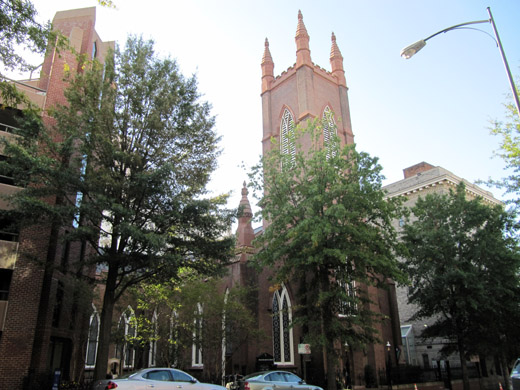
Crammed between newer buildings on 5th Street is the Second Presbyterian Church, completed in 1848. Here, we’re told, the first pastor “proclaimed that he was ‘tired of Grecian temples with spires on them'” and “determined to build the first Gothic church in Richmond, a city noted for its classic Greek architecture. His building committee persuaded the noted New York Architect Minard Lafever, one of the leading masters of the Gothic Revival in America, to design the building.”

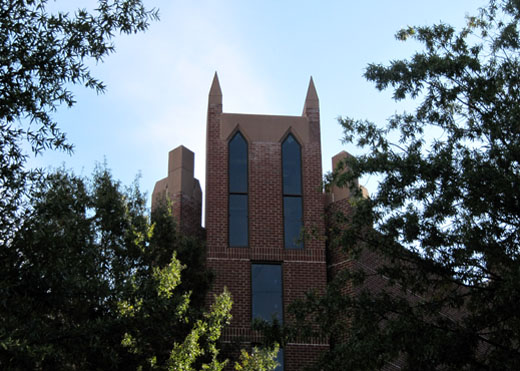
Ages later, the parking deck next door feebly acknowledges its Gothic elder.

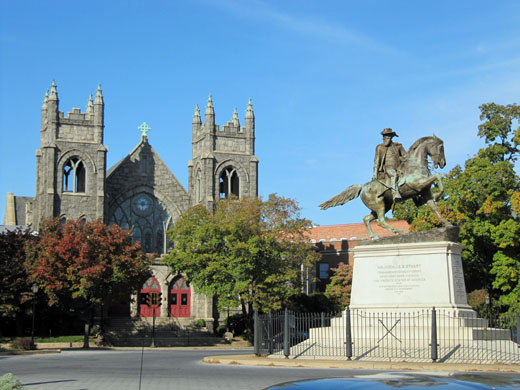
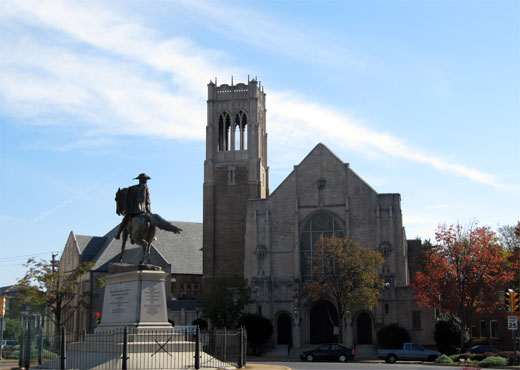
Old buildings in Richmond favor classical and Federal styles intermingled with eclectic Victoriana, but on the eastern edge of Monument Avenue, Jeb Stuart, statuesque, presides over a Gothic revival.

It’s the right assignment for a general whose biographer calls him “the Confederacy’s knight-errant . . . Amid a slaughterhouse, he had embodied chivalry, clinging to the pageantry of a long-gone warrior. He crafted the image carefully, and the image befitted him. He saw himself as the Southern people envisaged him. They needed a knight; he needed to be that knight.”

Around the statue of Stuart rise the First English Lutheran Church (above), St. John’s UCC (below), and Grace Covenant Presbyterian (photo).

Here, the Gothic fought the Federal to a standstill, if only in facades.

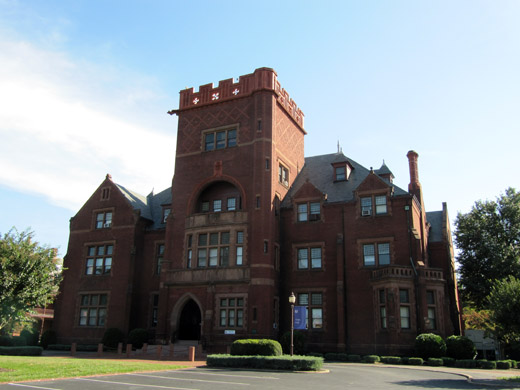
On the north end of town, at Union Presbyterian Seminary, whimsy is the prime mover at Watts Hall, designed by Charles H. Read and built in 1897. Gleefully asymmetrical, Watts is one of those buildings that gets weirder the longer you look at it.

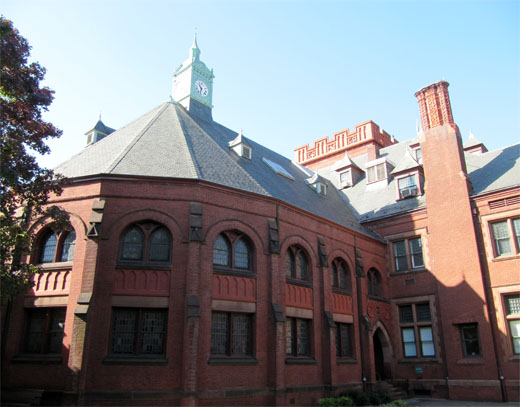
With its buttresses and blind triforium (those little rows of fake indented windows), its chapel could, at first glance, almost pass for medieval, but for that clock tower…

…and the quatrefoil-mad chimneys with wild Corinthian capitals.

Still, one terrific detail on the front of Watts Hall is all-American Gothic, perhaps befitting an age in which religious architecture is no longer a prominent carrier for medievalist ideas:

A lone grotesque, fleeing the scourge of theology.

“And they burned up the diner where I always used to find her…”

Autumn dawns, a new week begins, and clever links abound.

An obscure Old French translation of Ovid is finally being translated into English.

University Diaries leads you through “Sublunary,” a poem by A.E. Stallings.

Dylan pens a poetic paraphrase of Goethe.

Hats & Rabbits spins a parable: rabbit in a cage.

First Known When Lost finds a Wallace Stevens poem set in early fall.

Laudator Temporis Acti posts a sonnet by Francisco de Quevedo.

D.G. Myers recommends the novel Stoner.

Jason Fisher previews Tolkien and the Study of His Sources.

Steve Donoghue hails a niche Star Trek novel.

Patrick Kurp notes a federal bureaucrat, Latin translator, and formalist poet.

The New Criterion knows poems resemble jokes. (Hat tip: Frank Wilson.)

Jake Seilger reviews The Magician King.

Mental Floss unwinds an oral history of the American soap opera.

Classical Bookworm measures The Whole Five Feet.

Overthinking It explores the political economy of My Little Pony. (Hat tip: Prof Mondo.)

The Gaslight Anthem, one of my hometown bands, shares “Great Expectations.”