“Well, it’s a long way to Richmond, rollin’ north on 95…”

Before the Civil War, Richmond was, in the words of historian Rollin Osterweis, the “intellectual headquarters” of the upper South. In days of yore, it was also, not by chance, the regional capital of trendy medievalism.

In a state formed by the manners and patterns of English life, the Richmond-based Southern Literary Messenger (edited by Edgar Allan Poe) reinforced the romanticism of its readers by treating them to Gothic yarns, the pageantry of Sir Walter Scott, the thought of Thomas Carlyle, and, in the twenty years before the Civil War, mountains of chivalric poems. The wealthy in and around antebellum Richmond adored chivalric pageants and tournaments; by the 1850s, writes Osterweis, “[i]nstead of longing awkwardly for the days of knighthood, the gentry is now convinced that it is living in them.”

This weekend, I was honored to be a guest at the annual James River Writers Conference, an event hosted by what may be the most hospitable writers’ group in the country. New to a city that was once obsessed with knighthood, courtliness, and English heritage, I took advantage of glorious weather to track down charming traces of old, neo-medieval Richmond.

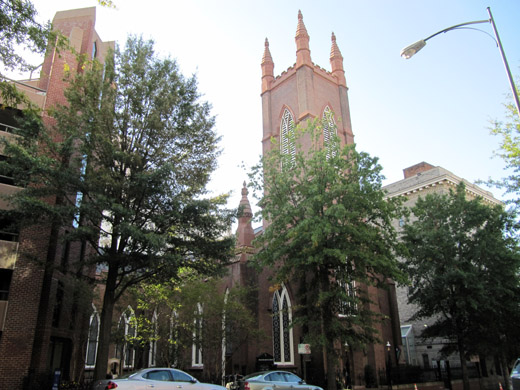
Crammed between newer buildings on 5th Street is the Second Presbyterian Church, completed in 1848. Here, we’re told, the first pastor “proclaimed that he was ‘tired of Grecian temples with spires on them'” and “determined to build the first Gothic church in Richmond, a city noted for its classic Greek architecture. His building committee persuaded the noted New York Architect Minard Lafever, one of the leading masters of the Gothic Revival in America, to design the building.”

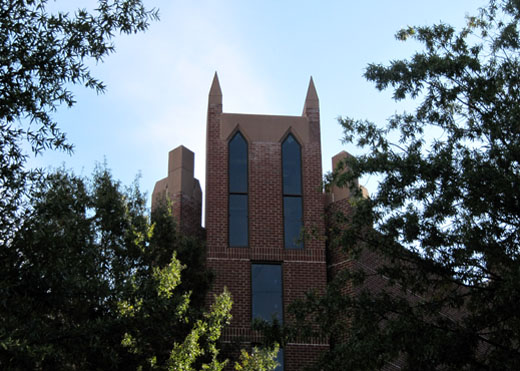
Ages later, the parking deck next door feebly acknowledges its Gothic elder.

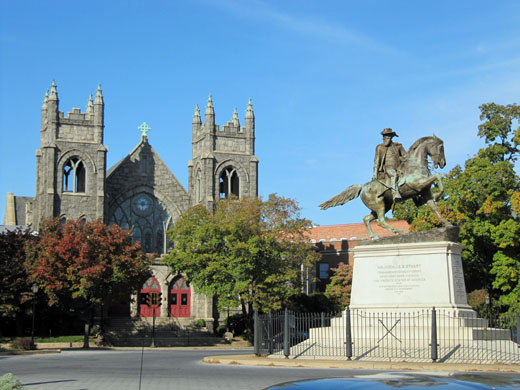
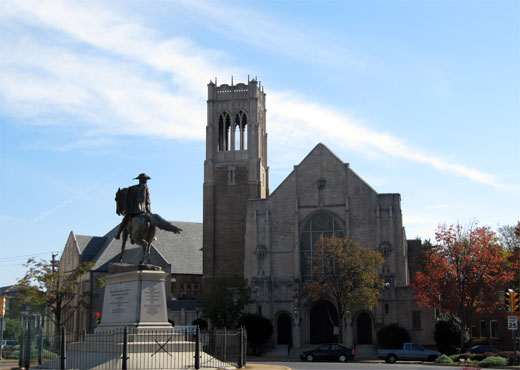
Old buildings in Richmond favor classical and Federal styles intermingled with eclectic Victoriana, but on the eastern edge of Monument Avenue, Jeb Stuart, statuesque, presides over a Gothic revival.

It’s the right assignment for a general whose biographer calls him “the Confederacy’s knight-errant . . . Amid a slaughterhouse, he had embodied chivalry, clinging to the pageantry of a long-gone warrior. He crafted the image carefully, and the image befitted him. He saw himself as the Southern people envisaged him. They needed a knight; he needed to be that knight.”

Around the statue of Stuart rise the First English Lutheran Church (above), St. John’s UCC (below), and Grace Covenant Presbyterian (photo).

Here, the Gothic fought the Federal to a standstill, if only in facades.

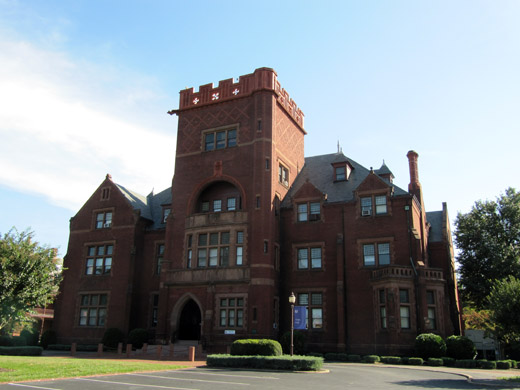
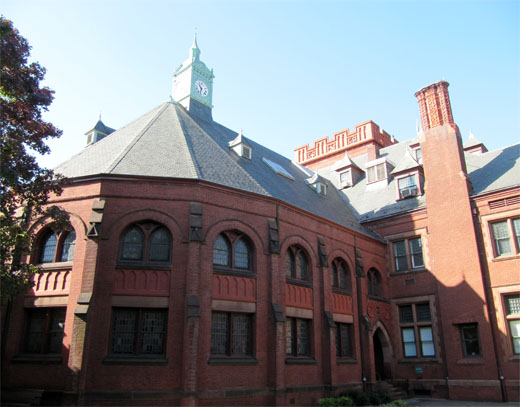
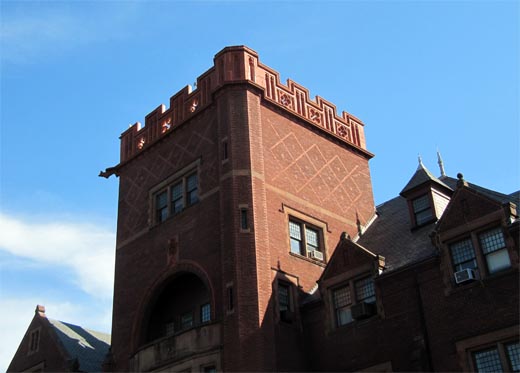
On the north end of town, at Union Presbyterian Seminary, whimsy is the prime mover at Watts Hall, designed by Charles H. Read and built in 1897. Gleefully asymmetrical, Watts is one of those buildings that gets weirder the longer you look at it.

With its buttresses and blind triforium (those little rows of fake indented windows), its chapel could, at first glance, almost pass for medieval, but for that clock tower…

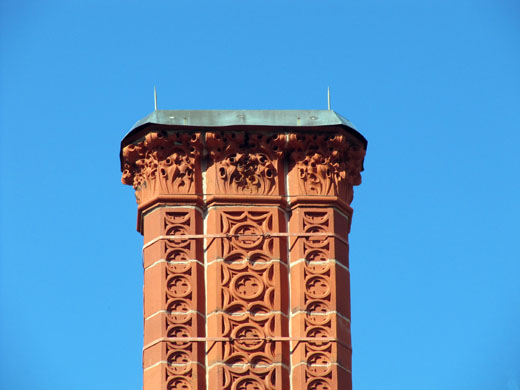
…and the quatrefoil-mad chimneys with wild Corinthian capitals.

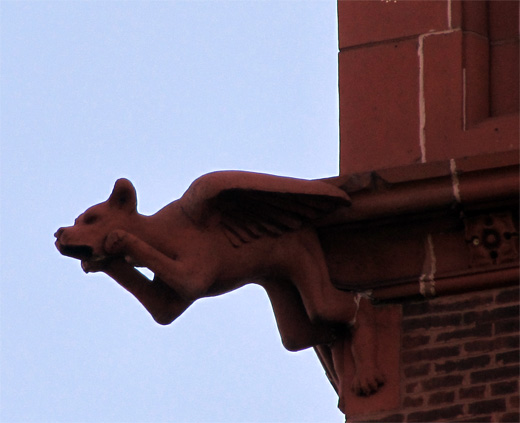
Still, one terrific detail on the front of Watts Hall is all-American Gothic, perhaps befitting an age in which religious architecture is no longer a prominent carrier for medievalist ideas:

A lone grotesque, fleeing the scourge of theology.

“And they burned up the diner where I always used to find her…”

Autumn dawns, a new week begins, and clever links abound.

An obscure Old French translation of Ovid is finally being translated into English.

University Diaries leads you through “Sublunary,” a poem by A.E. Stallings.

Dylan pens a poetic paraphrase of Goethe.

Hats & Rabbits spins a parable: rabbit in a cage.

First Known When Lost finds a Wallace Stevens poem set in early fall.

Laudator Temporis Acti posts a sonnet by Francisco de Quevedo.

D.G. Myers recommends the novel Stoner.

Jason Fisher previews Tolkien and the Study of His Sources.

Steve Donoghue hails a niche Star Trek novel.

Patrick Kurp notes a federal bureaucrat, Latin translator, and formalist poet.

The New Criterion knows poems resemble jokes. (Hat tip: Frank Wilson.)

Jake Seilger reviews The Magician King.

Mental Floss unwinds an oral history of the American soap opera.

Classical Bookworm measures The Whole Five Feet.

Overthinking It explores the political economy of My Little Pony. (Hat tip: Prof Mondo.)

The Gaslight Anthem, one of my hometown bands, shares “Great Expectations.”

“…and stained in the blood of a whole generation.”

In Icelandic sagas, it’s not an uncommon motif: Clinging to old ways, warriors flail as the heroic code that defines their lives gives way to something new and strange. Perhaps that’s how lifelong soap fans feel this week, as All My Children succumbs to cancellation after nearly 42 years, while its doomed elder sister, One Life to Live, glares anxiously into its grave.

Baby swaps, preposterous wealth, evil twins, travels through time—soaps are easy to mock, but their sheer continuity is remarkable. (Making All My Children and One Life to Live look like pikers, Guiding Light began on radio in 1937 and wasn’t snuffed out until 2009.) Most of us, medievalists especially, can point to the survival and adaptation of stories across decades and centuries and cultures—Arthurian legends, Icelandic sagas, the Song of Roland—but except for comic strips, I’m hard pressed to think of another example of continuous storylines unfolding five days a week for more than 40 years, sometimes pleasing their audience, sometimes not, rolling with the culture while aspiring, sometimes, to universality:

It starts on a quiet note with a group of people, neither particularly good nor particularly bad, who, because they are the way they are, clash with each other; not violently, but sufficiently hard to cause ill-feeling. This casual ill-feeling is transmitted to kinsmen and descendants, to friends and to allies. More and more people become involved, with fatal results…The early actors of the drama fade out, but the troubles they have started now seem to have a life of their own, until the action is galloping headlong, with brief tantalizing pauses where control seems to have been momentarily asserted, from minor mishap to major tragedy, until finally its inevitable impulse is exhausted in the last elegiac chapter.

That’s from Magnus Magnusson’s introduction to the 1959 Penguin Classics edition of Njal’s Saga, and it’s as fine a summary of the arc of a family saga, medieval or modern, as any you’re likely to find.

Even if the Cortlandts and the Chandlers never shed blood at the Law Rock, and although Erika Kane (who once faced down a grizzly bear) might quail before the ornery, resilient Hallgerd, there’s no harm in hearing outlandish medieval echoes in the death cries of a genre. The soaps’ own echoes carry on; they showed prime-time TV producers the potential of serialized rather than episodic storytelling, and early on, they crowdsourced plot twists to indefatigable fans.

Of course, the medieval/soap-opera connection has been common knowledge since 2009, when a courtly-love subplot on General Hospital showed that at least one of its writers has taken a medieval lit class. As such, we can only wish the citizens of Pine Valley a safe journey into the television afterlife, and hope that there, unlike in medieval Iceland, “face-lift” means something entirely kind.

“…come crashing in, into my little world.”

The standard line on this fellow is that he’s “refusing to listen to the word of God,” but since he lives on the highest point of a town that thrives on nonsense and noise, I imagine something else has got him all worked up.

TANTUM DIC VERBO

For peace, be still—and let me chase
One paltry prayer unforesworn:
Is grace alone in silence born,
Or else is silence born in grace?

Your craws, your pealings, plaints, and croaks
Resolve my riddle not; you claim
I hearken not? Then whet your blame
On yeas and yawps, whose wasting chokes,

Excruciates, my aching ear,
Be still—the prate of grating chords
Reproves me not, your feint rewards
Me not—and yet I hear, and hear,

And hear, though to the gargling round
My riddles read as coarse complaints:
“Avenge, O Lord, thy slaughter’d saints,”
They canter, lest my quest confound

The noise that lauds their long regret.
I plead you, peace—and beg your fray
Be still, and in your silence pray
For grace, to bear my silence yet.


(For all the entries in this series, hit the “looking up” tab, or read the gargoyle FAQ.)

“In the distance, the city lights flickered in the bay…”

In September skulks, nudging out the summer with books, buses, and damp autumn air. In with it, too, drift interesting links.

Jake Seliger isn’t surprised that technology doesn’t always foster education.

The Book Haven admires Churchill in the 1930s.

“Why I’m giving up Twitter and Facebook”: Hugh MacLeod hopes to reclaim blogging.

Steve Donoghue hears country music in Erec and Enide.

Tarzan fans, meet Imaro, the star of Charles Saunders’ heroic fantasy set in Africa.

Jason Fisher’s new book is out: Tolkien and the Study of His Sources: Critical Essays.

Fiat Lingua! The Language Creation Society creates a journal.

Michael Lista hears his heartbreak echoed in a villanelle.

Frank Wilson pens an earthquake poem.

The Trousered Ape invents a new poetic form: the nescopeck.

Dylan writes his own nescopeck and composes a Christian triolet.

The George Hail Library notes hypothetical carpenters in Tim Hardin’s famous song.

Martin Amis remembers Philip Larkin, his father’s friend.

Bill Peschel announces a new book: an annotated Whose Body? by Dorothy Sayers.

Hats & Rabbits ponders summer’s slow goodbye.

“I had to run away high, so I wouldn’t come home low…”

As a kid, I believed in the Jersey Devil. As an adult, I was surprised to spot him at the cathedral, but maybe I shouldn’t be. In our minds, most of us are rarely far from home.

GARDEN STATE LOVE SONG

Repent your flailing forkèd tail and brush
The wingbit crumbs, rewandring why you fled.
The must of menus nemdays made you flush
The tinct of Taylor ham, and wonder bred
A boldened kobold, who for lusher state
Regressed abroad to bask in devlish blight.
But now the mayfield double-garden-gate
That welked you wide, is barr’d. Thus ends your flight.
So must you bitter pandaemony sip,
And dine on lines of dower Greek alone?
“There is no road for you, there is no ship—”
Baloney. Lonely imps may yet atone
In vented verse: Old cauls, like murdrous birds,
Arise, as g’s fawl off the ends of words.


(For all the entries in this series, hit the “looking up” tab, or read the gargoyle FAQ.)

“My words trickle down, from a wound that I have no intention to heal…”

When the earthquake shook the National Cathedral on August 23, this bat-like beastie was damaged by falling stone. He clearly isn’t thinking straight; jilted, he may yet lose his head.

THEODICY
(DRÓTTKV
ÆTT)

rote & firmly formal,
first among the versed, we
spake no revolt, spelt our
spensings sans offenses.
dare we spect how dear my
dignant lord rewards me?
knife-stook bashes neck, &
never! I vow [bowing].

The broke-necked gargoyle on August 26, shot from the parking lot with a zoom lens…


…and photographed intact last summer from the observation deck:

(For all the entries in this series, hit the “looking up” tab, or read the gargoyle FAQ.)

“Look, a golden-winged ship is passing my way…”

Few cathedrals never know an earthquake. Most, like Lincoln, survive, with spires left unreplaced; others, like the cathedral in Christchurch, New Zealand, wearily face demolition after one earthquake too many. Tuesday’s quake gave Washington National Cathedral its first real rattle, knocking spires off the central tower, cracking buttresses, raining rubble onto the south transept steps, damaging a gargoyle, and probably causing damage yet unknown.

The rueful consolation of architectural history, both medieval and modern, is that it certainly could have been worse. In A.D. 1248, a busy year for crusading, church-state sparring, and all the usual duecento brouhaha, an earthquake hit England. Tallying up the year’s events in his Chronica Majora, the prolific monk Matthew Parris recorded the damage done to Wells Cathedral, around 20 miles southwest of Bath.

Here’s the original, for you Latinists:

Eodemque anno in Adventu Domini, scilicet quarto die ante Natale Domini, factus [est] terraemotus in Angia, ita ut, prout haec scribenti enarravit episcopus Bathoniensis, quia in ejus diocesi evenit, dissipatae sunt maceriae aedificorum, et lapides de locus suis avulsi in muris hiatus fecerunt patulos et rimas cum ruinis. Tholus quoque lapideus magnae quantitatis et ponderis, qui per diligentiam caementariorum in summitate ecclesiae de Velles ponebatur, raptus de loco suo, non sine dampno super ecclesiam cecedit; et cum ab alto rueret, tumultum reddens horribilem, audientibus timorem incussit non minimum. In quo etiam terrae motu hoc accidit mirabile; caminorum, propugnaculorum, et columpnarum capitella et summitates motae sunt, bases vero et fundamenta nequaquam, cum contrarium naturaliter debuit evenire. Et ille terraemotus tertius fuit, qui in triennio citra Alpes evenit; unus in partibus Sabaudiae, et duo in Anglia, quod ab initio mundi est inauditum, et ideo terribilius.

And here’s a quick translation:

That same year, during the Advent of the Lord, specifically on the fourth day before the Nativity of the Lord, there was an earthquake in England in which—as the bishop of Bath, in whose diocese it occurred, told this writer—the walls of buildings burst, and stones torn from their places left holes and cracks in ruined walls. The vaulted roof of the cathedral of Wells, set in place atop the summit through the diligence of masons and made of stones of great number and weight, was torn from its place, not without damage. It fell on the church, collapsing from on high and making a terrible crash that struck not a little fear in those who heard it.

During this earthquake, a wonder occurred: The peaks and summits of chimneys, ramparts, and pillars were dislodged, but the bases and foundations were not, although naturally, the contrary should have occurred.

This earthquake was also the third in three years to occur on the near side of the Alps, one in Savoy and two in England, a thing unheard of since the beginning of the world and thus that much more terrible.

Wells Cathedral survived, but its architectural future wasn’t placid. In the early 14th century, just a few decades after the earthquake, a new central tower cracked and seemed ready to collapse until a mason named William Joy invented a solution: scissor arches.

For nearly five years, I’ve written blog posts about the National Cathedral, finding Charlemagne’s heirs in the Bishop’s Garden (and butterfly amour there too) while taking autumn snapshots, looking into bloomin’ Arthuriana, admiring the spires draped in whimsical light, and tracing the building’s architectural kinship with a facade across the street. Then, of course, there are those nearly 40 poems about the gargoyles.

If you’ve enjoyed any of this stuff, please consider making a donation to help fix my favorite medievalist neighbor. The repairs are expected to cost millions, and structural engineers are “daunted by the idea of finding a way to repair such massive pieces so high up.” I suspect that like William Joy before them, these modern architects and masons will find ingenious solutions, but their work won’t be covered by insurance, so please drop a coin or two in the collection plate; you’ll be helping to restore a monument to the enduring influence of the Middle Ages. And if you’re feeling cheeky, you might insist that a gargoyle sent you.

“All around the world, statues crumble for me…”

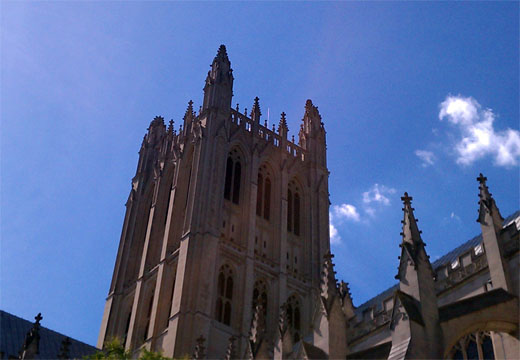
Contrary to CNN’s breathless claims an hour ago, today’s earthquake did not cause gargoyles to fall off the National Cathedral. However, the spires on the main tower sustained some damage. In the photo below, note the blunted spire on the left and the cockeyed one on the right; the building lost at least three pinnacles.

I spotted what may have been a section of broken stained glass, some rubble on the stairs where part of a spire reportedly fell, at least one other missing piece of ornamental stonework, and cathedral administrators anxiously surveying the foundation for signs of more serious damage.

The yellow-tape perimeter grew larger between 2 and 4 p.m., but the gargoyles all seem to be intact, which isn’t surprising; there’s at least as much unseen stone anchoring each one to the building as there is sticking out of the side.

Those of us for whom the cathedral is indispensable hope that the damage doesn’t extend beyond what we can see.

UPDATE, 10:55 p.m.: The Atlantic Wire has photos of damage at the higher levels and inside the cathedral.

UPDATE #2, AUGUST 24, 2011: The cathedral has a website devoted to earthquake damage; they’re soliciting funds to help with repairs.

“Catch the mist, catch the myth…”

Mark Twain was beguiled by medieval minds. Most Americans remember his satiric use of medieval spolia in A Connecticut Yankee in King Arthur’s Court, but Twain returned to the Middle Ages with telling regularity. He celebrated the jubilee of Queen Victoria by writing in the voice of a noble at a 1415 Agincourt victory parade, and he considered Personal Recollections of Joan of Arc his favorite of his own books. Like many late 19th-century Americans, even non-Catholics, Twain was obsessed with the French saint, finding “no blemish in that rounded and beautiful character” and calling her “easily and by far the most extraordinary person the human race has ever produced.”

Later, Twain taught his children medieval English history by linking pictures to pathways in his yard, and he even journeyed to Bayreuth, where his only mild appreciation of Wagner’s Tannhauser and Parsifal made him feel “like a heretic in heaven,” even as he declared the pilgrimage “one of the most extraordinary experiences of my life.”

As Twain knocked around Europe, he sometimes grumbled when the Middle Ages intruded on his vision of a more rational world. In Switzerland, after hearing a tale about a skeleton who testified in a medieval trial, he spat that it spoke of “a time so remote, so far back toward the beginning of original idiocy, that the difference between a bench of judges and a basket of vegetables was as yet so slight that we may say with all confidence that it didn’t really exist.” Still, even Sam Clemens, hostile to notions of nobility, could get swept up in the romanticism of Europe’s medieval past, provided it stayed on the far side of the Atlantic.

I pondered Twain’s medievalism last week while passing through Baton Rouge, a city he knew from his riverboat days. In Chapter 40 of Life on the Mississippi, Twain revisits the city, alive with magnolia blossoms: “For we were in the absolute South now—no modifications, no compromises, no half-way measures.” Like Twain, I found “a tropical sun overhead and a tropical swelter in the air,” and one of his more memorable rants still hanging in the August haze:

And at this point, also, begins the pilot’s paradise: a wide river hence to New Orleans, abundance of water from shore to shore, and no bars, snags, sawyers, or wrecks in his road.

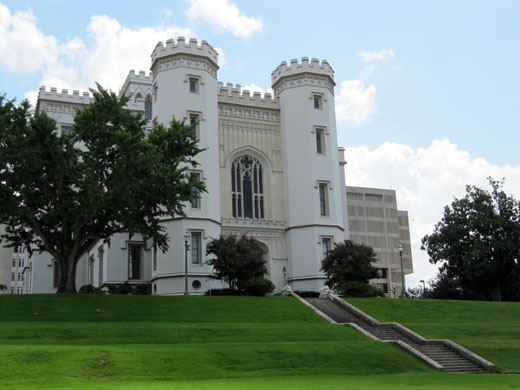
Sir Walter Scott is probably responsible for the Capitol building; for it is not conceivable that this little sham castle would ever have been built if he had not run the people mad, a couple of generations ago, with his medieval romances.
The South has not yet recovered from the debilitating influence of his books. Admiration of his fantastic heroes and their grotesque “chivalry” doings and romantic juvenilities still survives here, in an atmosphere in which is already perceptible the wholesome and practical nineteenth-century smell of cotton-factories and locomotives; and traces of its inflated language and other windy humbuggeries survive along with it.

It is pathetic enough, that a whitewashed castle, with turrets and things—materials all ungenuine within and without, pretending to be what they are not—should ever have been built in this otherwise honorable place; but it is much more pathetic to see this architectural falsehood undergoing restoration and perpetuation in our day, when it would have been so easy to let dynamite finish what a charitable fire began, and then devote this restoration-money to the building of something genuine.
[. . .]

By itself the imitation castle is doubtless harmless, and well enough; but as a symbol and breeder and sustainer of maudlin Middle-Age romanticism here in the midst of the plainest and sturdiest and infinitely greatest and worthiest of all the centuries the world has seen, it is necessarily a hurtful thing and a mistake.

* * *

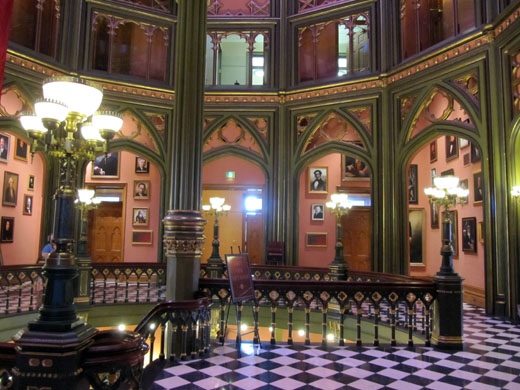
That’s Louisiana’s Old State Capitol, designed in a “castellated Gothic” style by New York-born James Harrison Dakin in 1847 and open for business (albeit 400 percent over-budget) by 1850. The designer of several neo-Gothic churches and college buildings, Dakin hated the idea of another derivative neoclassical statehouse and opted for a Capitol with “a decided distinctive, classic, and commanding character.”

Since the Civil War, the Old State Capitol, occupied and almost accidentally burned down by Union troops, has been stuck in a cycle of abandonment, decay, destruction, renovation, and rebirth. Although Twain recalled a “whitewashed castle,” Louisianans who picked up Life on the Mississippi between 1883 and 1902 knew a bolder folly, painted red and festooned with iron turrets that even I find excessive.
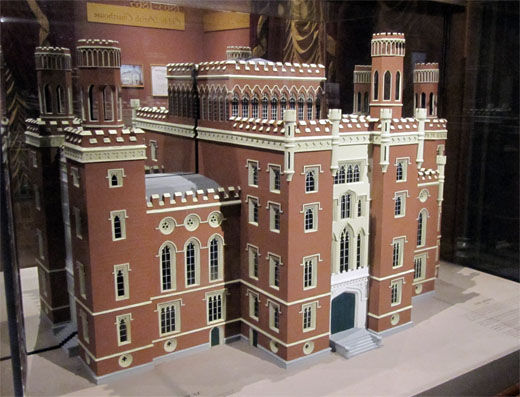
The people of Louisiana appear to have adored the Old State Capitol, but one political giant shared Twain’s hatred of the place: Huey Long. As governor, Long left the building’s fire insurance unrenewed, believing—perhaps hoping—that “it was about to fall down, and there was nothing left to patch,” according to Carol K. Haase. “He said there wasn’t another building in the whole country that was such a disgrace and that he wouldn’t pay twenty-five dollars for the whole thing.”

By 1932, a new capitol, an art-deco skyscraper, loomed over Baton Rouge. Twain would have been pleased. Infuriated by the stubborn Southern medievalism exemplified by plantation owners’ obsession with the works of Sir Walter Scott—more on that in a future post!—he wanted to see Americans spell out their culture in a homegrown, progressive idiom, shorn of courtiers and kings. After sighting the emperor’s daughter-in-law in Bavaria in 1891, Twain found her beautiful, kind, and humane, which troubled him all the more. “There are many kinds of princesses,” he sighed, “but this kind is the most harmful of all, for wherever they go they reconcile people to monarchy and set back the clock of progress.”

Browsing Life on the Mississippi and The Complete Essays in recent days, I’ve been impressed by the breadth of Twain’s knowledge and insistent rationality—but I’m also struck by also by how badly he misjudged the grip of medievalism on the American mind. Even as Twain mocked, in that same chapter of Life on the Mississippi, an advertisement for a Tennessee finishing school that played up its “resemblance to the old castles of song and story, with its towers, turreted walls, and ivy-mantled porches,” the United States was on the verge of a 40-year “collegiate Gothic” building binge that makes Twain seem far from prescient about his era and the culture of the century since. Were Twain to hear my four-year-old niece swooning over the Old State Capitol in Baton Rouge, he’d be despondent. “It’s like a real castle, where princesses live,” she gushed to an amazed friend. “I wish I could go back tomorrow. I wish I lived there.”

Like many Americans, Twain wandered the medieval world of his own imagination; it’s both humanizing and absurd that he thought he could write new lives for saints and kings without stirring the waves of medievalism that ceaselessly lap at American shores. His ambivalence also shows that you don’t need to like the Middle Ages to be a medievalist, as long as you fancy yourself that rare, rational aesthete who can thrill to monarchical pageantry without endorsing monarchies themselves. “One can enjoy a rainbow,” Twain claimed, suppressing a romantic twinge, “without necessarily forgetting the forces that made it.”