“In my blue heaven, there’s a bottle of Pontchartrain…”

I’ve never known what alligators dream. Apparently, it’s simple: “Laissez les bons temps rouler.”

CANAL STREET

When George leans back and waives his wyrmbent blade,
When golden Joan rolls up her banns of war,
When late Ignatius lutes his last crusade,
When Roch counts no more crutches by the door,
Then daub our brow with dust—but not today,
As saints salaam to every passing king
And all our sins are snatched and strewn away
Like bright, beloved beads that slip their string.

(For all the entries in this series, hit the “looking up” tab, or read the gargoyle FAQ.)

“Crossing the central reservation of my imagination…”

And so February ends with a work-weary sigh. Thanks for checking in! If life doesn’t continue to intervene, expect posts in March about barbarian poets, the medievalism of World War II—and, of course, a few more gargoyles.

Until then, find ye here some spiffy links.

If you love Njal’s Saga, why not take a scholarly tour of saga country on horseback?

If you haven’t yet read the first part of Adam Golaski’s funky new translation of “Sir Gawain,” what are you waiting for?

E-book publishing for medievalists might get easier with the debut of Witan Publishing.

Writer Beware helps make sense of the Borders bankruptcy filing.

Book Haven thinks about, like, the culture of vagueness and stuff.

Kevin at Interpolations reads a famous Whitman line in context.

Welcome to the Web, Washington Independent Review of Books.

Is Washington “death city” for one novelist?

Historians writing for non-scholars will dig the new Electrum Magazine.

Chris at Hats & Rabbits wins me over by explaining, mirable visu, why he doesn’t blog about the news.

Flavia contemplates grief, mourning, and the elusiveness of “closure.”

Inimitable fantasist Anna Tambour invites you to read her new book.

Tolkien fans await Verlyn Flieger’s collected essays.

The Silver Key kicks around nihilism in fantasy.

Jake Seliger offers a bevy of book-related links.

Castle Dragonscar remembers 1970s fantasy art.

“I’m no exception, please call my name…”

Some messengers are ambivalent about their own calling. This one perches 175 feet up, high above the birdwatcher, just below Medusa, and weirdly close to angels.

APORIA

Rilke from his rampart: Beauty’s naught
But terror’s dawn.
Then why do mirk-mites wrought
From strofe and stub, Creation’s afterthought,
Squat seraph-like on spits above the earth:
To herald terror’s end, or stress the birth

Of idle envoys? Will my gaze reverse
The pattern, roughly swat the form aright,
Or only skew the catachresis worse
For pious poets? Dismal in whose sight
We loom in low, like pests, and while you write
Like angels on a book-shelf in Berlin

We stand and wait for nothing to begin.

(For all the entries in this series, hit the “looking up” tab, or read the gargoyle FAQ.)

“I was walking in the park, dreaming of a spark…”

“You ask if I love you,” Charlemagne famously wrote to Queen Fastrada from the Avar front. “What can I say? You know that I do, and that this is just one of those games that we play.” The occasion for that letter was Valentimes, a little-known Frankish observance held on February 13 to honor a Roman citizen whose martyrdom in the jaws of a vicious bear was, historians now believe, a case of mistaken identity. Although little is known about Valentime, the Vatican recently named him the patron saint of supermodels and the illiterate, and the memory of his martyrdom lingers in a centuries-old custom by which undemonstrative men send costumed toy bears to their lovers as tokens of affection.

Those of us who harbor a passion for historical accuracy will observe Valentimes Day with ursine solemnity. However, because the spirit of Valentime demands that we tolerate misguided readers who venerate saints of far more dubious provenance, we offer this bouquet of music videos about love and romance to get you through a highly emotional Monday.

The great Louis Jordan loved Caldonia in spite of himself.

Neil Finn could have told him: she will have her way.

Boleslaus II may have fought for his people’s independence, but in the 1970s we recognized only one macaronic Polish prince: Moja droga, jacie kocham…

Roger Miller at his best: “Leavin’s Not the Only Way to Go.”

The year was 1985, and Kid Creole couldn’t answer a simple question: “Why can’t you be like Endicott?”

To my knowledge, there’s only country-western song about the effect of faster-than-light space travel on a long-distance relationship: “Benson, Arizona.”

What do you get when you filter an English nursery rhyme, the inexpressibility topos, and mid-1980s progressive rock through the liver of a disheveled Scotsman? “Lavender.”

Jersey guy Pat DiNizio puts a sober Smithereens spin on “Well All Right” by Buddy Holly.

Got halitosis before that big Valentimes date? Take a handful of Mighty Lemon Drops.

Guys, today isn’t the day to drunk-dial the girl you lost to cocaine.

John Waite, of all people, gives us a heartfelt cover of “Girl From the North Country.”

I didn’t think much of the Sting song “Fields of Gold.” Then I heard the late Eva Cassidy perform it.

“So I’ll sing you a new song…”

“You say I’m a dreamer; we’re two of a kind,” Charlemagne’s adviser Angilbert wrote to the king’s daughter Berta in A.D. 798, “both of us searching for some perfect world we know we’ll never find.” Angilbert and Berta went on to have children together, and Angilbert’s education ensured his prominence an abbot, administrator, ambassador, and poet in an otherwise imperfect world. Were Angilbert alive today, he’d likely endorse these interesting links.

Dame Nora wraps up “quince week” with some quince history, thoughts on quince marmalade, and a recipe. She also invents her own haggisy sausage.

The Cloisters blog nibbles on real plants in the unicorn tapestries.

Gabriele makes sense of the development of Roman helmets.

Ephemeral New York sights grotesques in Manhattan and shows you the long-shuttered City Hall station.

Steve Muhlberger reads the investigation of a modern jouster’s death. (Incidentally, Steve’s book about chivalric combat in the late Middle Ages just garnered some praise.)

Here’s a creepy fantasy tale about girldom: “Ponies.”

A philosopher-in-training meets an owl.

The Book Haven considers the kitchification of Vietnam and Joseph Brodsky and Egypt.

Just how is James Franco’s short-story collection?

Mark Athitakis peels back myths about J.D. Salinger’s crankiness.

Nicole at Bibliographing re-reads Laura Ingalls Wilder.

Debate time! James Gurney (whom I like) versus Frank Gehry (whom I don’t).

Jason unveils a new anthology of Tolkien source criticism.

Why not buy recordings of Old English poems? (I have ’em; they’re good.)

Leslie gives advice to the MFA-curious.

The “100 Reasons NOT to Go to Graduate School” blog serves up reason #43: changing attitudes.

Pete notes the dearth of fiction about finance.

Jake ponders imaginative career paths.

“A garden full of food will be my final contribution to the world…”

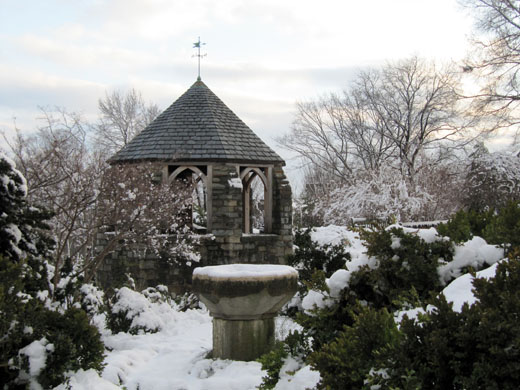
Regular readers of this blog may recall that part of the Bishop’s Garden is devoted to Walafrid Strabo, the Carolingian abbot and teacher best known today for De Cultura Hortorum, a poem about his garden at Reichenau. Walafrid was only in his early thirties when he drowned in 849 while trying to cross the Loire. This goat, apparently a medievalist, looks out over the garden and remembers him yet.

WINTER CANTICLE

Seminibus quaedam tentamus holuscula, quaedam
Stirpibus antiquis priscae revocare iuventae.
— Walafrid Strabo, Hortulus

As frozen fingers blunt the thorn,
So Walafrid was barb’rous born

But to that noble island brought.
There Walafrid a vision wrought

With falt’ring eye, but steady feet;
Yet Walafrid would fast retreat

To fertile slopes that front the east.
To Walafrid, to tend the least

Of bitter twigs was sweetest toil,
So Walafrid provoked the soil

To summon worms, and banish moles.
Ere Walafrid the care of souls

Attended, first he fathered roots;
So Walafrid, when bade by brutes

To court, would wall his fruitful mind.
There Walafrid was wont to find

That princelets spire like grasping vines;
And Walafrid tracked fraying lines

Of maidens’ woolspun, wound like gourds;
And Walafrid, when fraught by swords

Saw iris weigh her windblown blade;
And Walafrid left kings afraid

That striplings choke the root, like sage;
And Walafrid foresaw how rage

In bitter plots like wormwood grows;
Then Walafrid perceived in rows

Of scrabbled verse the reek of rue,
Which Walafrid perused, and knew

A soul his faith and friendship scorned.
Then Walafrid in silence mourned

Their idyll dawns, with leaf-light strewn;
But Walafrid prayed God the moon

Shone ghostly, sometime, on his face.
Lest Walafrid despair of grace,

He starved the flame, like seeds to drought;
And Walafrid dreamed long about

The flood, the torrent, murm’ring death;
Then Walafrid would gasp for breath…

Now wait, and watch the snow-bed yield
To branch and bramble unconcealed

That ache for thirst, but must bow down
To seed that drinks, but does not drown

As sprigs and spindrels long unseen
Entwine the font, and blinding green

And purple flash from wing to tree
And sepals spread to greet the bee

And raindrops burst in thick bright beads
And sun alights on lazing weeds

Where column-bright, the lily grows
And raises morning o’er the rose

That marks the day when winter dies;
Then Walafrid, refreshed, will rise.


(For all the entries in this series, hit the “looking up” tab, or read the gargoyle FAQ.)


“So I cut some cord, and I shouldn’t have done it…”

The southwest tower is haunted by a skeletal horse. Few people see it, but at sunset, you might hear it sing.

KINDERLIED

As I was riding to Banbury Cross,
Lazily lilting of lovers in loss,
Out swept a seeress who sneered down her nose:
“He shall have music wherever he goes.”

As I was riding to Banbury Square,
Twined in a tribute to tumbledown hair,
Out skipped a maid: “Are you singing for me?”
Studied and sober, I stared at the sea.

As I went riding to Banbury Street,
Rhyming a romance with riddles replete,
Out slouched a spinster: “Perchance it’s my day?”
Crabbed and confounded, I cursed the delay.

As I was riding to Banbury Lane,
Poignantly piping of passion and pain,
Out shuffed a widow: “Can you see his face?”
Piqued and impatient, I parted apace.

As I went riding to Banbury Road,
Wide by the wayside that wisdom bestowed,
Out rose a hymn: Every rapturous word
Rang through the alleyway. Nobody heard.


(For all the entries in this series, hit the “looking up” tab, or read the gargoyle FAQ.)
“We are, we are, we are but your children…”

A couple years ago, I thought I’d closed the book on Charlemagne, but current events will forever conspire to take me back to dear old Francia—like this story from today’s New York Times:

New Year’s Surprise: 4,000 Dead Blackbirds

Times Square had the ball drop, and Brasstown, N.C., had its descending possum. But no place had a New Year’s Eve as unusual — and downright disturbing — as Beebe, Ark.

About 10 p.m. Friday, thousands of red-winged blackbirds began falling out of the sky over this town about 35 miles northeast of Little Rock. They landed on roofs, roads, front lawns and backyards, turning the ground nearly black and scaring anyone who happened to be outside.

“One of them almost hit my best friend in the head,” said Christy Stephens, who was standing outside among the smoking crowd at a New Year’s Eve party. “We went inside after that.”

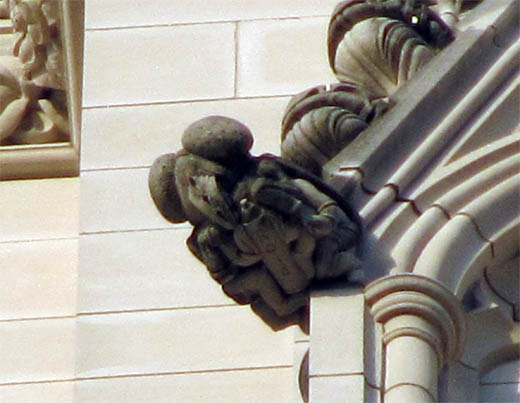
Noting that there’s nothing new under the Arkansas sun, Scott Nokes at Unlocked Wordhoard points out that the Anglo-Saxon Chronicle mentions a massive avian death-fest in A.D. 671. He’s right—but let’s also not forget Theodulf of Orleans and his very odd poem, “The Battle of the Birds.”

Readers of this blog know Theodulf as a witty poet who served as bishop of Orleans during the reign of Charlemagne. In his later years, the old Goth was implicated in a plot against Louis the Pious, and he spent his exile pleading his innocence and composing a lengthy poetic epistle to Moduin, bishop of Autun. In what appears to be a murky personal and political allegory (Dümmler, MGH Poetae I, 563-569), Theodulf dwells first on a weird story about a dry river and then spins two yarns about flocks of birds that clash like ancient armies.

In verse rich with allusions to classical warfare, Theodulf describes the birds dispatching envoys back and forth and then rushing to slaughter each other like Romans and Phoenicians. Here’s what Theodulf claims an eyewitness, Gerard, told his informant, Pascasius, about the aftermath:

Glans cadit autumno veluti de stipite querna,
Maturum et folium iam veniente gelu,
Non aliter avium moriens exercitus illic
Decidit et magna strage replevit humum.
Nam teres aestivis impletur ut area granis,
Campus ita extincta sic ave plenus erat.
A borea in boream veniens pars parva reversa est;
Tota in utraque cohors parte perempta iacet.
Res sonat ista, venit populus factumque stupescunt,
Mirantur variae membra iacentis avis.
Ipse Tolosana praesul quoque venit ab urbe
Mancio; plebs rogat, haec ales an esca fiat.
“Inlictis spretis, licitas adsumite,” dixit.
Plaustra onerant avibus, in sua quisque redit.

(Here’s my own quick translation)

As autumn acorns drop from oaken branch
And old leaves yield before the coming frost,
In no contrary way that troop of birds
Did fall, and such great slaughter filled the earth.
Like summer grain on polished threshing floors,
The battlefield was strewn with slaughtered birds.
A few that flew from north were northward turned;
On either side, a cohort lay, all dead.

The word went out. The folk drew round, amazed,
And marveled where lay limbs of different birds;
The bishop of Toulouse came from the town.
“Are wingéd omens edible?” they asked.
“Leave what’s proscribed, take what’s allowed,” said he.
Their wagons packed with birds, they headed home.

There’s no evidence that Theodulf’s third-hand anecdote was based in reality, nor is it the source for the pseudo-Charlemagnian quip, “Let my armies be the rocks and the trees and the birds in the sky.” Alas, in this case, medieval precedent isn’t very instructive. My only hope is that the good people of Beebe, Arkansas, will seek advice from someone other than their local bishop when they ponder the edibility of creatures that plummet en masse from the sky.

“Talkin’ jivey, poison ivy…”

Someone recently asked me if I thought gargoyles get bored. Spend a morning with the three-headed dog on the south transept, and then you tell me.

THREEPIPHANY

A martyr
sees saints circumambulate smarter
while legates who pult at the wall
fall.

A yeoman
scabs each sanguinarial omen
while canons for ungilded stone
moan.

A maiden
with sopp’d weialálas is laden
while posers who fish for the ring
sing.

A traitor
spins Fortune against her creator
while cold consolation reveals
wheels.

A seeker
finds calxiform beacons burn bleaker
while knaves see the weary-all thorn
born.

A fogey
dares cymricize non-mabinogi
while teardrops round wasting Mac Cool
pool.

A quester
lets pentacled purities fester
while gomish virídescent axe
whacks.

A hero
rounds duodenáry to zero
while Argonauts freighted to fail
sail.

A phony
maraunders in blind Laestrygóny
while fesseries dredge to exhume
Bloom.

A ptotic
turns thlebrous Caváfy demotic
while Sclepius hectors his snake
wake.

A portal
makes polycephálics immortal
while rhymers who rage in the dark
bark.


(For all the entries in this series, hit the “looking up” tab, or read the gargoyle FAQ.)

“Turn the clock to zero, honey…”

[This post originally ran two years ago, but repeating it feels like a fine way to welcome 2011.]

From time to time, I dig through the poetry of Theodulf, ninth-century bishop of Orleans, looking for nuggets to translate. Theodulf was a wit, so I’ve had fun making modern English versions of his Latin verses about pilgrimages, libations, wildlife, stolen horses, and children’s dreams. But what, I wondered, could Theodulf do for me on New Year’s Day?

I shouldn’t have worried; the old Goth didn’t let me down. In the middle of a dull poem about faith, hope, and charity (Dümmler, MGH Poetae I, 466-467), I found four lovely lines of Latin, and I plucked ’em:

Nam pia dona spei tereti signatur in ovo,
Tegmine obumbratum quod vehit intus habens:
Ut pullum ova tegunt, sic spem praesentia celant,
Hic patet exutus, illa futura parat.

With the reckless optimism of a Leyendecker baby, I give you this translation:

To see the blessed gift of hope, behold
The egg that keeps a secret in its shell:
The present, hiding hope, conceals it well;
The future cracks it: tiny wings unfold.

Those of you who read Latin are shaking your heads at this rather free rendering. So be it! It’s a new year! Old habits limp to their graves, ashamed! Besides, I did some research and found that these four lines have been translated repeatedly throughout the centuries, often by poets who took far greater liberties than I did.

For example, here’s a little-known translation by Langston Hughes:

THEODULF AT THE 125th ST. DINER

The sunny side
An egg supplied
Upon t’morrow gambled.
It hides in a shell
That poached it well
And never got it scrambled.
The present keeps our dreams deferred.
The future hatches: out pops a bird.

And here—dear reader, I was as astonished to discover it as you surely are—is a translation of Theodulf by none other than T.S. Eliot:

PERTELOTE SENESCENS

The sea-birds race inland from the storm
Above the subtile chicken seeking quiet in the barn
Where she dares not hope
“Lasciate ogne speranza, voi ch’intrate“—
But for the egg:
The shell conceals our tatterdemalion past—
The shell incubates our necessitous future
—and hope becomes a farmer
With shards of egg in his desquamative palm
Forgetting the recrudescent monotony of the plow, straining
To hear the eager peeping in the straw.

My translation isn’t looking quite so loose now, is it?

On behalf of Theodulf, T.S. Eliot, Langston Hughes, and a room full of imaginary chickens, I wish you a happy and recklessly hopeful new year.