“Walking back to you is the hardest thing that I can do…”

Sure, the average American associates this week with football, tryptophan, and noncommital nodding during awkward conversations about politics, but here at “QP?” headquarters, Thanksgiving means only one thing: experimental recreations of carrot jam from the medieval Islamic world.

Carrot jam? Yes, carrot jam. Known in Arabic as jawārish, the dish appears in a cookbook called The Treasure of Useful Advice for the Composition of a Varied Table, probably compiled in Egypt or Syria in the 13th century. The recipe is translated in Medieval Cuisine of the Islamic World by Lilia Zaouali, and while Islamic cookbooks are just as blithe as European cookbooks about assuming expertise on the part of the reader, this one seemed like a no-brainer. After all, sweet carrot dishes are common today, and carrot preserves and marmalade aren’t terrible exotic—so again we endeavor to answer, probably in vain: What did the past taste like?

First, our ingredients: cookbook, carrots, honey from a friend’s New Jersey apiary (plus two plastic-bear backups), various spices, and a can of Chef Boyardee Ravioli that had nothing to do with this recipe but whined about being left out of a group photo.

From the recipe:

It is necessary to select fresh, red carrots, to wash them, clean them, and cut them as thinly as possible. Put them in a ceramic pot, add a little bit of honey, and cover them with water.

Lacking red carrots, I had to go with plain old orange. Here they are, simmering in the Le Creuset like flunkies in Charlemagne’s bath house.

Thus sayeth the recipe:

Cook them until they are soft, then strain off the water with a sieve and add a quantity of skimmed honey equal to that of the carrots.

An hour later, a pound of carrots yielded around a cup and a half of carrot glop, to which I added one cup of honey. Rather than bore you with lame photos, let’s hail the return, by popular demand, of the Trapper Keeper Unicorn of Applied Paleobromatology.

Distracted by the hard work of mushifying a few carrot chunks with the aid of Sir Braun de Hand-Mixer, I failed to witness a shocking crime on the countertop behind me.

Did you know that the tradition of selling honey in bear-shaped containers derives from the Abbasid practice of importing actual bears from Europe, squeezing them while upside down, and seasoning food with whatever spurted from their skulls? The caliphs really were that wealthy.

The recipe calls for spices:

Mix in seasonings chosen from among pepper, ginger, cardamom, cinnamon, cubeb, spikenard, mace, galangal, aloe wood [Aquilaria agallocha], saffron, and musk.

Fresh out of spikenard, and stunned by the recipe’s endorsement of a freeform jazz odyssey of spices, I opted for four I knew I had in my cabinet: 1/4 teaspoon each of pepper, ginger, cardamom, and cinnamon. (I’m not positive that “pepper” in a medieval Middle Eastern recipe meant “ground black peppercorn,” but so be it.)
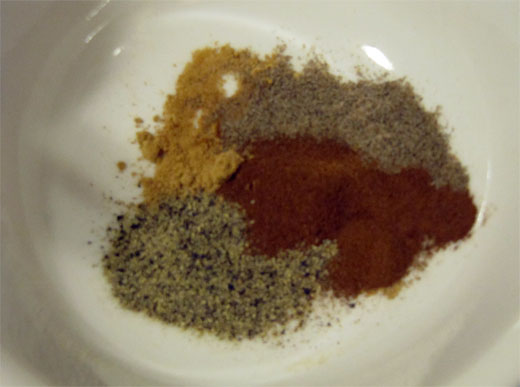
I mixed up this little masala, dropped it into the honey-and-carrot mush, and did as I was told:

Cook to thicken the carrot jam.

Twenty minutes later, carrot jam was bubbling like sweet orange lava.

Two teaspoons of spices turned out to be too strong for fewer that two cups of carrot jam, but holy hopping Barmakids, hot jawārish a la Sypeck is tasty.

Medieval Islamic royalty had a sweet tooth to rival modern America’s, as I found when I whipped up a batch of tabaahaja, the wince-inducing candied lamb of the Abbasids, but carrot jam just isn’t that strange. Scale back the spices and you could probably convince Thanksgiving guests that you’re feeding them Aunt Harriet’s sweet potato mash, albeit with a throat-catching kick. (I suspect a version with spikenard, cubeb, and galangal might land harder on the Western palate.)

One question lingers: In the medieval Islamic world, was “jam” eaten hot? Zaouali’s book doesn’t say. The jawārish recipe includes only one more line: “Pour it into a glass jar and consume as needed.” Which is what I did.
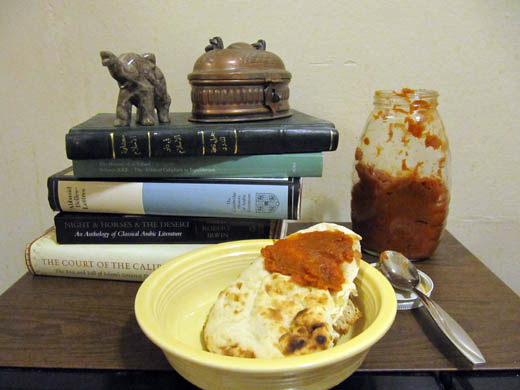
You know what? Cold jawārish smeared on toasted naan isn’t bad either. The pepper and coriander give the jam a kick we more commonly expect from heated food, but that’s because of the spices and quantities I chose. Medieval Islamic cooks were free to make this stuff with whatever spices they wanted, as are modern paleobromatologists.

Of course, I can’t help but pine for the ideal jawārish chaser: a cold, fizzy glass of galangal soda.
“Spending warm summer days indoors…”

Longtime readers know this blog took an odd turn in late 2009 when poems about the National Cathedral gargoyles started popping up. To my surprise, a whim—a sonnet about a boar and a dashed-off song about a monster—turned into both a long-term project and a refreshing creative challenge.

Readers tell me they like the gargoyles, but I’ve also fielded enough questions that it’s probably time for a FAQ.

So why did you decide to follow up a moderately successful nonfiction book with a batch of gargoyle poems?
My agent and editor tell me that light, formal verse is the next big trend in publishing. A team of highly paid consultants is working day and night to ensure that I’m branded in the public mind as “the Dan Brown of medievalist gargoyle ekphrasis.”

No, really, what’s the deal?
From 2006 through 2008, I promoted Becoming Charlemagne, an adventure that was wonderful in hindsight but very tiring. Then I spent most of 2009 on long writing projects for other people, to the point of word-weariness and exhaustion. These poems, like most posts on this blog, let me re-associate writing with pleasure without worrying about marketability, editors’ impressions, or other people’s needs.

Are you going to write poems for all of the cathedral’s gargoyles?
Heck no. The cathedral sports 112 gargoyles and more than 1,100 grotesques. I’ll focus only on my favorites, around 50 in all.

Does this project have a name?
I’ve been calling it “Looking Up.”

How can I read all of the gargoyle poems to date?
Easy: just hit the “looking up” link at the bottom of each gargoyle post or under “Categories” in the right-hand column of the page.

If you’re a new reader looking for a sampling, check out the cicada ghazal, the song of a lovelorn monster, the alliterative advice of a bitter mother, the fretful musings of an artsy fawn, the domestic drama of an octopus reappraising her lobster, and the most popular poem so far, a yarn about where dragons come from.

Will you turn these poems into a book when you’re done?
Several readers have told me they want one, so yes.

How long will that take?
I don’t know. I have a full-time job, I teach part-time, and occasionally I do engage in pastimes unrelated to gargoyles. Probably mid-2012.

Do you take requests?
Several of these poems have been inspired by anecdotes from readers, students, and friends. So yes, if you have a favorite vocation, cultural icon, wild animal, or mythical beast, send me a note and tell me a story and I’ll see what I can do.

Do you take the gargoyle photos on this site?
Yes. I’m a crummy photographer who happens to own a point-and-click camera with a decent zoom lens.

Are you affiliated with the National Cathedral?
No. The cathedral just happens to be an easy, one-mile stroll from “Quid Plura?” headquarters. Its grounds and gardens offer a welcome getaway from the rest of D.C. when the city’s at its ephemeral worst.

Are there any guidebooks to the National Cathedral gargoyles?
Wendy True Gasch’s Guide to Gargoyles and Other Grotesques is packed with info-nuggets and photos. It sells new at the gift shop for $12.95. The Stone Carvers: Master Craftsmen of Washington National Cathedral focuses on the lives and work of the Italian masons. The cathedral also offers gargoyle tours.

So have you stopped writing about books and medievalism and Charlemagne and galangal disasters and dumpsters full of hobbits?
Of course not! The gargoyles, for however long they linger, won’t supplant any of that.

You must like Shel Silverstein.
Not really. The only two works of his I know are his ancient Irish drinking song and that book about the codependent tree.

How can I support your gargoylish endeavors?
You can’t, really; it’s not a commercial project. But I won’t complain if you pick up a copy of Becoming Charlemagne (paperback or Kindle) or The Tale of Charlemagne and Ralph the Collier (paperback or Kindle).

Or, heck, just keep reading this blog or subscribing to its feed. I’ll keep writing as long as you keep bringing the eyeballs.

“And in this town of disco heat, the dancing of a thousand feet…”

When I was in fourth grade, I wrote to Lloyd Alexander’s publisher as part of some long-forgotten school assignment. Weeks later, the mailman dropped off a few brochures clipped to a generic cover letter. The impersonality didn’t faze me; simply receiving something from a publisher—someone who understood all that cryptic stuff on the opening pages of books—was a treat, not because I was enamored with the arcana of the industry, but because holding that packet was like receiving a transmission from the Mushroom Planet: These people, I marveled, really exist?

As a kid, I didn’t know any authors. I didn’t know any for much of my adult life, either—but I know a few now, and I’m happy to praise them, plug them, and let “QP?” readers know they exist.

Thanks to this blog, I’ve chatted with Alexis Fajardo, a cartoonist at the Charles M. Schulz Studio and the author of Kid Beowulf, a series of charming, all-ages graphic novels. The most recent volume, Kid Beowulf and the Song of Roland, is Lex’s humorous take on the Charlemagne legend; it combines his passion for world epics with a cartoonish style reminiscent of Jeff Smith or Albert Uderzo. Chat up Lex at comic cons, especially if you want to bring something home for your kids.

“Jeff,” I hear yon straw man cry, “you don’t seem like the ideal reader for a gay military romance set in ancient Rome.” No, I’m not, but The Soldier of Raetia by my pal Heather Domin is a sharp, engaging read. Knowing her book didn’t easily slot into existing genres, Heather opted out of the publishing industry snake-dance and instead went with Lulu—but hers is the rare self-published novel that’s as solid as anything on the bookstore shelves. Historical Novels Review liked it, too.

Steven Hart and I have yet to meet, but we keep finding people and places in common. He now owns a bookstore near my childhood home, and his 2007 book The Last Three Miles: Politics, Murder, and the Construction of America’s First Superhighway is a perhaps the world’s only page-turner about transportation infrastructure. On the surface, it’s the story of the Pulaski Skyway, but you’ll also learn how America built bridges and tunnels in a far less politically genteel era. (At 224 tightly-written pages, The Last Three Miles is also the perfect length; you don’t have to commit to a 600-page tome.)

While wandering Iceland in 1998, I met William Short, an award-winning acoustic engineer who documented his ten-year study of medieval martial arts in the excellent Viking Weapons and Combat Techniques (which I wrote about here.) An increasingly familiar face to Icelandic scholars and reenactors alike, Bill has written a second book, Icelanders in the Viking Age: The People of the Sagas, a terrific introduction for would-be saga readers who haven’t been sure where to start.

A few years ago, Neville Tencer of British Columbia wrote to me from out of the blue to see what I knew about the Via Francigena, the old Frankish pilgrimage route to Rome. (Alas, I knew little.) Neville and his partner, Julie Burk, laced up their boots and hoofed it through the Alps, documenting their travels in An Italian Odyssey: One Couple’s Culinary and Cultural Pilgrimage. This news video about their journey makes me want to follow in their footsteps, undaunted by the reviewer who praised the book for telling “the grubby truth about pilgrimage.”

I’ve never met Bill Peschel, but I do read his blog, and I suspect he’s too modest to hype the fact that his book Writers Gone Wild: The Feuds, Frolics, and Follies of Literature’s Great Adventurers, Drunkards, Lovers, Iconoclasts, and Misanthropes went on sale this week. The book looks like a fun peek into the libertine side of literary history, and I love that Bill has posted the book’s ideal soundtrack on the New York Times “Paper Cuts” blog. Black 47, Lou Reed, and Peter Gabriel—what’s not to like?

“Look, I must have a star on my door…”

No sun—no moon!
No morn—no noon—

No dawn—no dusk—no proper time of day—
No sky—no earthly view—
No distance looking blue—
No road—no street—no “t’other side the way”—
No end to any Row—
No indications where the Crescents go—
No top to any steeple—
No recognitions of familiar people—
No courtesies for showing ’em—
No knowing ’em!
No traveling at all—no locomotion—
No inkling of the way—no notion—
“No go”—by land or ocean—
No mail—no post—
No news from any foreign coast—
No Park—no Ring—no afternoon gentility—
No company—no nobility—
No warmth, no cheerfulness, no healthful ease,
No comfortable feel in any member—
No shade, no shine, no butterflies, no bees,
No fruits, no flowers, no leaves, no birds—
November!

Thomas Hood (1799-1845)

“Slipping the clippers through the telephone wires…”

Cathedral visitors are sometimes confused, even offended, by gargoyles that honor irreverence or depict blatant evil. The suicidal, Gollum-like “Stabber” on the west front isn’t surprised; he knows what he is.

ALL HALLOWS’ EVE

Long live the weeds and the wilderness—yet
What would be left of the wildness and wet
Were it not for the curdle, the canker, the theft
That threaten to render the blessèd bereft?

Our beady-boned eyebulge flits over the burn;
Wily we twitch through the sack-shriveled fern
As the groin-growls enrage us where daggers bite through,
Damning the bloodline that dapples the dew.

Yet rounded in couplets, despair-darksome sneering,
Frown pitchblack poets defy all our leering,
Twindled revisioners burbling like broth,
Donning their Jesuit wind-shriven cloth.

What pumpkin-maws mumble, we ache to express;
Ghouls plunder verses they dare not possess.
Take heed of the unhallowed eyeblight you mourn:
Then know why the saints of the morning were born.

(For all the entries in this series, hit the “looking up” tab.)

“Way up there in the poison glen…”

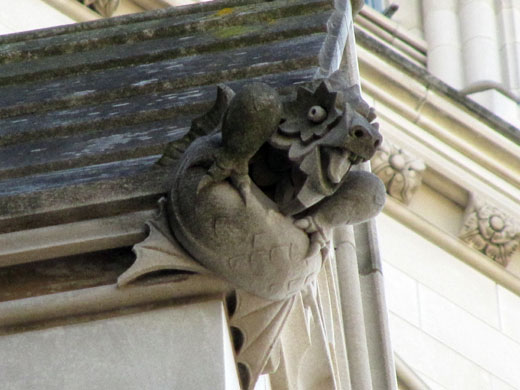
This creepy dragon on the north nave hides within his own fishy body. If you approach him, he’ll sing prophetic nonsense.

AUTUMN SONG

Clerks wrap swords in newsprint gray;
Voices of Avalon pine and pray.

Spine-cracked quartos brace the wall;
Voices of Avalon flake and fall.

Cursors burn a wanton field;
Voices of Avalon yawn and yield.

Spiders fast in pyx and grail;
Voices of Avalon fade and fail.

Glowing points rouse brush-bent hair;
Voices of Avalon strain and swear.

Roof-beams warp like corset bone;
Voices of Avalon mince and moan.

Unplucked medlar rots to wine;
Voices of Avalon pout and pine.

Marshes drown the back-toll’d bell;
Voices of Avalon swoon and swell.

Mice in moat-muck bloat face-down;
Voices of Avalon fuss and frown.

Grave-masks grin, but none deceive;
Voices of Avalon groan and grieve.

No knights rise, though one did try;
Voices of Avalon drift and die.

Furze-pigs rove in disarray;
Voices of Avalon seethe and say:

“Run, and raise the rust-white gate.”
Voices of Avalon wait.

(For all the entries in this series, hit the “looking up” tab.)

“Thrashing all deceivers, mashing non-believers…”

One of my favorite objects at the American Art Museum, and maybe the strangest, is The Throne of the Third Heaven of the Nations’ Millennium General Assembly, a sprawling altar built in a Maryland garage out of tin foil, light bulbs, and cardboard tubes. I’ve never known whether the Smithsonian curators were drawn to this piece for its demonstration of the grandiose precision of madness or because it reflects the indefatigability of religious vision. Either way, museum-goers respect James Hampton’s weird masterpiece. They approach his altar with a snicker, but then they linger, often for far longer than they expect, beguiled by a sense of coherence only its creator could fully understand.

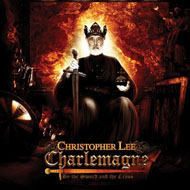
Judged by its opening tracks, Charlemagne: By the Sword and the Cross promises a singularly mad plan of its own. Billed as an “epic canvas of symphonic metal,” this concept album (now available on CD or as an iTunes download) features Christopher Lee as a the King of the Franks, backed by singers and musicians from across Europe. I wish I could say this album is more “heavy metal” than “weighty brass,” and I’d love to report that Sir Christopher and his compatriots weave trancelike melodies that slip over the transom of social consciousness and insinuate themselves into your dreams. Unfortunately, in symphonic metal as in the ninth century, the reach of Charlemagne’s mailed fist far exceeds his grasp. This album is exceedingly strange.

Oh, the concept is sound: Languishing on his deathbed, Charlemagne speaks fondly of his family, recalls his conquest of the Lombards, and regrets his wars against the Saxons. In scenes set by the crisp voice of a female English narrator, Sir Christopher Lee recasts the rex Francorum into Rex Harrison, gamely talk-singing his role over catchy orchestrations that cross Rent with those Vivaldi-inspired diamond commercials from a few years back. Occasionally, flecks of metal do glitter when guitars rev up for a memorable hook; verily, I won’t soon forget hearing Saruman growl, “I shed the blood of the Saxon maaaaan!” As someone who’s long hailed the mating of medievalism and metal, I unironically love this sort of thing; I want to grimace musically and run with it.

But as the hardscrabble heirs of Wagnerian drama, concept albums need more than a plot; they need perspective, often a nutty one, to buttress some overarching theme. Pet Sounds is an ode to fleeting adolescence. The Wall is obsessed with (among other things) the intersection of the individual and history. Time, ELO’s 1981 time-travel disco concept album, is about homesickness. Operation Mindcrime by Queensryche revels in paranoia. By contrast, the opening tracks of By the Sword and the Cross are a blur. The dying Charlemagne praises himself for baptizing pagans and prays that God will forgive him for relieving 4,000 Saxons of their heads. Then he cries, “I am the chosen one to lead the faithless to the Cross,” as we flash back to his war with the Lombards, and a choir and a roaring guitar herald: “SPRINGTIME!”

So all of this looks, at first, like an ode to Charlemagne’s worst deeds—until the cloying narrator informs us that Charlemagne worshiped “a ruthless, vindictive God” and that “the blood-steeped king consoled himself with the idea that he was genuinely out to save souls.” So is this album a critique of medieval Christian violence? Well, let’s look at what Charlemagne, Queen Hildegard, and their backup singers proclaim as the final act, “Starlight,” builds to a climax:

Come, let’s drink to the time
When peace and the sun will shine
And the world will be as one,
Forever.

Charlemagne! Your peoples are there for all to see.
The power and the glory are your destiny!
The dawning of a new age will shine just like a star…

What can I say? At a time when Brussels has molded Charlemagne into history’s blancmange, it’s downright bracing to stumble upon an artistic project in which a pan-European cast of musicians and performers dramatizes incidents of horrific medieval violence and then belts out apotheotic hymns while a blood-stained emperor midwifes a Heaven on earth.

Forget that Charlemagne’s imperial coronation is absent from this album. Never mind that Procrustes’ entire comitatus couldn’t make lines like “You have incurred the wrath of Lombard King Desiderius!” metrically snug. And don’t judge the bonus track, a sound-effects-heavy dramatization of Charlemagne rallying the Franks to undertake a Spanish crusade, even though it ends at the climactic moment when the producers, presumably, ran out of weed. I’ve listened to By the Sword and the Cross twice, and I still have no sense of its ideal listener. I do know that it’s not an album for hawkish Christians, nor for secular EU supporters, nor for disinterested humanists, nor for committed aficionados of stage musicals or heavy-metal concept albums.

So who’s this album for? Maybe it’s for people who simply want to hear Sir Christopher Lee sing-talk lines like this:

When all the deeds of my life are played before my eyes,
Will what I see come as a great surprise?
Life is short, the hour of death uncertain;
I must confess my sins before they draw the final curtain!

Lee gives this album a dash of B-movie panache, but he can’t give it coherence. That would require the symphonic-metal equivalent of a Roger Waters or a Brian Wilson, or even a Tommy Saxondale, a lunatic who might have pumped By the Sword and the Cross into a vivid personal vision.

For 1,200 years, artists, scholars, and politicians have created Charlemagnes for all seasons. Here, two Karls stand side by side: the bland icon of European unity who’s fond of neither sword nor cross, and the Christian warlord who’s rarely groomed for modern pop-culture respectability. Although leery of legend, the folks behind this album can’t commit to the implications of history and let the two Karls clash. Ambivalence is not metal, so they need to close the Ernst Kantorowicz and pick a king worth dramatizing: a Charlemagne who’s stark raving mad, or wildly pious, or turned on by bloodshed, or haunted by regret. A journey through such a mind might have been a guilty pleasure to get heads banging—the musical equivalent of an altar of trinkets and tin.

[For a historian’s take on this album, see the review by Jonathan Jarrett at A Corner of Tenth-Century Europe.]

“When August and September just become memories of songs…”

Sometimes October surprises us, coming over the Potomac like a shower of warmth. We stop in the colonnade and go on in sunlight, into the Bishop’s Garden, and drink Gatorade, and talk for an hour.

Sunday was one of those days. Push away from the desk, leave your thoughts unwritten, and remember the timeless words of Gerard Manley Hopkins: “Holy crap, it’s nice outside!”

Park your trike by the door into (Indian) summer.

Among the flowers, find a bronze sundial on a 13th-century capital from a monastery near Rheims. Look: it’s medievalism o’clock.

Someone left a flower for our old friend, the satyr…

…and a bouquet of herbs, berries, and chilies at the fish pond.

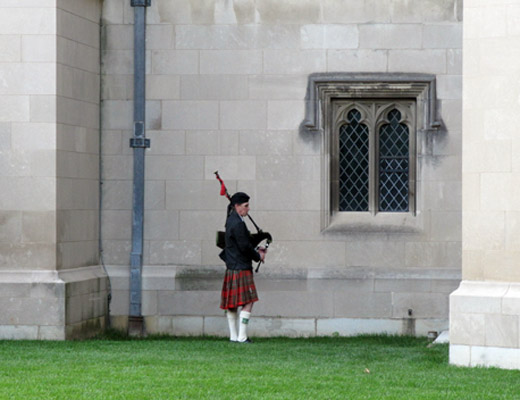
And then, homeward bound—but not before pausing to note a lone Scotsman mournfully piping at sunset.

“‘I might be old, but I’m someone new,’ she said…”

In May, a cicada on a buttress chirped a ghazal. Today, a cockroach replied. Who knew insects talked like this?

FROH

The background: you returned—a draught of wine
Fulfilling sweet the word the wind had thrown,
Returning scents and sight, restoring mine.

Despairingly, we wandered on our own
Beyond you evermore, or so we feared,
Eternal, guileless girl—then how we cheered…

The foreground: love, it glows with you alone.


(For all the entries in this series, hit the “looking up” tab.)