“…far away from dry land, and its bitter memories.”

Seamus Heaney is a fine poet, but his Beowulf and I have sailed past each other for ten hopeless years. When I skim his translation, I drift, and the audio version only lulls me to sleep, despite its potent brogue. Having failed to enjoy Heaney’s Beowulf as a poem all its own, I had hoped that the book might at least appeal to reluctant readers who’d otherwise flee from medieval lit. Instead, Heaney’s Beowulf is, I’d bet, one of the least-finished bestsellers of the last 25 years, while its omnipresence has overshadowed more recent attempts to draw readers into a lost heroic age.

One such Beowulf, the 2004 Longman Cultural Edition, comes packed with a timeline, a glossary, genealogies, and snippets of primary sources. At its core is a translation by Alan Sullivan and his partner, Timothy Murphy, whose respect for formal poetry dictated the guidelines Sullivan enumerates in his introduction:

(1) It would be written in four-beat lines, like the original, though differing somewhat in metrical detail. (2) It would follow a loosened variant of the Scop’s Rule, alliterating three times in most lines, but using other patterns of alliteration as well. (3) It would employ modern syntax, with some inversion for rhetorical effect. (4) Words of Germanic origin would be chosen preferentially.

Their boundaries set, Sullivan and Murphy spin a translation that evokes the craftsmanship of the original poem without the stringency of an antiquarian exercise. Here’s Beowulf and his men bidding farvel to Denmark:

They boarded their vessel,      breasted the deep,
left Denmark behind.     A halyard hoisted
the sea-wind’s shroud;     the sail was sheeted,
bound to the mast,     and the beams moaned
as a fair wind wafted     the wave-rider forward.
Foamy-throated,     the longboat bounded,
swept on the swells     of the swift sea-stream
until welcoming capes     were sighted ahead,
the cliffs of Geat-land.     The keel grounded
as wind-lift thrust it     straight onto sand.
The harbor-guard hastened     hence from his post.
He had looked long     on an empty ocean
and waited to meet     the much-missed men.

Heaney’s version of this same passage is a lovely bundle of lines—but Heaney, by his own admission, is “less than thorough” regarding meter and confesses that his alliteration “varies from the shadowy to the substantial, from the properly to improperly distributed.” By contrast, Sullivan and Murphy find power in form. Read their translation aloud, as I have since finding it in the library last month, and you hear—and feel—diction constrained by rules and traditions, restlessness evident in every line, the entire translation all the more vibrant and immediate for it.

Over the years, I’ve sometimes dropped by Fresh Bilge, Alan Sullivan’s blog about poetry, religion, politics, weather, and sailing. Since I share only the first of those five interests, I’ve never been one of Sulivan’s regular “rare readers,” but a few weeks ago I went to drop him a note telling him him how much I was enjoying his Beowulf—but I was too late. Alan Sullivan died on July 9, 2010, after a long battle with leukemia.

Blogger Brendan Loy has written a heartfelt appreciation of Alan Sullivan. Here’s Sullivan’s death announcement and obituary, plus a selection of his poetry. Here’s Timothy Murphy conducting a far-ranging interview of Alan Sullivan in Able Muse magazine, in which Sullivan discusses being critiqued by Richard Wilbur and implores would-be poets to pry themselves away from the campus:

I would add a more general comment that introversion and bookishness have harmed the estate of poetry. Teachers who encourage these traits do their students no favors. Better to foster the natural curiosity of the young, press them to acquire general knowledge, demand accuracy and precision in language, and promote monomanias as escape hatches from the self.

That advice, and the above translation of Beowulf’s leave-taking, aren’t a half-bad way for a poet to be remembered: as a man who knew the difference between worda ond worca, and made the best of both.
“…and August’s rare delight may be April’s fool.”

Medieval romances aren’t sacred texts, but translators often treat them with a reverence that overshadows their sheer entertainment value—so thank goodness for Adam Golaski, who’s grappling with Sir Gawain and the Green Knight in an effort to make the poem his own. Playing Tom Lehrer to Cotton Nero A.x’s “Clementine,” Golaski began posting pieces of Green to the Open Letters Monthly web site in 2008, and OLM recently published the entire first fitt.

Here’s the opening stanza of Green:

Since ceased th’siege + assault upon Troye,

bones brok’nd brittled t’bronz’nd ashes,

that soldier who trod treason o’er th’plots’v

his enemies was tried f’r treachery tho

agile Ennias, of th’truest on Earth, of high kind,

haunted by shade Dido, was worth th’wonder

wealth’v all th’west isles——

From rich milk’v wolf-mother Romulus

rose Rome’nd’n its captured riches Romulus was

swath’d. W/ arrogance he built his name

upon a hill + took Palatine t’Romulus t’Rome——

Tirius traveled t’Tuscany he built beginnings,

Langaberde’n Lombardy left us houses,

+ far o’er th’French floods Felix Brutus

on many full banks built Bretayn + sits

w/ one

where war’nd wreck’nd wonder

by surprise has went therein,

+ oft both bliss’nd blunder

fool hope shifted t’sin.

And here’s a bit of the Green Knight’s appearance at Camelot:

Arthur’nd Arthur’s court
look’d long’nd in wonder, + wondered what kind’v man be-held them,
wondered what this magical spectacle must mean,
f’r’a knight’nd’is horse to’ve accrued such’a hue that is

green

green as th’grass’nd growing greener it seemed
green glow’n’nd bright’nd brighter than enameled gold.

Translating medieval poems, whether long works or short, is a cage-match between meaning, meter, and form. Tricky passages drive the disheartened translator to other people’s versions, all of which have their own iffy relationships with the original. Preserving the sound of favorite lines clashes with the need to sacrifice fine medieval details—someone else’s favorite lines—for storytelling, while the manuscript context of the poem gets all the respect of a Carolingian hunchback.

That’s why Green is a hoot. Having developed his own idiom, Adam Golaski doesn’t try to spackle over its seams. He makes deliberately insensible decisions, jamming words together for the sake of sound and using typographic gimmicks to bemuse anyone who tries to read this thing aloud. Every conundrum a translator faces becomes, in Green, a source of amusement; some lines he barely translates at all. Golaksi gleefully defenestrates the needs of teachers, scholars, and students, but his Green makes a point that won’t be lost on medievalists: the original poem is really, wonderfully weird.

(Related “Quid Plura?” posts: a defense of the Gawain-based film Sword of the Valiant and a look at Christopher Logue’s rewriting of the Iliad.)

“Sing ‘hi, lo, lay,’ at the end of the day…”

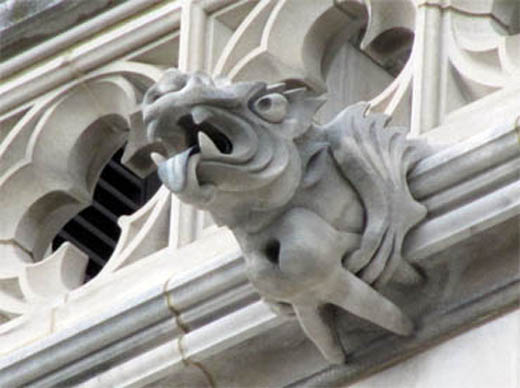
National Cathedral tour guides may try to tell you why this monster is clutching a giant molar 40 feet up on the south nave. I prefer his own explanation.

SONG

In my dream, a Pictish maiden
Paused and prayed here half a while,
Shade and snow a-swirl around her,
Something wanting in her smile.

From my scrafe, I spied in silence,
Watched her wend round weed and hill
And rose, and passed from forests dim,
Her foremost longing to fulfill.

Late I loped through Roman markets,
Hove the doors off Saxon halls,
Plumbed the moats of Norman mansions,
Flinched, then froze, when furtive calls

Enthralled me, lost, where mental mazes
Shrank, and starlight shone by day,
Until I found the hope I sought,
Extracted it, and stole away.

Sovereigns rise and storm-clouds scatter;
Chapels fall and winters turn.
Truth survives a thousand summers:
What is lost may yet return.

In my dream, a Pictish maiden
Marches past, her patient soul
Reflecting suns that swirl around her;
After all, her smile is whole.

(For all the entries in this series, hit the “looking up” tab.)

“Take off your hat, sir, there’s a tear-stained eagle passing…”

Yes, we have heard the glory of the Founding Fathers, how the Second Continental Congress approved the Declaration of Independence on July 4, 1776, but this coming Sunday also marks the 234th anniversary of our birthright as Americans: the plodding bureaucracy that almost gave the United States a cool, medieval-themed emblem.

On that first Fourth of July, Congress handled a fair amount of business, but before they adjourned for potato salad and horseshoes, their penultimate motion was this:

Resolved, that Dr. Franklin, Mr. J. Adams and Mr. Jefferson, be a committee, to bring in a device for a seal for the United States of America.

I’m no fan of group work, but that’s a committee I wish I’d seen. Franklin, for his part, offered a grand biblical vision:

Moses standing on the Shore, and extending his Hand over the Sea, thereby causing the same to overwhelm Pharaoh who is sitting in an open Chariot, a Crown on his Head and a Sword in his Hand. Rays from a Pillar of Fire in the Clouds reaching to Moses, to express that he acts by Command of the Deity. Motto, Rebellion to Tyrants is Obedience to God.

Adams was gung-ho on an allegorical painting that depicted

a succession of appeals to the young Hercules, by female impersonations of Virtue and Vice or Sensuality . . . . Vice speaks first and points out the flowery path of self-indulgence; Virtue follows and adjures Hercules to ascend the rugged, uphill way of duty to others and honor to himself.

Jefferson, meanwhile, was chasing forest murmurs of his own. As Allen J. Frantzen explains in Desire for Origins: New Language, Old English, and Teaching the Tradition, Jefferson proposed an embryonic vision of Manifest Destiny, complete with a rarity in American allegory: Germanic barbarians. “On one side,” says Frantzen,

he wanted to picture the mythical Anglo-Saxon warriors, Hengst and Horsa; on the other, he wanted to portray the Chosen People following a pillar of fire. Jefferson saw Hengst and Horsa as ideal leaders of a free and democratic people who were, at least in Jefferson’s imagination, “chosen” to live in a free world of individual rights and communal blessings. The English Constitution and Common Law were Saxon “legacies” for Jefferson, a time of wide-spread liberties for freedom-loving Anglo-Saxons, a pre-Christian Paradise destroyed by Norman-led feudalism and restored by the Magna Carta.

Jefferson’s take on the Anglo-Saxons wasn’t unusual for the time. In the 16th century, Matthew Parker, Archbishop of Canterbury, busily promoted the notion that England’s break from Rome marked the restoration of a pure and primitive church. In the late 16th and 17th centuries, parliamentarians were so awed by the venerability of English legal and political institutions that they hailed the Anglo-Saxons as a nation of freedom-loving democrats: elected kings! assemblies! jury trials! common law! For centuries, English churchmen and monarchs and politicians squinted, wallowed in wishful thinking, and selectively saw themselves in the Anglo-Saxons—thus giving Jefferson a myth on which to help found America.

After establishing the study of Anglo-Saxon at the University of Virginia, Jefferson further hoped to stabilize a young nation by rooting Old English in the national elementary school curriculum. Looking ahead, he proposed ways to make Old English spelling more comprehensible to the statesmen and humanists charged with propagating Anglo-Saxon institutions in America. “As the histories and laws left us in that type and dialect, must be the text books of the reading of the learners,” he wrote, “they will imbibe with the language their free principles of government.”

In the end, fourteen people on three committees spent six years working out a design for the Great Seal of the United States; only the Eye of Providence, “1776” in Roman numerals, and the motto E Pluribus Unum survived those initial Franklin-Jefferson-Adams brainstorming sessions. Horsa and Hengist failed to stake their claim, and Thomas Jefferson failed to found an America where surveyors measure farmland in “hundreds” and Old English leaps from the tongues of country lawyers.

Had Jefferson been a more persistent medievalist, Americans might still have spent this weekend grilling meat and blowing stuff up, but we might also have swelled with pride to celebrate the founding of niw rice, geacnod on freodome and gegiefen to þæm geþohte, þæt ealle menn beoð gelice gesceapen—without having to turn to graduate students to tell us what that means.

“They let us in, so I’m feeling all right…”

“I like to go where, sometimes, they refuse,” quipped Alcuin in a letter composed during a heat wave at the end of the ninth century, likening his humid chamber at Tours to the fires of Hell. “Yes, I remember last Saturday night,” replied Charlemagne wearily, “but I’m feeling cooler now.” As the Franks found relief in swimming holes and breezy groves, so may you find shade in these summertime links.

Lawyers know that unicorn flesh is not, in fact, “the other white meat.”

Jake Seliger interviews Lev Grossman, author of The Magicians.

Maggie Stiefvater talks about revising novels.

Adrian Murdoch serves up recent books on Late Antiquity.

Steven Riddle reads “Sonnet V” by Elizabeth Barrett Browning.

When you write a book, people with little to no publishing experience turn into marketing gurus whose outlandish recommendations for self-promotion make the ShamWow guy look like Emily Dickinson. That’s why I relished author Maureen Johnson’s contrarian manifesto about “branding.” (Via Lynn.)

My friend at Ephemeral New York discovers “the birdmen of an Upper East Side building.”

If one of Chaucer’s sneakier pilgrims got lost in 1944, he might look an awful lot like Louis Jordan’s “Deacon Jones.”

The world is a better place when it contains a one-woman, polyphonic, ukulele cover of “God Only Knows.”

Finally, for the hundreds of you who’ve written to me asking, “Where would a starving hobbit in suburban Maryland seek quasi-magical refreshment?”, here’s your long-awaited answer:

“Some are mathematicians, some are carpenters’ wives…”

Being a medievalist isn’t as glamorous as you might suppose. Often I can’t find a peon within thrashing distance to pit the olives for my Old Yellers, and during those baleful episodes, I pry myself from the vampiric talons of my forthcoming magnum opus (working title: “Sommes-nous encore , Papa Schtroumpf?”: Henri Pirenne, l’Union européenne, et le médiévalisme prospective de Pierre ‘Peyo’ Cuilliford), disable the laser array around the DeLorean, and pursue intellectual regeneration in the shopping malls that serve as economic underwire to the sweat-dappled bosom of suburbia.

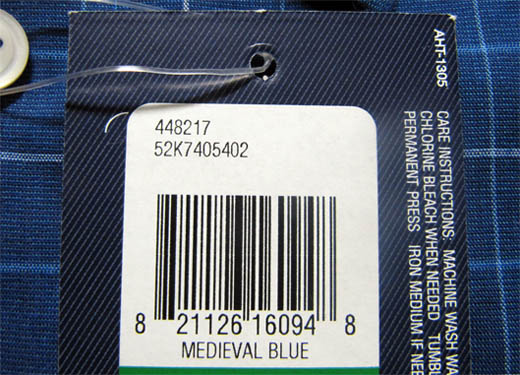
So did base commerce provide the hoped-for mental holiday? Alas, no. Having stumbled across an intriguing line of shirts at a charming cosmopolitan boutique, I found myself as startled as a stag in a Laibach video by the color designations on the tags. “Moonless Night” meant “black,” “Black Forest” meant “green”…and then a shirt hove into view, blue as the veil of Thetis:

Apparently, “medieval blue” is a real Pantone color, RGB #2F3654 (presumably inspired by medieval pigments), and all sorts of things are available in it, including wool, windbreakers, tank tops, snow boots, tennis shoes, and chiropractic pillows.

But isn’t “medieval blue” more of an idea—a simile, even? Trailed always by a trembling amanuensis, I made dramatic writerly gestures, paced the menswear aisle, and recorded these golden thoughts for later rumination:

  • “as blue as a miller’s Netflix queue”
  • “as blue as the metaphorical heavens in the pick-up lines of the Duc de Berry”
  • “as blue as the blood of Charlemagne’s nephews nibbling Roquefort while rowing in the Oxford-Cambridge Boat Race
  • “as blue as absinthe in Utgard”
  • “blue as the grass where Auðumbla moo’d indigo”
  • “as blue as a summer princess sprawled across a winter grave”

Readers are invited to pass the weekend conjuring tortured similes of their own. Meanwhile, some of us, draped anew in cerulean shades that Carolingian clothiers could never envision, shall return to crafting prose that is plainly, unflinchingly purple.

“Drawn into the stream of undefined illusion…”

“These changing years, they add to your confusion,” grumbled Charlemagne to Alcuin when the old abbot defied his king in a legal dispute involving an escaped convict. “You need to hear,” the king warned cryptically, “the time that told the truth.”

I have no idea what Charlemagne meant, but I do know that “Quid Plura?” turns three years old today. I truly appreciate everyone who stops by, subscribes to the feed, leaves comments, and sends emails—especially those of you who stick around even when updates are erratic, sporadic, enigmatic, or odd.

Without further ado, here—for the benefit of new readers, random Googlers, and anyone looking to run down a slow afternoon at the office—are highlights from the past three years.

Naturally, early “QP?” posts often focused on Charlemagne, so let’s revisit the best thing Charlemagne never said (as well as the second-best thing), check out the only Charlemagne-themed country song, and ponder the connection between Charlemagne and SpaghettiOs.

Can you believe my open letter to the Sci Fi Channel went unanswered?

Acquaint yourself with some curious characters: Discover Chaucerian filmmaker Oscar Micheaux, get to know Belgian historian Henri Pirenne, visit the grave of Henry Adams, and meet Anna Julia Cooper, the most inspiring medievalist you’ve never heard of.

Don’t miss occasional medieval-themed excursions to the Balkans or the Caucasus.

Here in D.C., you’ll search in vain for a famous science fiction author forgotten by her alma mater.

At the National Cathedral, take a stroll into a corner of the ninth century or enjoy an ongoing project: the griping of garrulous gargoyles.

Medievalism abounds in Louisiana: in small towns, in Cajun country, in shrines in the Lower Ninth Ward.

What’s medieval about Ocean City, Maryland? Vikings, and dragon temples, and stupid fat hobbitses.

Commercial break! If you want to enjoy a rarely-read medieval romance (and help support this site), take a chance on The Tale of Charlemagne and Ralph the Collier.

Remember when we celebrated Medieval Shark Week? It was around the time I mutilated a duck.

No one else wanted to defend the movie Sword of the Valiant, so I gave it a go.

On the other hand, readers liked this appreciation of the Pogues.

Why is “Quid Plura?” free of politics? It runs in the family.

Finally, a shout-out to my homeland: Nothing says “New Jersey” like Oscar Wao.

“And the little wheel runs on faith…”

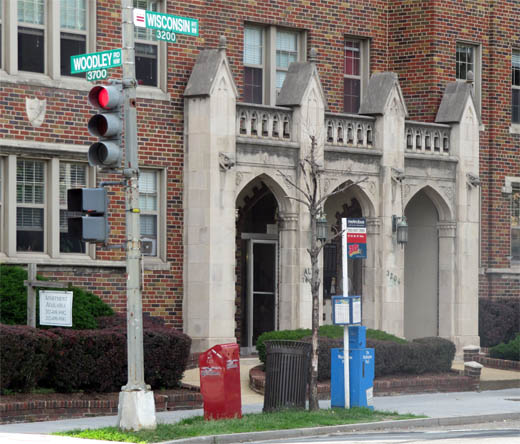
Tourists never notice it, but then neither do most locals. Behold: Alto Towers, catty-corner to the National Cathedral at 3206 Wisconsin Ave NW.

Alto Towers went up in 1932, in the heyday of D.C. suburbanization. This eight-storey apartment house is the work of Arthur B. Heaton, a half-forgotten architect who’s partly responsible for the look and feel of northwest Washington—and who was, briefly, an unabashed medievalist.

Heaton was ridiculously versatile. In 1901, he built Tudor Revival apartments and later designed the Altamont, a local apartment house with an Italian Renaissance twist. In 1914 and 1931, he put Classic Revival additions on the National Geographic Society building. In 1926, he gave his (now-demolished) Capital Garage a funny, car-themed facade, and his interest in the automobile led him to design our local “Park and Shop,” the prototypical strip mall, in a Colonial Revival style. Heaton oversaw the construction of new facilities on the GWU campus while also designing banks, churches, and countless other D.C. buildings and homes, apparently without ever developing an identifiable “Heaton style.”

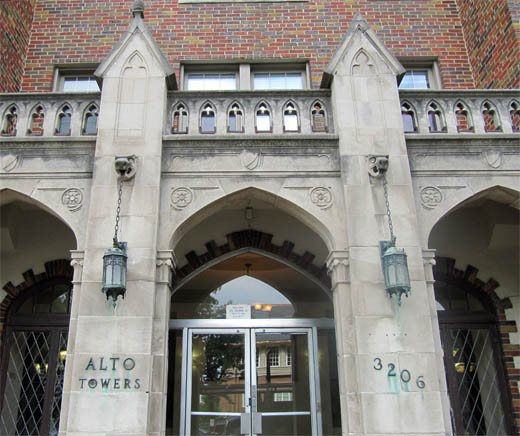
…and that’s what makes Alto Towers a treat for the medievalist. Take a gander at the entryway.

When Heaton wasn’t serving as president of the local chapter of the American Institute of Architects, co-founding the Washington Building Congress, or spearheading the “Renovize” movement during the Depression, he was also, from 1908 through 1920, the supervising architect for the National Cathedral, where he helped chief architect Henry Vaughan oversee construction during the cathedral’s first 12 years.

In 1932, more than a decade after Heaton’s time there, the cathedral was little more than an overgrown apse festooned with a few angelic grotesques. Given a chance to design an apartment house across the street, Heaton—who could have built damn near anything—set loose his inner medievalist.

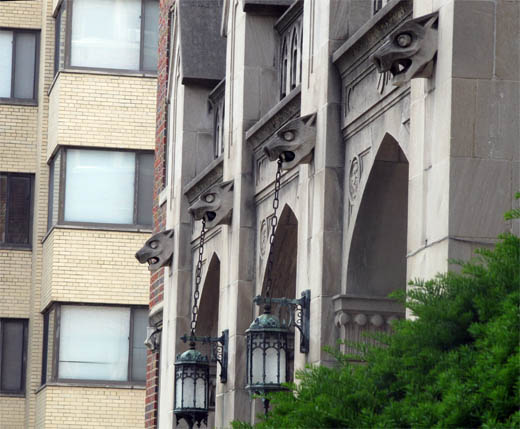
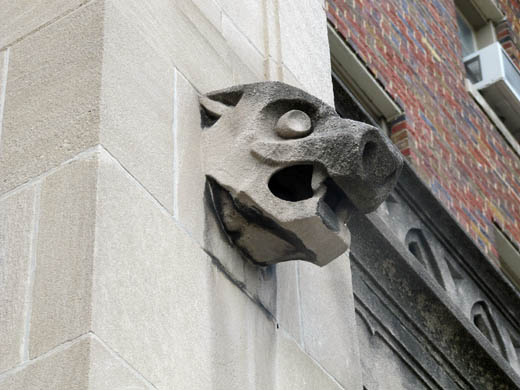
Those snarling, gargoylish grotesques are the most blatantly cool thing about Alto Towers, but the whole arcaded entryway is a neo-medieval romp.

The quatrefoils (four-leaf clovers) in the spandrels (the warped triangles above each arch) are pretty standard, but those thick, gabled supports are an architect’s fancy. Each one resembles a cathedral buttress while also containing blind tracery of a Gothic arch.

At Alto Towers, periods and cultures trip over one another and have a good laugh. The pine cone finials hark back to ancient buildings and the medieval fascination thereof, while those funny little nubs at the tops of the smaller arches—including the little ones in the triforium, the upper row—strike me as very American. Meanwhile, on both sides of the interior of each large arch are squared, Art Deco-ish shadows of Corinthian columns. Behind them, the brick-lined inner doors whisper “Cordoba” in an American accent.

Most of Alto Towers is plain brick, but Heaton decorated just enough of its topmost level to show that the neo-medievalish entryway wasn’t an afterthought.

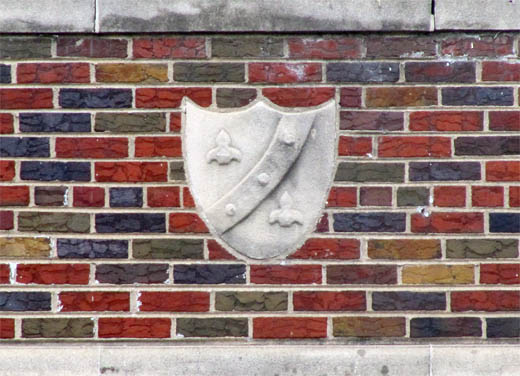
Note the two types of ornamented shield. They may be purely decorative, but I’ll gladly send a free book to any heraldry buff who can show that they’re meaningful.

While Heaton’s 1926 Capital Garage (PDF with photo) featured large, leonine gargoyles, Alto Towers is his full medievalist statement, the rhapsody of a restless architect who knew he wouldn’t live to see the cathedral completed.

When Heaton died in December 1951 at 76, the new apartment buildings rising around the cathedral were blocky and bland. Today, tourists tromp right past them, fixated on the promise of sighting quirky gargoyles on the Gothic spires beyond.

Of course, the cathedral’s first proper gargoyles weren’t put in place until around 1960, so if the beasties at Alto Towers forever bare their fangs, I can’t really blame them. No one remembers that they were here first.