“Sacré-sacré-sacré-sacré-sacré Charlemagne…”

My Paralyzed Veterans of America fundraiser is still on. It’s simple: If you make a donation to Paralyzed Veterans of America, I send you a free hardcover copy of Becoming Charlemagne.

What are you waiting for? All the details are here. At the time of this posting, I have only four books left. Snag ’em while you can!

(If you don’t act now, I promise that you will be forever haunted by guilt in the form of France Gall singing “Sacré Charlemagne” to you over and over and over again.)

Remember, Charlemagne loved to swim, so the book is perfectly appropriate for the beach or the pool. Or, heck, you can force it on your teenager who’s planning to hike across Europe this summer. The book is free, the cause is good—and did I mention the book is free?

Please spread the word, and let’s raise a little more money for paralyzed veterans this week.

*** UPDATE: 25 June 2008, 12:00 p.m.:

All ten books have been claimed! I’ll post a final tally once I know how much everyone donated. If you’re feeling inspired, it’s never too late to make a donation to PVA: www.pva.org.

“I really love to watch them roll…”

After 20 months of book promotion, I’m left with fond memories, many new friends—and clutter.

I have ten hardcover copies of Becoming Charlemagne sitting in a box. These books went unclaimed at lectures and signings because the dust jackets all suffered minor damage: a tear here, a chip, dent, or crinkle there. Sometimes the damage is barely discernible, and all ten copies are perfectly readable.

So I’m giving them to “Quid Plura?” readers, but with a catch:

1. Go to www.pva.org and make a donation of at least $10 to Paralyzed Veterans of America.

2. Post a comment letting us know you’ve done so. (Anonymity or pseudonymity are fine.) Keep an eye on this, because I have only ten books.

3. Send your address to jeffsypeck -at- gmail-dot-com and I’ll send you a book. Postage is on me. (Also, if you don’t mind, tell me how much you donated so I can give my PVA contact a general sense of our total amount.)

If “Quid Plura?” readers are generous enough to take all ten damaged books off my hands, I’ll make my own $75 donation to PVA. Please feel free to spread the word.

You’re probably wondering why a blog about medievalism is asking you to donate to PVA. Before she retired, my mom, in her role as a secretary for a big corporation, helped secure funding for the National Veterans Wheelchair Games. I volunteered at the games in Minneapolis in 2005 and Anchorage in 2006 and met some outstanding athletes: men and women who were paralyzed, and missing limbs, yet still out there golfing on two prosthetic legs, running over dear friends in rugby chairs, or blowing into tubes to navigate an obstacle course.

Some of these vets were injured in Vietnam, Afghanistan, and Iraq, but others were left paralyzed by workplace accidents, car crashes, strokes, or disease. Many of them, their spouses told me, were depressed and reclusive—until they discovered the doggedly competitive but deeply supportive world of wheelchair sports.

PVA keeps these veterans rolling. The organization pays to send newly injured vets to wheelchair events, they fund research into spinal-cord injuries, and they lobby for disabled veterans’ benefits and rights. The Veterans Wheelchair Games, my favorite of their programs, ensures that veterans who struggle physically, emotionally, and financially can still accomplish astonishing things. If you live near Omaha, you should go cheer them on this year. Frankly, they make us able-bodied people look like wusses. Seeing them compete will change your life.

So, watch this video (part one and part two), be moved, make a donation, help injured veterans, and get a book. Quid plura dicam: What more can I say?

*** UPDATE: 25 June 2008, 12:00 p.m.:

All ten books have been claimed!  I’ll post a final tally once I know how much everyone donated. If you’re feeling inspired, it’s never too late to make a donation to PVA: www.pva.org.

“Have to believe we are magic…”

When Lloyd Alexander died last year, everyone talked about how much they loved the Prydain books when they were children. Alexander will always be remembered for that series, but while we, his former readers, grew up and moved on, he continued to write for us—and not just the occasional novel, either, but more than two dozen books over 35 years. I’ve already written about his wonderful autobiographical novel, The Gawgon and the Boy. In the months to come, I’ll continue to read his less familiar books and post brief reviews of each one. To see all posts in this series, click on the “Lloyd Alexander” tag.]
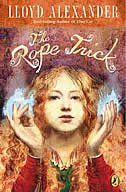
Lidi is a charlatan; people pay her money to fool them. “They understand that it’s just make-believe,” explains the heroine of Lloyd Alexander’s 2002 novel The Rope Trick. “[I]t makes life easier to put up with. It’s consoling.” Lidi, alas, is the only one who’s not consoled by magic. As she roams the roads of Campania performing sleight-of-hand for gullible villagers, the young magician obsessively searches for the secret to the one trick her bitter father swore she wasn’t skilled enough to learn: the famous last illusion of Ferramondo, who was rumored to have thrown a rope into the air, climbed it—and disappeared.

Even in his seventies, Alexander remained a humane and genial writer, but in The Rope Trick his whimsy is eerily muted. Protagonists in his other novels often find their tunnel vision mitigated by wise and pithy companions, but when Lidi is presented with typically Lloyd-Alexandrian statements about the inherent quirkiness of the world, her responses are notable for their lack of humor:

“I have to find a magician named Ferramondo. He’s the only one who knows how to do the trick.
“I’m looking for a town—Montalto,” she added. “He might be there.”
“You shouldn’t have any trouble,” Julian said. “We only have a few dozen Montaltos. It means ‘high mountain.’ So if a town has a bump in the road, it gets called Montalto, and everybody walks up and down admiring it. A crazy country, but we like it that way.”
“My father told me it was in the south.”
“Ah,” Julian said. “That makes things easier. In the south, they only have maybe ten or twelve Montaltos. That cuts it down a little.”
“I’ll find it.”

From Lidi’s obsessive quest to prove her dead father wrong to suggestions of abuse suffered by the child savant she rescues from a roadside tavern, The Rope Trick is darker than readers of Alexander’s early novels might expect. The pseudo-Italian world of Campania is populated by characters who are haunted, scarred, mistreated, or lost. Despite the presence of Alexander’s latest good-hearted charlatan, a circus ringmaster with a troupe of dancing piglets, the novel’s villain firmly establishes the tone of the book: he steals from poor farmers, shoots a man in cold blood, and horsewhips a peasant for fun.

Fortunately, The Rope Trick isn’t dreary; it’s a mature work by a children’s novelist who doesn’t talk down to adults. As Lidi and her companions hear bizarre and conflicting stories about Ferramondo, their quest for the fabled magician becomes a genuinely engaging mystery. Alexander also weaves a love story into The Rope Trick as Lidi falls for Julian, a fugitive who longs to take revenge on a corrupt overseer. In keeping with the book’s determined melancholy, Alexander sets an obstacle between the couple in the form of their one shared and potentially tragic trait: an obsessiveness that threatens their instinct to love.

With its quibbling lovers forced to compromise and mature as they confront injustice, The Rope Trick seems to tell a typical Lloyd Alexander story, until something even more magical happens: a strange and beautiful ending unlike anything in Alexander’s better-known novels. The Rope Trick affirms that a magic trick really can be the greatest consolation, although not in the literal way the heroine has come to expect. Exploring the spiritual dimension of life, a topic largely absent in his earliest novels, Alexander redeems his heroes and refutes their cynicism, but he does so with undiplomatic truths about the secrets to living well, baldly stating that some people “get it” while others never will.

The Rope Trick must have baffled many of the children to whom it was marketed; surely the book left some parents scratching their heads. The novel was touted as children’s fantasy only because the author was an acknowledged master of the genre, but The Rope Trick is the sort of fable for grown-ups that only an old man could write. Alexander’s most clever young readers will treasure this story, but only in retrospect, when they’re old enough, and troubled enough by life, to understand it.


“Medicine is magical, and magical is art…”

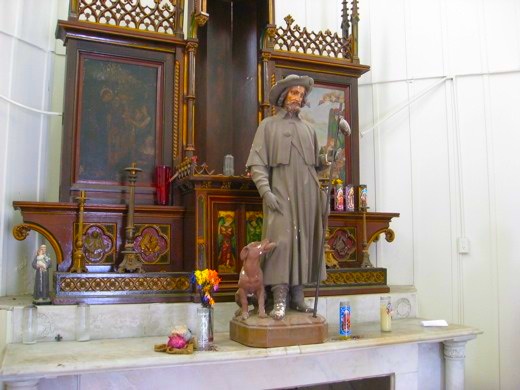
After he’s wandered the French Quarter for the thousandth time and snapped a sufficient number of crawfish in half, what does the errant medievalist do when he’s in New Orleans? Demonstrating a disregard for common sense which he urges his dear readers not to emulate, he seeks out a shrine to a medieval saint in the city’s Ninth Ward.

In the heart of a half-abandoned neighborhood, the small, above-ground cemetery occupies two compact blocks.

The saint’s shrine is pleasant but unremarkable—until you look at it from the side. Then it become an apse whose cathedral has flown away.

Inside the shrine stands the saint, with a friend. According to medieval legend, Roch miraculously cured the sick while making the pilgrimage to Rome. Eventually he also came down with the plague, but miracles—and food provided by a dog—kept him alive. The dog’s name is unknown, but “it has been reported that some people think the dog is at least as holy as Roch and offer prayers to the dog.”

In 1867, after his entire congregation survived a yellow fever outbreak, the New Orleans priest who prayed for the saint’s intercession raised this shrine in thanks—and, as an inscription over the front door reveals, “in fulfillment of vow.”

A barred alcove holds a collection of tokens offered by the grateful. Most of them represent body parts believed to have been cured through the saint’s intercession. Several pairs of old, awful crutches hang against the wall.

Outside, even as a storm rolls in, the cemetery is peaceful: empty, but hardly sad.

A hint of sadness waits across the street, where a monument to miraculous cures faces the troubles of the 21st century. Rarely have the Middle Ages seemed like the more hopeful place to be.

“It’s obvious we’re cooler now…”

I started this site one year ago, not knowing quite where it would lead. But you came, you saw, you read—and to my great surprise and delight, you kept on coming back. Visitor numbers increase every month, and I’m heartened to know you’ve found something worth reading, whether over your coffee and toast every morning or as part of your efforts to kill time at work.

Since the bulk of my blogging is not about me, a few friendly readers have told me I’m “cryptic.” In response, I’ve whipped up an “about” page, which you can read by clicking my name at the top of the sidebar. (Be warned: It’s not exactly Krishna revealing himself to Arjuna.)

To everyone who visits, links, leaves comments, and browses this site via feed readers: thank you! Keep reading, and I’ll gladly continue to ply you with strained historical analogies, silly videos, makeshift medievalism, and the eloquence of other people.

“When everything’s quiet, will you stay?”

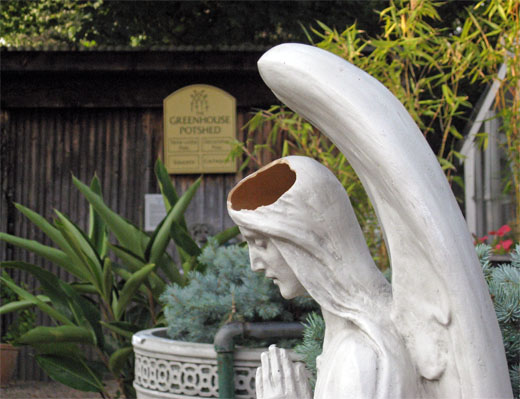
Walahfrid Strabo is always at work on the grounds of my local cathedral. The ninth-century abbot who tutored Charlemagne’s grandson is remembered in the garden, where a stone baptismal font is surrounded by plants he described in a poem. Gardening gave Walahfrid the metaphors he needed to talk about the world. Plurima tranquillae cum sint insignia vitae was the sum of his teaching: “A quiet life has many rewards.”

More than eleven centuries later, Walahfrid would probably be as troubled as today’s neighbors were when they learned the cathedral is closing its greenhouse.

In “On the Cultivation of Gardens,” Walahfrid wrote that a plot full of flora was evidence of hard work repaid, a notion that made him an optimist:

True, that part there
Below the high roof is dry and rough from the lack
Of rain and the heaven’s benison; true, this
Part here is always in shade, for the high wall’s
Solid rampart forbids the sun to enter.
Yet of all that was lately entrusted to it, the garden
Has held nothing enclosed in its sluggish soil
Without hope of growth.

Friends of the greenhouse aren’t nearly as hopeful; the cathedral insists its decision is final. Walahfrid, who found poetry easy but gardening hard, would likely see metaphors here.

The closing will make us one metaphor poorer. In a city that thrives on ephemeral matters, it’s a pity to lose a place that hints at the timeless rewards of a quiet life.

“Les yeux sans visage…”

Humidity be darned, here are some writing-themed links for a stuffy summer weekend.

At The Story’s Story, Jake revists the cheeseball novel Day of the Triffids and contemplates the signals he’s receiving from the publishing industry as he shops around his science-fiction novels.

Ephemeral New York finds written proof that the East Village never changes.

Steven Hart notes that Philip K. Dick’s Library of America editions are selling well.

Art Durkee says not to seek out advice about writing. (Link via Books, Inq.)

Market research may not be the publishing industry’s strong point, but Random House and Zogby International have started to put faces to pairs of anonymous eyes. Their nationwide poll (12-page PDF here) does help explain who purchases books, but it won’t tell you why people bought your book—so authors, keep those runestones and pigeon livers handy!

Finally, since it’s going to be a scorching outside, here are two videos to keep you cool: Jose Iturbi listening patiently to “Route 66” and then demonstrating the real way to play the song. After that, who needs air conditioning?

“Tusk…tusk…”

Years ago, in days of old, I was an aspiring cartoonist. Pathetically, I still nurse vain daydreams about literally going back to the drawing board—so it made my week to learn that I helped inspire, however tangentially, a character in a forthcoming Kid Beowulf graphic novel. Can Charlemagne plush toys be far behind?

Here’s an interview with Kid Beowulf creator Alexis Fajardo, who explains why he chose to develop an all-ages comic in which a 12-year-old Beowulf and his brother, Grendel, romp through the epics of the world:

I was always a bit of a mythology nut when I was a kid so I was familiar with these types of stories. But BEOWULF was the first epic poem I ever read and I remember being struck by the language of it; it was very different from the language of Bulfinch’s or those dreaded “novelizations” of epics that seem crop up. Believe it or not, the poetry really popped: the specificity of the visuals and the characterization of the heroes clicked for me in a way that those other stories didn’t. Epic poetry sounds boring, but it really isn’t, a lot of it depends on the teacher you get and the translation you read, because these heroes are bad-ass and worth reading about.

Fajardo describes his work as “a weird hybrid of the humorous and the heroic,” a worthy combination. It’s no secret that English teachers often inspire cartoonists; it’s neat to see a cartoonist returning the compliment.

“And the fox is on the town-o…”

Do you ever feel like a crepuscular critter in a diurnal world? I do, because I am, but sleeplessness hath its benefits: while most of Washington is lost in slumber, I can go outside, walk ’round the corner, and catch a rare glimpse of our neighborhood fox.

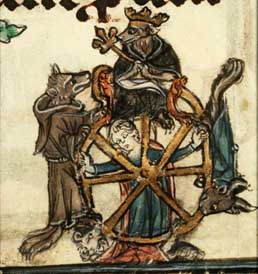
Foxes are uncommon in the middle of cities, but this one appears to be prospering; he’s getting so big that he’s easy to mistake for a coyote. I worry, though, because he’s been spotted darting across our busy intersection at night. The life of a fox is, alas, precarious. How long can his good fortune hold out? I pose this question as a flimsy pretext for reproducing this wonderful medieval image of foxes on the Wheel of Fortune.

For more about this illustration (which comes from a medieval psalter) and to learn more about the foxes of story and song, check out Carl’s latest post at Got Medieval (whence swiped I yonder image) or hark back to his April post, which he illustrates with a medieval fox behaving rather lewdly. Both posts will introduce you to Reynard, the ultimate bad-boy of medieval animal stories and a varmint who always seems to be at the top of Fortune’s wheel.

If you’re more keen on seeing a fox get busted—perhaps you’ve lost a chicken to the jaws of le renard?—enjoy a little “Quid Plura?” flashback and read a poem by Theodulf of Orleans about an incident at the monastery of Charroux. Fortune’s wheel is always whirling, even for a fox in dapper clothing.

While I’m going on about foxes, here’s Nickel Creek’s rendition of the folk song “The Fox,” and here are several video variations on a modernized medieval beast fable: the “Oo-De-Lally” scene from Disney’s Robin Hood in English, German, Swedish, Russian, French, Catalan, Hebrew, and Arabic. Let it not be said that we’re not multicultural on this site—or that we can’t find ways to string together a variety of trifles to give you something, however flimsy, to browse on a humid June morning.

“I read about it free in a fifty-cent illustrated guide…”

A few spiffy links for your Thursday:

At the pop-culture blog “A List of Things Thrown Five Minutes Ago,” my friend Heather is watching the National Spelling Bee. Heather, one smart cookie, did the Bee 25 years ago; her first post is here.

Who was that girl on the cover of “The Freewheelin’ Bob Dylan”? Steven Hart is reading her memoir.

Ephemeral New York wants you to meet the 19th-Century Hipster Queen.

Books, Inq., points out an outdoor Latin language club for Oxford suburbanites.

Unlocked Wordhoard notes the death of Robert Asprin, whose fantasy novels were omnipresent in the days when bookstores (and bookstores’ genre sections) were much, much smaller.

Withywindle ponders the lyricism of Roger Miller.

Speaking of Roger Miller, I’ve declared him the official country singer of “Quid Plura?” Here’s a good video for a languid day: Miller doing a live version of “Whistle Stop.”