“Er war so exaltiert, because er hatte Flair…”

Too few of us are lucky enough to associate the Middle Ages with Newark, Delaware, but I’m glad to know at least one other soul who does: Matthew Gabriele, who returned to the University of Delaware last weekend to deliver the keynote address at the Undergraduate Research Symposium.

Over at Modern Medieval, Matt has posted his entire speech, an accessible and interesting summary of the Crusaders’ use of Charlemagne and the influence of that connection on modern rhetoric. The result is a passionate defense of the study of history, a response to the cries of so what?—”a valid question,” sayeth Matt, “albeit one that scholars too rarely think to ask, let alone answer.”

(I should add that Matt incubated his work at UD in the days when Newark—or, as I like to call it, “the Aachen of I-95″—had only three bars, no coffee shops, and hardly any chain stores. Why, conditions back then were downright barbaric…)

“They rose up out of a sinking sand…”

My interest in Tolkien is passing at best, but lately I just can’t escape him. Here are a few clever Tolkienesque tidbits that popped up last week on the Web.

Steven Hart is willing to give Guillermo del Toro a shot at directing The Hobbit.

At The One Ring, they think del Toro faces a “dragon problem.”

Elberry ponders hatred in The Lord of the Rings. (Link via Books, Inq.)

At The Cimmerian, Steve Tompkins revisits The Silmarillion. (Link via Wormtalk.)

Heading to Birmingham? Why not visit “Tolkien tower”?

“Green thoughts come around every now and then…”

Hark! Open Letters Monthly has posted the fourth installment of Green, Adam Golaski’s funky translation of Sir Gawain and the Green Knight.

Here’s a typical passage, which shows how Golaski’s weird diction brings out the exoticism of the original:

Arthur’nd Arthur’s court
look’d long’nd in wonder, + wondered what kind’v man be-held them,
wondered what this magical spectacle must mean,
f’r’a knight’nd’is horse to’ve accrued such’a hue that is

green

green as th’grass’nd growing greener it seemed
green glow’n’nd bright’nd brighter than enameled gold.

Can Adam Golaski sustain this idiom through an entire translation? I don’t know—but after the past few years, when translations of medieval poems have met with such reverence, it’s nice to read one that’s just fun.

“Silhouettes and shadows…”

This weekend, why not wander out of the Middle Ages and into Ephemeral New York? This new blog, set up by a great friend of mine, exists to chronicle “an ever-changing city through faded and forgotten artifacts,” including 19th-century bicycle ads, ghostly painted advertisements, and long-gone elevated trains.

I’ve had the pleasure of bumming around the boroughs with the blogger in question. She loves New York, she has a sharp eye for historical curiosities, and her observations promise to be “sometimes wry and often wistful” rather than predictably snarky. Bookmark her blog or add her to your feed reader; her scans and snapshots are a welcome respite from the endless stream of words, words, words.

“In the house of the gods, where no mongrels preach…”

Are conditions in Thai shrimp factories “medieval”? Matt Gabriele considers the use of the m-word in a report quoted by CNN:

Maybe it’s just an adjective that means “other,” an uncritical, enlightenment perception of a darker past that we, generally, have moved beyond. And generally, I might like to agree. The problem, then, is that this kind of thinking asserts that such behavior—torture, kidnapping, etc.—are aberrant in our society, when in fact they’re really not. Certainly, all that stuff was there in the Middle Ages too. The thing is though, it never left.

Matt’s conclusion—that misery and human cruelty aren’t consigned to the past—is sensible, and worth reiterating; people do have a tough time getting beyond the pejorative implications of “medieval.” My Chaucer students, for example, know that Chaucer himself was well connected, and they understand that the Powers That Be had neither the resources nor the inclination—nor, for that matter, any real reason—to persecute him for his poetry. And yet my students wonder: Feisty women, farting, harshing on friars—how did Chaucer get away with so much?

The misperception that Chaucer “got away with” something isn’t surprising; his humanity, sensibility, and wit run counter to stereotypes about those oppressive Middle Ages. It takes gentle persuasion to convince students to see Chaucer as a poet who can illuminate his era for modern readers, allowing them to put aside preconceptions and behold his world anew—and then, if they’re lucky, rediscover their own.

But sometime it’s fruitful to try the reverse: to ponder a modern subject that puts the medieval world in context. That’s why I couldn’t help but consider Chaucer recently while reading a new biography of a decidedly un-medieval figure: pioneering black filmmaker Oscar Micheaux.

Born in 1884 to former slaves, Micheaux worked as a Pullman porter before becoming a homesteader in South Dakota. He self-published and promoted three autobiographical novels; then, between 1919 and 1948, he wrote, directed, and produced more than 40 movies for black audiences. Motivated by his near-worship of Booker T. Washington and inspired by stories of self-made men, Micheaux was an entrepreneur, an auteur, a fascinating American figure.

He was also a wonderfully Chaucerian guy. Attentive to the quirks of human nature, Micheaux made films that featured, but didn’t glamorize, the black underworld, where a motley pageant of lowlifes and gamblers spouted racial epithets; he even offered the occasional hint of nudity. Micheaux dabbled in multiple genres, sometimes recombining beloved story elements in bizarre and amusing ways: a musical comedy about a haunted house, for example, or a morality play about racial segregation that also featured Alaskan frontiersmen, wild dream visions, and an assortment of scoundrels and saints. Micheaux was something of a scoundrel himself, a raconteur who traveled the country and who would happily lie, cheat, and even plagiarize to promote the few prints of his films he was able to afford. Cheerful, beguiling, optimistic, and perceptive, Oscar Micheaux was was a grand character: Chaucer’s plowman, pardoner, squire, and alchemist all rolled into one.

So yes, Micheaux was interesting—but why strain to see a connection between him and Chaucer? Because Micheaux, a modern artist, suffered “medieval” repercussions that Chaucer never experienced. Beyond having to deal with blatant racism, Micheaux faced the wrath of both church and state when his films were literally snipped to shreds. Sometimes, censors banned his films outright, denying black audiences the opportunity to see his take on black people who “passed” as white, or depictions of lynching, or—Heaven forbid—black and white people dancing together. State and local censors were often clergy who objected, naturally, to one of Micheaux’s recurring character types: the corrupt, hypocritical preacher.

Treated as a fourth-class citizen, denied the ability by clergy and government officials to show his films as he envisioned them, Micheaux was often broke, even bankrupt, and was completely ignored by the mainstream white press. Although film historians recently rediscovered him and restored a few of his movies, his persecutors can’t be said to have failed. They succeeded at suppressing him; his obscurity was their victory. Today, we have a greater percentage of Chaucer’s 14th-century corpus than we have surviving films by Oscar Micheaux, who faced the sort of institutional censorship my students expect from the medieval world, even though Micheaux died only in 1951.

“Maybe,” Matt Gabriele writes in his post about “medieval” shrimp factories, “we all should acknowledge that good stuff and bad stuff happens to all people, at all times, in all places.” That’s one of many lessons to take from the life of Micheaux. Unlike Chaucer, who had little to fear, Micheaux “got away with” much, but he suffered much as well.

If the poetry of Geoffrey Chaucer reminds us not to judge all medieval people by the worst aspects of the Middle Ages, then the career of Oscar Micheaux warns us not to judge our own era only by its best. The life story of an ambitious black filmmaker reminds us that the modern world is hardly bereft of “medieval” indignities. We live in more comfortable, prosperous times, but we ought to think twice before assuming we’ve nothing in common, really, with medieval people.

“What was the question? I was looking at the big sky.”

The past is a foreign country—and, as David Brooks has discovered, they don’t hold presidential elections there. The New York Times columnist recently read an essay about C.S. Lewis and the medieval view of the cosmos and became rather fond of it. Imagining the world through medieval eyes is, Brooks claims, a “refreshing dip in a cool and cleansing pool” after covering politics for more than a year:

There’s something about obsessing about a campaign—or probably a legal case or a business deal—that doesn’t exactly arouse the imaginative faculties. Campaigns are all about message management, polls and tactics. The communication is swift, Blackberry-sized and prosaic. As you cover it, you feel yourself enclosed in its tunnel. Entire mental faculties go unused. Ward’s essay has been a constant reminder of that other mental universe.

It’s a pleasure to see a political columnist, someone who’s immersed in the dreary ephemera of campaign journalism, pause to contemplate a subject as profound as conflicting views of the heavens across the centuries. It’s also gratifying to see an op-ed writer acknowledge that medieval people were not mental primitives, but that they may in fact have made better use than we do of certain mental faculties.

Unfortunately, Brooks stops short of neo-medievalist epiphany:

The medievals had a tremendous capacity for imagination and enchantment, and while nobody but the deepest romantic would want to go back to their way of thinking (let alone their way of life), it’s a tonic to visit from time to time.

Notice his last-minute change of heart: what has been a “constant” reminder of the medieval world will, in the end, only be useful to him “from time to time”—and then only as a form of escapism.

Brooks’ cheerful hesitance reminds me of some of the students I’ve met. Happy students tend to fall into two camps: the friendly, chatty souls who chirp “fun class!” as they hand in their finals and forget what they’ve read; and their more serious classmates, the ones who know that having been amused or distracted for fourteen evenings is hardly enough, the folks who hearten me by emphasizing, when they say goodbye, how much they learned during the semester. Most of them will never be medievalists, but a tiny piece of the Middle Ages—a character, a stand-out scene, a piece of historical context, a few lines of life-changing poetry—will always be a part of them.

In his column, Brooks demonstrates that he’s willing to ponder a new notion, turn it over a few times, and marvel at the alien beauty of a mindset other than the modern. But he’s reluctant to make that more audacious leap, the one that requires him to return to the present with what he’s learned in the hope of seeing the modern world anew. The Michael Ward essay clearly dazzled him, but the resulting aesthetic and intellectual experience remains a novelty he can’t or won’t internalize. Medieval history, he implies, will not enhance his analysis of polling data, inform his ruminations on current trends, or alter his understanding of social dynamics; it’s simply a distraction. Like students who are so happy to be entertained that they can’t be bothered to think a little harder, Brooks is denying himself, after 15 months on the campaign trail, what more political writers surely need: a fresh, overwhelming perspective.

“Keeping versed and on my feet…”

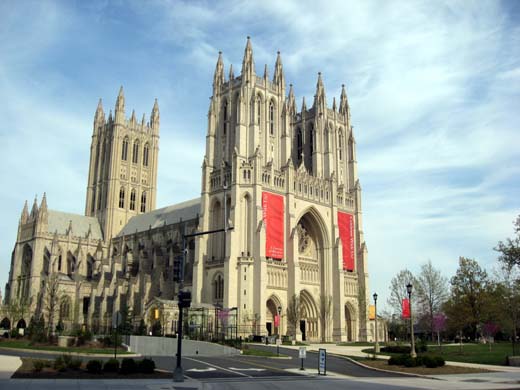
As Today in Literature reminds us, yesterday, April 18, was the day Chaucer’s pilgrims set out for Canterbury. Appropriately, my block was packed with pilgrims passing to and fro, some of them heading to the zoo, the hooly blisful pandas for to seke, others hiking up the hill to our friendly neighborhood Gothic cathedral.

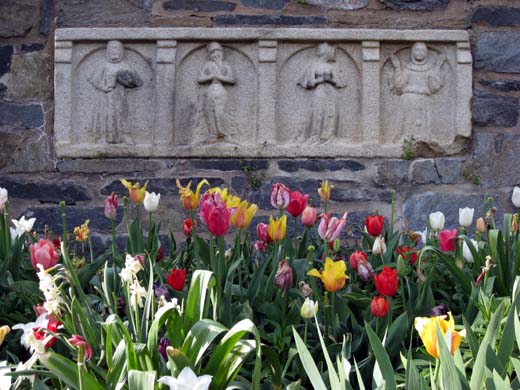
The cathedral grounds were in full bloom today: camera-toting tourists, elderly couples asleep in the grass, wedding parties, flirting lovers, romping puppies, children fleeing bees, even bagpipers, as if to lead us grandly out of town. Beauty intermingled with chaos; Chaucer no doubt would approve.

But not every medieval poet took the path of the pilgrim for granted. Writing six centuries before Chaucer, that old wit Theodulf, bishop of Orleans during the reign of Charlemagne, rolled his eyes at peregrinatory pretensions:

Qui Romam Roma, Turonum Turonove catervas
Ire, redire cupis cernere scande, vide.
Hinc sata spectabis, vites et claustra ferarum;
Flumina, prata, vias, pomiferumque nemus.
Haec dum conspicies, dum plurima grata videbis,
Auctoris horum sis memor ipse dei.

Here, inspired by an afternoon on the green alongside the Bishop’s Garden, is a shamefully loose translation:

You clamor for the crowd, for something more;
So take your tour of Rome, and roam to Tours.
The tender crops are all we gather here,
By berries, brooks, and barns, and byways clear.
So go—for if you stay, you’ll just recall
In simple sights the one who made it all.

I know! Spring fever is my only defense. The tulips made me do it.

In denying the pilgrimage instinct, Theodulf fought, with snide futility, the tide of human nature. Geoffrey Chaucer better understood his fellow man—in fact, I think Geoffrey better understood a great many other truths as well—but Theodulf was right about one thing: Some days, whatever it is you’re looking for, that unnamed source of fulfillment and beauty which seems like it ought to be elsewhere, may turn up outside your own door.

“Everybody’s coming, leave your body at the door…”

What are you doing? It’s a beautiful weekend! Get outside! Soak in some sun! Gather ye rosebuds, people!

Still here? Okay. Here are some quasi-medieval doodads to occupy your curious minds.

Washington Post writer Philip Kennicott has a maudlin take on the re-opened Byzantine collection at Dumbarton Oaks. “Getting visitors from there to the next level of understanding is the great desiderata of good museums,” says he, “and it rarely happens.”

Sure, Orson Welles was terrific as Falstaff in Chimes at Midnight, but few remember his triumphant turn as the pitchman for the electronic fantasy board game “Dark Tower.” You can play “Dark Tower” online and enjoy game artwork by Bob Pepper, who’s known for his trippy sci-fi book covers.

Journey back to the Dark Ages—the mid-1970s—and behold, if you dare, the Mystic Knights of the Oingo Boingo battling a dragon on “The Gong Show.”

Where have all the unicorns gone? Per Omnia Saecula will tell you. (Be warned: They’ve got their own planet now.)

“So let the wind blow, carry me home…”

Congrats to Jen A. Miller, whose guide to the Jersey Shore was published ahead of schedule. Jen is asking readers to share their Jersey Shore memories. Here’s one from a few years back.

* * *

At a counter down the shore, three adults debate the necessity of fluff.

On fries? Stuff dries like Elmer’s Glue, for cryin’ out loud. We don’t need it, not if they put it on top

“Comes onna side,” mutters Lex Luthor, who gives us no choice. So we partake of the fluff, though it’s more than we need, and we continue to eat our way along the boardwalk. The rides are rolling, the rigged wheels are whirling, and strangely shaped people waddle past with pizza. Somewhere behind them is the ocean.

“Funny how little it changes,” says dad, getting philosophical. “Kids come here to goof around, and then they bring their own kids. It’s been that way for a hundred years.”

We browse: bandannas, frilly shirts, switchblade combs, and bowls of seashells shrink-wrapped for the shameless and the lazy. Everything reeks of sea salt and grease. Later, so will we, even when we’re hours away.

“If we bring your nephew up to visit,” mom says from behind her ice cream cone, “we’ll come here. They don’t have this in Louisiana.”

They sure don’t. I’ll show the boy his heritage: the tiki bar where his mom hung out and the skee-ball arcades where her boyfriends won a menagerie of stuffed animals, if not her heart. We’ll feed him real pizza and other native delicacies to teach the kid just why his uncle can stay here, scavenging like a seagull, watching metalheads-turned-family-men wander by, listening as old, familiar vowels rise and fall. Then maybe he’ll see what our home state can give him: his own rightful portion of fluff.

“…comme il pleut sur la ville.”

This weekend, if it must rain, then let it rain interesting links.

Scott Nokes offers a typically excellent round-up of medieval blogging.

Did you know that they were singing a prayer in Anglo-Saxon in the season premiere of Battlestar Galactica? (Major spoiler warning; thanks to Dave for sending the link.)

In Maastricht, a 13th-century church is now the world’s most beautiful bookstore. There’s a better photo here. (Link via Books, Inq.)

And I thought my neighbor with the booming TV was bad: In Moscow, students manufacturing medieval arms have blown up their apartment. (Link via The Cranky Professor.)

Pining for Rome? Eternally Cool finds relief in the Via della Reginella and discovers sheep performing public duty in Turin.

Non papa, sed cardinal: Latin pops up in the oddest places, such as this cheesy D.C. Metro ad featuring a bobbleheaded pontiff. (The archdiocese’s problem: he’s dressed as a cardinal.)

Steven Hart appreciates Steinbeck.

Leslie Pietrzyk will pay you to title her novel.