“…the dreams all made solid, are the dreams all made real.”

After fifteen weeks of teaching about King Arthur, reading about King Arthur, gabbing about King Arthur, and drumming into my students that King Arthur is omnipresent in modern culture, I shouldn’t find it weird when the creaky old king makes a cameo—but honestly, I hadn’t expected that a wrong turn in suburban Virginia would land me in the Camelot subdivision of Annandale, where the streets are named after Arthurian characters and motifs.

Unlike the occasional cul-de-sac dubbed “King Arthur’s Ct.” by some card of a developer, the Camelot neighborhood along the Beltway appears to have been mapped out around 1966 by someone whose knowledge of Arthurian legend wasn’t entirely facile. Lancelot, Merlin, Guenevere, and Arthur are all here, but characters who rarely surface in popular Arthuriana are also represented by such stately addresses as Balin Court, Bedivere Court, and (my favorite) Pellinore Place. Charmingly, Lancelot Way meets Guenevere Drive while King Arthur Road does not—although King Arthur Road does cross Saxony Drive before turning into something else.

There’s no Mordred Avenue, but the residents of this particular Camelot probably hope their neighborhood leans toward Lerner and Loewe rather than Tennyson. Mortgages and foreclosure are mundane subjects for Arthurian legend, but nowadays “my house hath been my doom” might hit too close to home.

“Little lines, in the ice, splitting, splitting sound…”

So yesterday, Washington got snowed on; tonight, freezing rain has encrusted the city in ice, which, while all sparkly and picturesque, is sufficiently treacherous to prevent a muddle-headed, flu-fighting medievalist from hitting the streets at 2 a.m. in search of his remedy of choice: an assortment of donuts from 7-Eleven.

And so, donut-deprived, frosting-forlorn, bereft of blueberry filling, I can only squint pensively at the snow from my window and be glad I’m not Charlemagne, who likewise tries to settle his brain with a bit of twilight snow-gazing in Longfellow’s “Eginhard and Emma”:

That night the Emperor, sleepless with the cares
And troubles that attend on state affairs,
Had risen before the dawn, and musing gazed
Into the silent night, as one amazed
To see the calm that reigned o’er all supreme,
When his own reign was but a troubled dream.
The moon lit up the gables capped with snow,
And the white roofs, and half the court below,
And he beheld a form, that seemed to cower
Beneath a burden, come from Emma’s tower…

You’ll have to read the whole thing to find out what Charlemagne spied with his imperial eye. (Hint: it wasn’t a donut.)

The story of Eginhard and Emma was popular during the 19th century: It was retold in corny books about Rhineland legends, Strindberg turned it into a short story, and Schubert made it part of his opera Fierrabras. How the actual fling between Charlemagne’s daughter Berta and his adviser Angilbert got transformed into a romance between Charlemagne’s biographer and a wholly fictional daughter is a mystery to me, but it’s a ready-made thesis for a dissertation, or at least the starting point for an ambitious novelist with a penchant for romantic fantasy.

To his credit, Longfellow kept his version both eloquent and concise, giving us lots of memorable couplets and a lovely description of Alcuin. It’s no donut—but really, what is?

“…but on the way, you know that I will abide.”

Living through history is unnerving. As an unknown number of visitors descend upon the city—a million strong? Five million? A few hundred thousand?—the urban core becomes an armed camp, the river becomes a defensive wall, and mobs cross the bridges on foot. After clambering over monuments, some folks shack up with locals who’ve turned into hostelers, a few of them are bound to be scammed, and the authorities scramble to react to an influx of tourists whose movements are decentralized and largely spontaneous.

The medieval Romans may not have draped patriotic bunting across the facades of their buildings, but 710 years ago, they braced for unprecedented crowds. In late 1299, apparently with no official prompting, pilgrims began streaming into Rome, driven by the widespread belief that the year ahead offered special blessings to those who visited the graves of St. Peter and St. Paul.

Here’s Paul Hetherington on what became the Church’s first Jubilee Year:

The word spread like wildfire through Europe, and even by New Year’s Eve of 1299 a great crowd had assembled at St. Peter’s to greet the opening of the Jubilee Year at midnight. From then on, the crowds flocked to Rome from all over the known world. No one had ever experienced anything like it before. The crowds were so massive that the papal police had to institute a keep-right system for all the crowds crossing the bridge on foot that led over the Tiber to St. Peter’s . . .

The spontaneity and scale of the Jubilee took everyone by surprise. Even the pope, Boniface VIII, seems to have been nonplussed by it, and only issued the decree authorizing it late in February 1300. The various estimates made by contemporaries of the numbers that visited Rome vary so wildly that none can be regarded as trustworthy, but it was probably somewhere between one and two million.

Hetherington translates an eyewitness account by chronicler William Ventura, who visited Rome at the end of 1300:

It was a marvellous thing how many went to Rome in that year, for I was there and stayed for 15 days. Of bread, wine, meat, fish, and fodder for horses there was, but all at special prices…Leaving Rome on Christmas Eve I saw a great crowd that I was not able to number; there was a report among the Romans that there were then more than two million men and women in the city. Several times I saw men and women trampled under the feet of others, and even I was in the same danger, only just escaping on several occasions. The Pope received an untold amount of money from them, as day and night two priests stood at the altar of St. Paul’s holding rakes in their hands, raking in infinite money…And I, William, was there and earned fifty years and more of indulgence. Each hundred years it will be the same.

Like all pilgrimages, Tuesday’s inauguration and its attendant brouhaha will be a pageant of honor, corruption, villainy, and holiness, so if you’re in town, and if your peregrinations take you to Connecticut Avenue, look for me. Adapting the experience of William Ventura to Washington tradition, I’ll be pacing the sidewalk with ful devout corage and wielding my new favorite medieval-themed religious implement, the money rake. Commit yourself to change—or simply fling cash. I promise it will go someplace deserving. Weary pilgrim, have faith in me: I wol yow nat deceyve.


“Then I went off to fight some battle…”

On Saturday, I’ll be sitting on a panel at “Going Freelance,” a workshop sponsored by AIW and the Johns Hopkins writing program. Tilt your head and you can see the medievalist traces in this event if, like me, you were told in grade school that “freelance” was a term to describe medieval soldiers of fortune. Of course, medieval mercenaries did exist, but “freelance” isn’t a medieval word at all. The term was coined by Sir Walter Scott, the 19th-century author who almost singlehandedly inspired quasi-medieval fandom in the English-speaking world.

From The Knight and the Umbrella, here’s Ian Anstruther explaining how Scott lit the fire under the Victorians who romanticized and reinvented the Middle Ages:

It is hardly possible to realize today the immense influence of this author on contemporary drama, literature and art. His early poems like the Lay of the Last Minstrel and Marmion, which were first published in 1805 and 1808 respectively, and his great series of tales in prose which began with Waverley in 1814 and reached its peak, according to many critics, with Ivanhoe in 1819 . . . truly hypnotised all who read them.

The proof of this may be seen at a glance in the catalogues of the major exhibitions throughout the country. In the twenty-five years between the first appearance of the Waverley Novels in 1814 and the Eglinton Tournament in 1839, two hundred and sixty-six different pictures inspired by the pen of the “Wizard of the North” appeared in public galleries; every summer without a break, a scene from Ivanhoe was the subject of two of them.

According to the Oxford English Dictionary, the first use of some version of “freelance” appears in 1820, in chapter 34 of Ivanhoe: “I offered Richard the service of my Free Lances.” The OED cites subsequent uses of “free-lance” or “freelance” as a negative term to describe politicians and journalists with minds of their own. By the early 20th century, “freelance” was a verb; soon, it came to refer to the self-employed.

If, in the spirit of medievalism (or at least dorkiness), freelance writers wanted to liken themselves to an authentic figure who represents the reality of late-medieval English contract law, they might see a kindred spirit in the Franklin from Chaucer’s Canterbury Tales. In the late 14th century, franklins were a newly prominent class of independent landholder. Not bound by hereditary feudal obligations, a franklin could sell his produce to the highest bidder while negotiating or even canceling deals. Like any successful freelancer, a franklin was blessedly exempt from the 14th-century equivalent of corporate team-building exercises, i.e., clearing woodlands, draining swamps, or taking an arrow in the sternum for a leek-breathed feudal lord.

But can you imagine telling your friends you’re a franklin? Can you imagine writing “franklin” under “occupation” on your tax return? It’s a legacy of the romanticized Middle Ages bequeathed to us by Sir Walter Scott and other writers, artists, and poets that we overlook the agricultural drudgery that defined most medieval lives, so that even we who sit and type all day can dream of jousts and banners bright, and tell ourselves we’re charging into battle.

“Back to school, it’s a bad situation…”

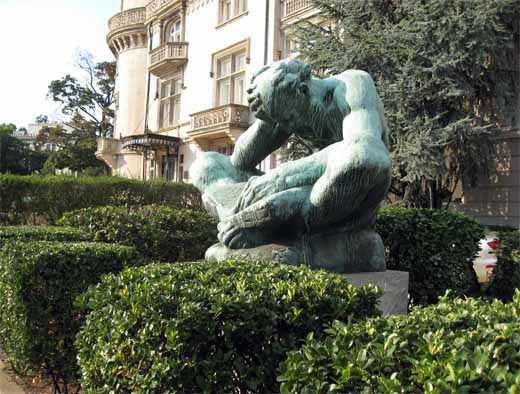
It’s back-to-school time for teachers and students alike. If you stroll along Massachusetts Avenue looking for inspiration, you’ll find this fellow at the Embassy of Croatia.

It’s Saint Jerome, who’s clearly immersed in his work. If you’ve ever grappled with Jerome’s page-length Latin sentences, you’ve probably made this gesture, too.

For many of you, the coming weeks will call for much sighing and staring at tomes. Whether you’re a teacher or a student, here’s to a pleasant and productive semester—without too much hieronymian clutching of the forehead.

“When everything’s quiet, will you stay?”

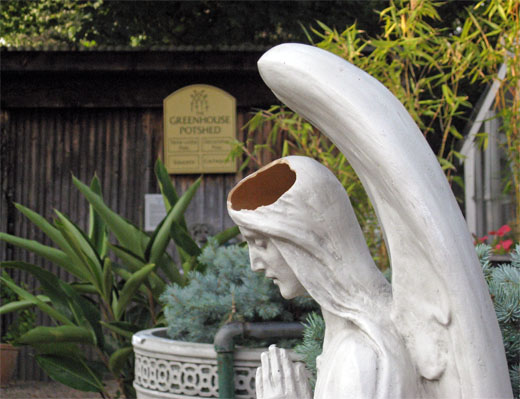
Walahfrid Strabo is always at work on the grounds of my local cathedral. The ninth-century abbot who tutored Charlemagne’s grandson is remembered in the garden, where a stone baptismal font is surrounded by plants he described in a poem. Gardening gave Walahfrid the metaphors he needed to talk about the world. Plurima tranquillae cum sint insignia vitae was the sum of his teaching: “A quiet life has many rewards.”

More than eleven centuries later, Walahfrid would probably be as troubled as today’s neighbors were when they learned the cathedral is closing its greenhouse.

In “On the Cultivation of Gardens,” Walahfrid wrote that a plot full of flora was evidence of hard work repaid, a notion that made him an optimist:

True, that part there
Below the high roof is dry and rough from the lack
Of rain and the heaven’s benison; true, this
Part here is always in shade, for the high wall’s
Solid rampart forbids the sun to enter.
Yet of all that was lately entrusted to it, the garden
Has held nothing enclosed in its sluggish soil
Without hope of growth.

Friends of the greenhouse aren’t nearly as hopeful; the cathedral insists its decision is final. Walahfrid, who found poetry easy but gardening hard, would likely see metaphors here.

The closing will make us one metaphor poorer. In a city that thrives on ephemeral matters, it’s a pity to lose a place that hints at the timeless rewards of a quiet life.

“And the fox is on the town-o…”

Do you ever feel like a crepuscular critter in a diurnal world? I do, because I am, but sleeplessness hath its benefits: while most of Washington is lost in slumber, I can go outside, walk ’round the corner, and catch a rare glimpse of our neighborhood fox.

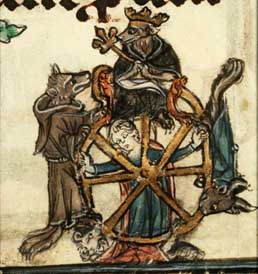
Foxes are uncommon in the middle of cities, but this one appears to be prospering; he’s getting so big that he’s easy to mistake for a coyote. I worry, though, because he’s been spotted darting across our busy intersection at night. The life of a fox is, alas, precarious. How long can his good fortune hold out? I pose this question as a flimsy pretext for reproducing this wonderful medieval image of foxes on the Wheel of Fortune.

For more about this illustration (which comes from a medieval psalter) and to learn more about the foxes of story and song, check out Carl’s latest post at Got Medieval (whence swiped I yonder image) or hark back to his April post, which he illustrates with a medieval fox behaving rather lewdly. Both posts will introduce you to Reynard, the ultimate bad-boy of medieval animal stories and a varmint who always seems to be at the top of Fortune’s wheel.

If you’re more keen on seeing a fox get busted—perhaps you’ve lost a chicken to the jaws of le renard?—enjoy a little “Quid Plura?” flashback and read a poem by Theodulf of Orleans about an incident at the monastery of Charroux. Fortune’s wheel is always whirling, even for a fox in dapper clothing.

While I’m going on about foxes, here’s Nickel Creek’s rendition of the folk song “The Fox,” and here are several video variations on a modernized medieval beast fable: the “Oo-De-Lally” scene from Disney’s Robin Hood in English, German, Swedish, Russian, French, Catalan, Hebrew, and Arabic. Let it not be said that we’re not multicultural on this site—or that we can’t find ways to string together a variety of trifles to give you something, however flimsy, to browse on a humid June morning.

“Dann sind wir Helden…”

There, from the hilltop, I beheld the valley deep,
Where brave King Lothar crushed his foes
As they took flight across the little stream.

On Charles’ side, on Louis’ side as well,
The ground grows white with shrouds to cloak the dead,
Just as in autumn, when fields grow white with birds.

– Angelbert, survivor of the battle of Fontenoy, A.D. 841

“Give me a word, give me a sign…”

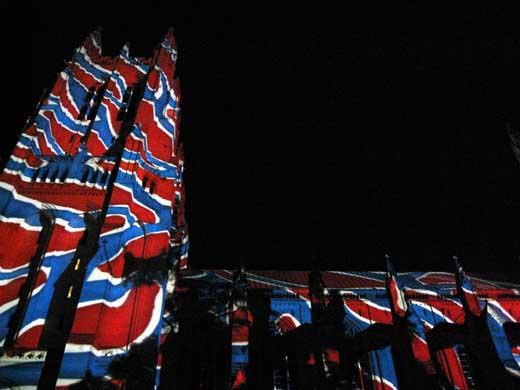
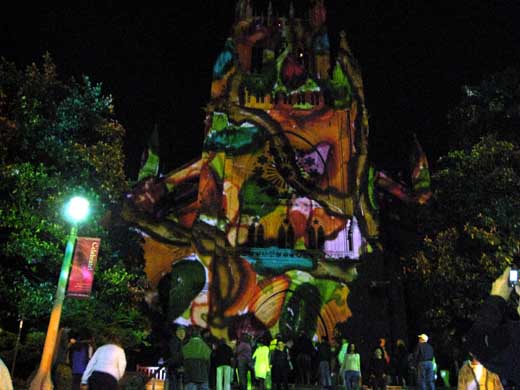
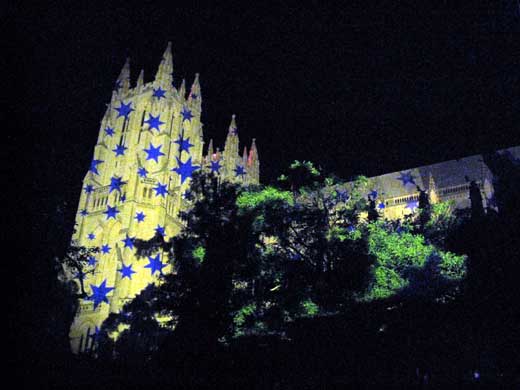
You may be enriching your knowledge and refining your scholarship, American Blogging Medievalist Community, but one Washington cathedral is having the best weekend ever.

For three nights, Swiss artist Gerry Hofstetter is projecting a colorful slide show onto the western and southern sides of the National Cathedral. Supposedly, the images are devoted to “illustrating [the cathedral’s] mission of reconciliation, spotlighting its role as a spiritual beacon for the nation, and proclaiming hope for all humankind,” but mostly they’re just eye-popping fun.

Thousands of people gathered on the grounds tonight. Traffic slowed; families kept their kids up late; couples huddled in the gardens and on moonlit benches; a group of frat guys cheered like sports fans every time the colors changed; and an older lady told me that the light show was “better than fireworks, because here you have time to think about each one.”

Groovy, baby!

We are stardust, we are golden…

One passerby muttered, “How much artistic skill does it take to project an image onto a building?” There’s an argument to be made from that, but how often do workaholic Washingtonians pause to look up and reflect? Making stressed people patient with lights, shapes, and symbols—that, in itself, is an art.