“World tour, media whore, please the press in Belgium…”

Friends tell me I’m underzealous in promoting my own books. I see this blog as something other than a relentless sales pitch—but since April is the dubious “National Poetry Month,” it’s time to tout two titles. I’ll say only this: If you enjoy the way this blog chases down medievalism in everyday life, then the “Quid Plura?” team of kobolds would be grateful for your support.

In 2009, after promoting my Charlemagne book and working on projects for other people, I was word-weary and exhausted. To make writing fun again—without worrying about marketability, editors’ impressions, or other people’s needs—I started composing poems inspired by the gargoyles and grotesques that adorn my friendly neighborhood neo-Gothic cathedral.

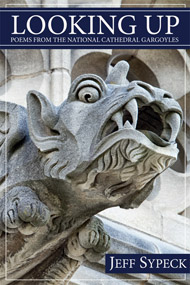
Light verse! Sonnets! Strange soliloquies and songs! Translations from Latin and German! Three years and more than fifty poems later, the folks at the cathedral graciously gave me permission to show their typically publication-shy beasties in print. The resulting book, Looking Up: Poems from the National Cathedral Gargoyles, is now available at the cathedral gift shop, through Amazon, or (most profitably) directly from me. I’ll donate 75 percent of the net profits to the National Cathedral to help repair damage from the 2011 earthquake. It’s my way of saying thank-you for the many quiet afternoons I’ve spent on the cathedral grounds. (Browse the first drafts of 51 of the 53 poems, and learn more about the book here.)

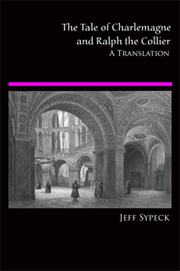
In 2007, I translated the 15th-century romance “The Taill of Rauf Coilyear,” a 972-line Middle Scots poem about the kerfuffle that ensues when Charlemagne, separated from his entourage by a snowstorm at Christmastime, seeks refuge in the home of a proud and irascible collier (a sort of medieval Tommy Saxondale). Combining folklore motifs with burlesque humor and elements of chansons and chivalric romances, “Rauf Coilyear” is a lively but rarely-read tale of courtesy, hospitality, and knighthood. To my knowledge, it’s also the only medieval romance in which Charlemagne totally gets slapped in the face.

The translation was an experiment: I wanted to see if I could imitate all 75 of the original poem’s tricky rhyming, alliterative, 13-line stanzas in a translation that was both readable and entertaining. (Check out “The Taill of Rauf Coilyear” in its original Middle Scots to see what I was up against.)

The Tale of Charlemagne and Ralph the Collier is now available through Amazon as a $10 paperback. There’s also an e-book specially formatted for the Kindle. (To get a taste of the translation, sample this low-res PDF of the first few pages.)

No one else has translated “Rauf Coilyear” into rhyming, alliterative, modern English verse, and I doubt anyone else will be nutty enough to try—so whether you’re a longtime reader of this blog, a student of medieval literature, a fan of old-fashioned poetic formalism, or a collector of truly obscure manifestations of Charlemagniana, I hope you’ll find this translation a satisfying read. Despite what Mamillus claimed, sometimes a sad tale isn’t best for winter after all.

“…und auch das größte Wunder geht vorbei…”

Poems, novels, short stories—we expect creative works to be labors of love, but it’s easy to forget how personal a work of scholarship can be to its creator, and how much is riding on the most arcane and specialized tomes. In an atypically personal blog post, Anglo-Saxonist and Tolkien scholar Michael Drout remembers the low point in his career, when his love for his work was fizzling out:

In 2001 I had been stuck. The success of Beowulf and the Critics was combining with the difficulty I was having in putting together my first monograph on Anglo-Saxon to pull me away from the field. Kalamazoo that year had been a big, depressing disappointment. What other people seemed to find exciting did nothing for me, and the terrible job market had caused a number of my friends to leave academia altogether. The intellectual spark had gone out.  Anglo-Saxon studies was following a path that led only to insignificant but all-consuming quibbling. The field was entangled in miserable thickets of personal and institutional politics, and those who–through the positions they occupied, if not the work they were no longer doing–should have led were instead dissipating the hard-won intellectual inheritance of our titanic forebears (not on debauchery, more’s the pity, but on orthodoxy, groveling, scheming). It was just a radical change from my feelings of immense excitement at ISAS ’95 at Stanford or ’97 at Palermo or ’99 at Notre Dame. I wanted out, to be away from this whole field that I had loved so much.

I clearly remember sitting on the floor of O’Hare airport at 6:30 a.m. on Sunday morning exhausted (having gone to bed at 3:00 and gotten up at 4:30), bored, and with a five-hour wait ahead of me, thinking that this was going to be my last Kalamazoo. I would focus on Tolkien, get my tenure in a couple years, and spend my energies on my 1-year-old daughter.

What changed Drout’s life and restored his faith in his field? A book about what he calls “[p]ossibly the most boring set of ‘texts’ in the history of earth.” Whether you’re a scholar, an academic refugee, or a writer itching with doubt, check out Drout’s tribute to a scholar whose meticulous research and logical arguments gave his own work new direction—and “brought the dead to life.”

“You say, ‘ere thrice the sun done salutation to the dawn…'”

If you’re wont to ask, “Where can I see plays that have rarely been staged for 400 years?”, then hie thyself posthaste anon to Staunton, Virginia, where the American Shakespeare Center reanimates old scripts in a reconstruction of London’s Blackfriars Theater, and under truly humbling conditions: The actors perform in as many as five plays at a time, with multiple roles in each.

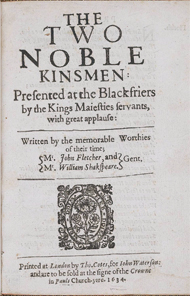
We popped down to Staunton this weekend to see The Two Noble Kinsmen, an adaptation of Chaucer’s “Knight’s Tale” by John Fletcher with an assist from William Shakespeare. The play is supposedly “deeply flawed,” but a dozen actors (who directed themselves) made it engaging and sharp. They earned a standing ovation—and propelled the Canterbury pilgrims through the 17th century and onto the sidewalks of a small Virginia town.

With my own ful devout corage, I did what I do in any new place: I hunted for further medievalism. After good finds in other Virginia towns—Williamsburg, Richmond, Annandale, and the imaginary Swallow Barn—I knew Staunton would come through, and it did, just up the hill from the theater.

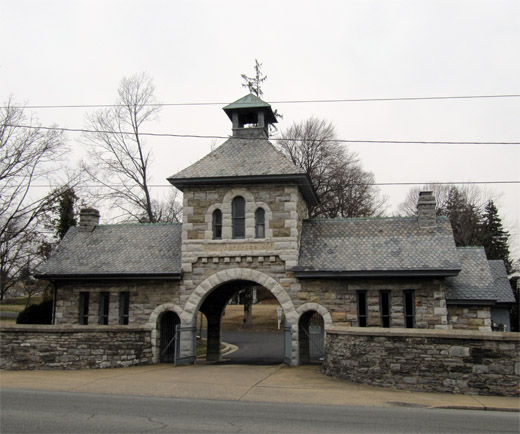
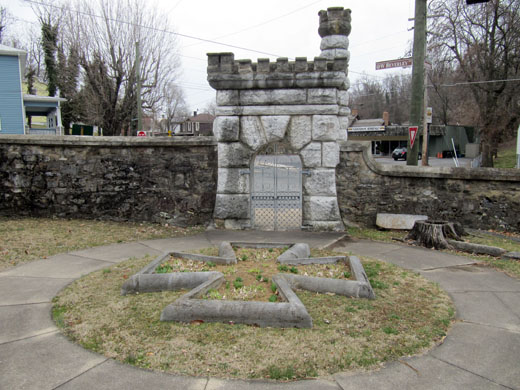
Welcome to Thornrose Cemetery, designed by Staunton’s own Thomas Jasper Collins, who built eclectic homes and churches throughout his adoptive hometown.

Although Collins never visited Europe, he did (according to James Madison University) study Gothic Revival architecture in Baltimore, Richmond, and Norfolk. Just inside the cemetery gates is a monument to his medievalism: a stocky little keep.

When Collins went medieval by the cemetery walls, his work was striking, if too weighty to be whimsical.

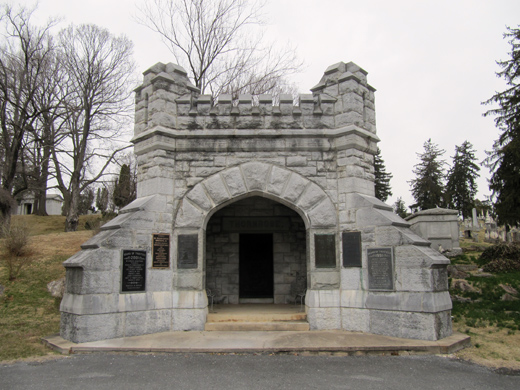
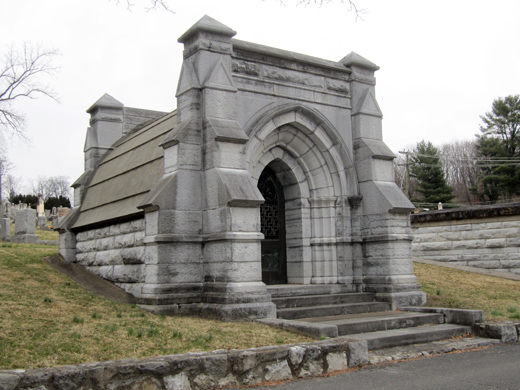
Collins also designed the lovely Effinger family mausoleum, which looks like a stone drawer pulled from the facade of a Gothic cathedral.

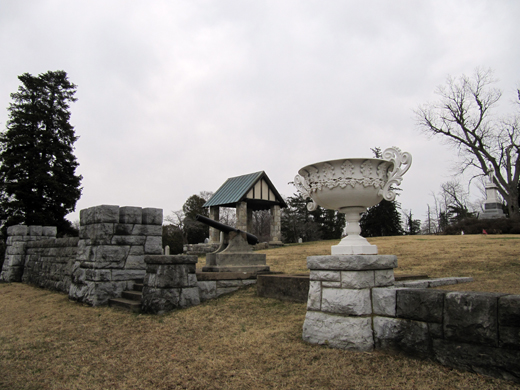
One of the weirder corners of Thornrose leads to a monument to the Confederate dead. There’s good reason to associate faux-medieval castle ramparts with Southern chivalry, but look:

A huge neoclassical urn! A chuppah with square stone pillars and Tudor half-timbering! Civil War artillery! The committee-driven incoherence is wonderfully American.

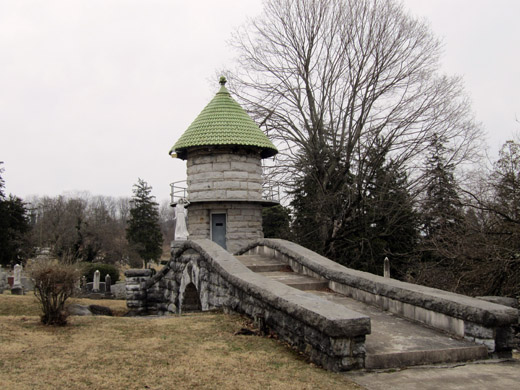
Like Staunton itself, Thornrose grows ever more eclectic. Its wind-worn headstones aren’t lurid or sad; there’s a matter-of-factness here that harks back to The Two Noble Kinsmen:

This world’s a Citty full of straying Streets,
And Death’s the market place, where each one meetes.

A few blocks away, on a gloomy Sunday morning, you might spot the fellows who play Chaucer’s knights leaning into freezing rain and muttering lines that have only been heard from a handful of actors in 400 years. Later, on stage, they’ll offer up a fine reminder for the week before Easter: not everything that dies is gone for good.

“Cool winds wash down your hope, and you slipped…”

When I was teaching, and books like Beowulf and The Faerie Queene hove into view, my students gamely kicked around a question: Does America have an epic?

Lonesome Dove. The Godfather. Roots. Each book or movie they floated was a lengthy, multigenerational take on an ethnic or regional experience. Other students brought up Star Wars and The Lord of the Rings, and one of them argued, with rare passion, for Stephen King’s Dark Tower/Gunslinger series. In the end, no one was satisfied. Ours, they sighed, is an epic-less nation.
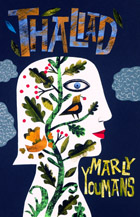
But if we don’t currently have an epic, the people who will live here someday may. That’s the premise of Marly Youmans’ eerie and beautiful Thaliad, a 24-book poem about seven children who survive a fiery apocalypse—and how one of them becomes the founding matriarch of a lakeside tribe in upstate New York.

Recounted 67 years later by Emma, a teenaged librarian who roves the wastes with sword and gun in search of unrescued books, the Thaliad fuses several out-of-vogue elements—formalist verse, narrative poetry, classical epic—to a familiar science-fiction trope. What grows from this grafting is a weird, fresh, magical thing: the story of a new world rooted in the ingenuity and optimism of “one who / Was ordinary as a stone or stem / Until the fire came and called her name.”

Like any classical epic, the Thaliad states its purpose: “to make from these paper leaves / A book to tell and bind the hardest times / That ever were in all of history.” Emma even invokes a muse, but in a nice teen-angst twist, she prays for inspiration from the dream husband she’s sure she’ll never have. “And so I am now married to the quill,” she vows with the melodramatic certainty of youth, recording the origins of her people in a tale that glows with mystical visions, prophetic messengers, and the hard bargain of a divine covenant.

What makes the Thaliad most compelling and real is a certain cheekiness in Marly Youmans’ choice of setting. The children who survive the unexplained holocaust migrate north, as Youmans did, and end up where she lives: Cooperstown, New York, with its nearby Glimmerglass Historic District and Kingfisher Tower, a (yes!) neo-Gothic folly on Otsego Lake. What fantasist hasn’t looked around and wondered what familiar streets and settings might someday become? In that sense, Thaliad recalls Ursula Le Guin’s Always Coming Home, and Youmans is at least as skilled as Le Guin at using mythic elements to solidify and universalize a story, from hints of Beowulf in the raising of funeral mounds to fateful echoes of Ophelia and the Lady of Shalott.

Because epic must be larger than life, Thalia and her fellow children are preternaturally articulate, as is their historian-poet, sometimes in amusing ways. When Emma praises Thalia’s ancestry, we learn that her mother was a doctor, while her father

           was unknown, donor of seed,
Impregnator without shape, a formless
Father of the mind who though a mortal
Receives immortal honors from our kind.

By crafting lofty language to describe an immaculate scientific conception, Youmans reminds Thaliad readers that we’re seeing everything in this poem through the eyes of a teenager and the distorting lens of epic—but also that we’re half-blind to the wonders of our own world. Three generations on, Emma doesn’t think much of us:

Then beauty was abolished by the state
And colleges of learning stultified,
Hewing to a single strand of groupthink.
It was a time bewitched, when devils ruled,
When ancient ice fields melted, forests burned,
When sea tossed up its opal glitterings
Of unknown fish and dragons of the deep,
When giant moth and demon rust consumed,
And every day meant more and more to buy.
Some people here and there lived otherwise,
But no one asked them for any wisdom,
And no one looked to their authority,
For none they had, nor were they like to have
The same—no one expects the end of things
To come today, although it must some day,
And so no one expected the great flares…

Fortunately, Youmans doesn’t rest on easy social criticism. Through unsettling depictions of cruelty, negligence, and loss, she argues that despair in times of horror is a choice, not an inevitability. Even as the Thalians struggle to preserve scraps of civilization, the stars over Cooperstown offer another chance for humanity to get things right. Keen to reinvent the constellations, Thalian poets gaze at a sky

Where unfamiliar constellations rule
A dazzling zodiac—the Nine-tailed Cat,
The Throne of Fire, the Fount of Anguishing,
Un-mercy’s Seat. I might go cruelly on,
But I have brooded for too long on fall
And desolation, hidden history
Of world’s end, thing unwritten in the books,
Its causes and its powers scribed on air
And seen out of a corner of the eye
Or not at all. Better to dream and say
That sparking zodiac shows sympathy
For trial and weariness, presenting Hope
In Silver Feathers, Gabriel in Light,
The Mother’s Arms, the Father’s Sailing Boat,
The Seven Triumphant Against the Waste.

To Youmans, whether you like what you see when you look heavenward depends entirely on what you want to see.

Youmans’ hopeful epic has a recent precedent: Frederick Turner’s brilliant science-fiction poem The New World, in which the learned citizens of a 24th-century Ohio republic fend off fanatics in bordering lands. Maybe two poets don’t represent a trend, but a few clever souls have begun to look beyond short, personal lyrics to rediscover the potential of narrative poetry. Christopher Logue’s retelling of Homer is one of the coolest long poems in decades, and Dana Gioia’s most recent book includes a ghost story in syllabic verse.

By writing an epic, Youmans is endorsing a poetic renaissance that has its detractors. Since the 1980s, dyspeptic critics have argued that neoformal poetry is too obsessed with poetry itself (at the expense, they say, of looking out at the world) and that neoformalism “decontextualizes” poetry. Of course, people who point out the same problem with the past century of visual art get dismissed as reactionary cranks, so I’m content to mutter “de gustibus…” and move on. Youmans’ poem is a call to restore old and beautiful forms of literature—that’s what Emma, librarian and historian, literally does when she speaks of the past:

It was the age beyond the ragged time
When all that matters grew disorderly—
When artworks changed, expressive, narcissist,
And then at last became just tedious,
A beetle rattling in a paper cup,
Incessant static loop of nothingness,
When poems sprang and shattered into shards,
And then became as dull as newsprint torn
And rearranged in boredom by a child
Leaning on a window seat in the rain.

Even so, the Thaliad isn’t just literature about literature. By building a plausible world in fiction, Youmans, like any good science-fiction writer, makes us more aware of the weirdness of the real world, where we should look for life in all sorts of seemingly dead things:

We found a sourwood tree that had been killed
By something, but the leaves still drooped in place,
Though every one had faded into brown.
When we came closer, leaves burst into wings—
The tree was green, the death was butterflies,
Alive and pouring like a waterfall
But upside down from us…

Not remotely a formalist novelty, the Thaliad is a remarkable book about surviving a crisis of faith.

Although the Thaliad runs only 102 pages, it’s a rich poem, and I couldn’t find room in this post for half of my notes. Detecting influences ranging from Milton to Cavafy to A.A. Milne, I reacted just as Dale Favier did:

But having finished, I turn at once to the beginning, to read it again, which is of course what one always does with a genuine epic. They begin in the middle of things because they understand that everything is in the middle of things: they’re structured as a wheel, and its first revolution is only to orient ourselves.

If they’re willing to take a chance, fantasy and science-fiction fans and even the “young adult” crowd might all find much to love here. The Thaliad is rare proof that verse need not be difficult or obscure—and that even now, narrative poetry can still leave readers, like Thalian children eyeing strangers in their orchard, “[e]nchanted into stillness by surprise.”

“Success or failure will not alter it…”

“A thousand skeptic hands won’t keep us from the things we planned,” Alcuin wrote to Theodulf of Orleans at the dawn of the ninth century, “unless we’re clinging to the things we prize.” Despite Alcuin’s optimism, life keeps me from updating “Quid Plura?” as often as I’d like, but here’s an enlightening array of late-winter links.

Return to Prydain with Jared Crossley’s 69-minute documentary about Lloyd Alexander, now out on DVD. (Disclosure: I did a small amount of unpaid work on this project.)

Looking for a lurid novel in the heavy-metal club scene? Warren Moore’s headbanger noir Broken Glass Waltzes is now out for the Kindle.

Erik Kwakkel looks for the oldest photo of a person with a medieval manuscript—and finds a heck of a shot from Ohio instead.

Speaking of minuscule, the Classical Bookworm finds wonderful tiny libraries (including one built from Lego).

Lingwë delves: Did Tolkien coin the plural “dwarves”?

Nancy Marie Brown turns back to half-forgotten fantasist E.R. Eddison.

So Many Books digs The Canon: A Whirligig Tour of the Beautiful Basics of Science.

Sarah Werner suggests that in the humanities job market, you make your own luck.

Writer and professor Ann Boesky recalls her life as a Sweet Valley High ghostwriter.

Wuthering Expectations cracks open “the most boring and mendacious author in the whole of German literature.”

Jake Seliger reads the urban-planning book Planet of Cities.

Steve Donoghue explores Sir Philip Sidney’s The Countess of Pembroke’s Arcadia.

Cynthia Haven fondly remembers Edna St. Vincent Millay.

First Known When Lost honors four-line poems.

“Look down, look down, there’s twenty years to go…”

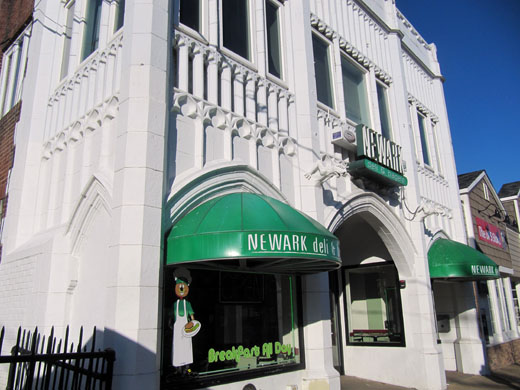
When you’re young, it’s easy to miss the obvious. Skulking around the University of Delaware in days of yore, I wasn’t unaware of this building on Newark’s Main Street, just footsteps from the campus—but I didn’t appreciate its striking Gothic facade, and until last weekend I hadn’t really looked at…

…the canine gargoyles on either side of the entrance.

Now prospering as Newark Deli and Bagels, the storefront at 36 East Main Street began life in 1917 as the Rhodes Pharmacy. The building was designed by Richard A. Whittingham, an architect of the Maryland division of the Pennsylvania Railroad. (His other works include a now-gone greenhouse on the U.D. campus and the reviewing stand for William McKinley’s 1897 presidential inauguration.)

I’ve not yet found reason to believe that either Whittingham or his client, pharmacist George W. Rhodes, were gung-ho for Gothic architecture—but maybe this cool little building says it all. (It used to have parapets!)

By 1917, American Gothic was passing its prime among church architects even as it picked up steam among the designers of college campuses. Its use on a commercial building is rare enough to earn 36 East Main Street a spot on the National Register of Historic Placesbut I’m convinced that the gargoyles of Newark, Delaware, were influenced by a much grander building thousands of miles away.

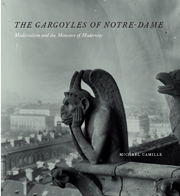
Notre-Dame de Paris! Its gargoyles are iconic—especially the bitter critter on the cover of this book—but even many medievalists aren’t aware that he and 53 of his fellows aren’t medieval at all, but the products of an ambitious 19th-century restoration.

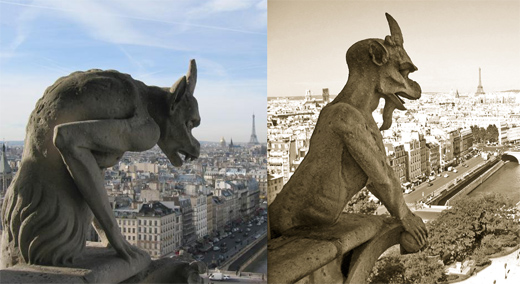
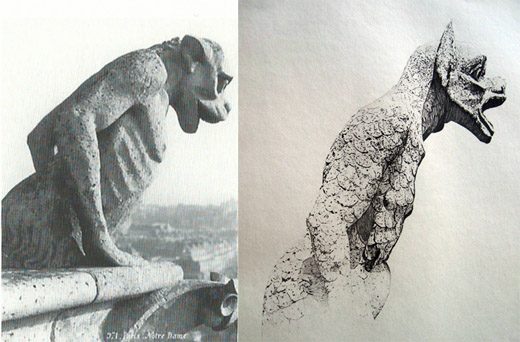
Michael Camille tells this story well in The Gargoyles of Notre-Dame: Medievalism and the Monsters of Modernity. By the 1840s, Notre Dame was a ruin; the cathedral had been cursed as a symbol of medieval irrationality, denuded of royal statues and other symbols of féodalité, and wrecked by weather and time. In 1843, in the wake of Victor Hugo’s fictional tribute to the cathedral’s former glory, architect Eugène-Emmanuel Viollet-de-Duc began restoring Notre Dame—which included commissioning sculptors to create the replacement monsters he dubbed chimères. Camille documents how these modern “chimeras” entered European and North American popular culture through engravings, etchings, photographs, postcards, paintings, and books—and how quickly the world forgot that they weren’t medieval creatures at all.

The 54 chimeras are a lurid lot. Partly inspired by France’s 19th-century fascination with Egypt, their fellowship includes demonic birds, a goat, an elephant, a pelican, a wild boar, a two-headed dog, a (now destroyed) unicorn, and (lamentably) a Wandering Jew. Most of them, though, are humanoid animals—which brings us back to the dog-faced beasties of Newark, Delaware.

Look at this fellow, and then consider a few of the chimeras from Notre Dame:

(Above left: Michael Reeve, via Wikimedia Commons; above right: Chosovi, via Wikimedia Commons.)

(Above left: vintage postcard of the “ape-satyr”; right: John Taylor Arms, “A Devil of Notre Dame,” c. 1929)

The Newark grotesques don’t look like any one of the chimeras on Notre Dame, but they’re arguably a loose composite of several of them. Those big, bent arms that allow the creature to lean menacingly forward are common to several of the chimeras, and we could easily build the (relatively tame) faces of the 1917 Delawareans from the ears, mouths, brows, and noses of some of these 19th-century forebears.

So did Richard Whittingham or George Rhodes dream, like Miniver Cheevy, of medieval glory?

Did they see the Notre Dame chimeras in illustrations of Victor Hugo’s Hunchback of Notre Dame? Or in the paintings of Winslow Homer? In the photography of Alvin Langdon Coburn? On postcards from family and friends?

Are Newark’s chimeras barking in defiance of home-grown architectural forms? (Weirdly, these creatures came to life the same year the University of Delaware settled on Colonial Revival, a sensible but decidedly un-Gothic style that still predominates across the campus.)

Or maybe Rhodes considered his pharmacy a cathedral and saw his work as a sacred calling?

The fun thing about American medievalism is that there’s rarely a single reason for this stuff. Just as people in 2013 have complicated motives for studying, idealizing, or reenacting the Middle Ages, Whittingham and Rhodes might have offered explanations that combined the personal, the social, the religious, and the political.

Twenty years after ignoring 36 East Main Street for reasons I’ve long since forgotten, I’m glad I looked up. You never know when the place where you first met Charlemagne and Chaucer will reveal to you, just over your head, the bewildering traces of somebody’s medieval dream.

“Looking down on empty streets, all she can see…”

“The blog’s been quiet lately,” I hear yon straw man cry. “Why not head out to northwestern Maryland on a torturously cold morning to hunt for gargoyles?”

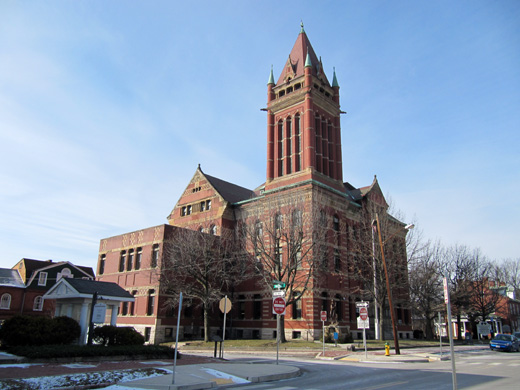
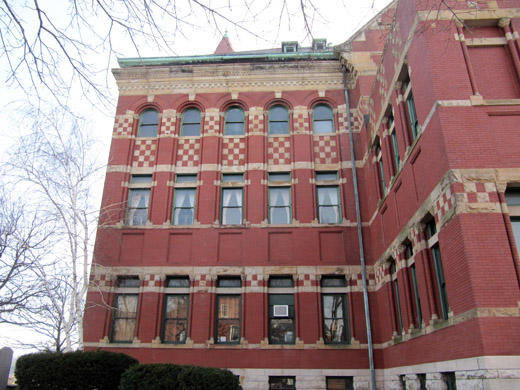
That’s the Allegany County Courthouse, designed in 1893 by local boy Wright Butler in “Richardsonian Romanesque”—the eclectic style popularized by Henry Hobson Richardson. (Butler’s design appears to owe more than a little to Richardson’s Allegheny County Courthouse in Pennsylvania.)

On a freezing Saturday morning, downtown Cumberland is abandoned. Markers and monuments festoon the courthouse grounds—including a statue of George Washington and a tribute to the Ten Commandments—but look up for a good view of the stony creatures large enough to catch the eyes of speeding drivers on nearby I-68.

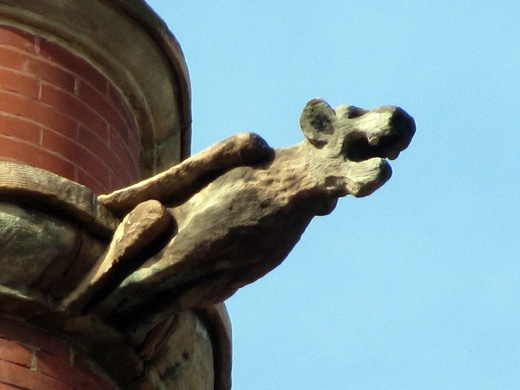
Four porcine fang-bats haunt the corners of the courthouse tower. Were they this roughly hewn when they were raised into place, or have the mountain winds coarsened them in the past hundred years?

Like other architects of his era, Wright Butler had fun with his facade. He surrounded the main entrance with all sorts of carven vegetation, and it’s not unreasonable to look at his slim and pleasingly complex window bays and see hints of a cathedral, where modern-day windows might once have held saints.

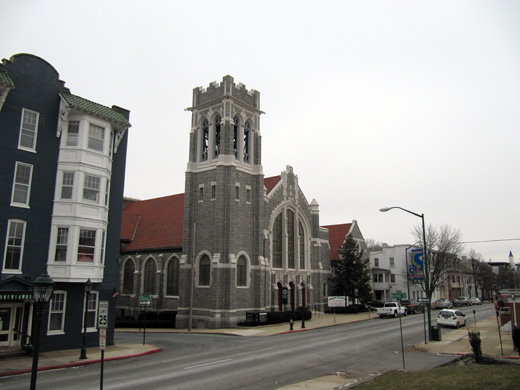
Racing snow-clouds back to D.C., we pass through Hagerstown, stopping to gawk at Trinity Evangelical Lutheran Church, built in 1909.

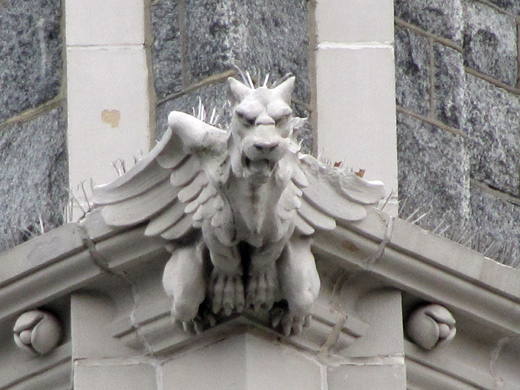
The church’s huge bell tower is home to four magnificent beasties. Photographed head-on, they look as if they just flew in from a Japanese movie…

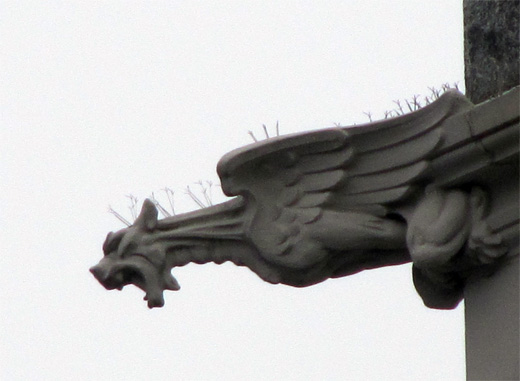
…but they’re best seen in profile, howling across generations, thwarted, bristling, forever out of time.

“With a wintry, storm-blown sigh…”

“Sometimes I sleep,” Alcuin wrote to Charlemagne shortly before his imperial coronation. “Sometimes,” he confessed, “it’s not for days.” Plagued by visitors to the shrine of St. Martin, the abbot of Tours wrote wistfully about the transience of earthly pilgrimage. “The people I meet,” he noted, “always go their separate ways.”

Alcuin was a busy man, as am I lately—but I’ve time enough to help you stave off the cold with a bundle of bright, blazing links.

Michael Drout posts a long, spoiler-laden review of The Hobbit: An Unexpected Journey.

Jason at Lingwë wonders why Bilbo Baggins “looks more like a grocer than a burglar.”

Nancy Marie Brown, who’s just written the first English-language book in ages about Snorri Sturlusson, looks at Icelandic myth and the Tolkien connection.

A Common Reader ponders the Periplus of the ancient traveler Hanno.

My friend ‘nora points me to a lovely Gothic Revival Jewish mausoleum in Vienna.

The Lost Fort visits St. Isaac’s Cathedral in St. Petersburg.

Is the TV show Arrested Development actually The Brothers Karamazov?

At Hats & Rabbits, Chris acknowledges the hard work that goes into dreams.

First Known When Lost looks at the conceit of life as a work of art.

Levi Stahl has literary thoughts on the death of Dave Brubeck.

A.E. Stallings reads a poem.

Stephanie McCarthy interviews Bill Peschel, annotator of Dorothy Sayers.

Anna Tambour shows you what it’s like to live in the path of an Australian wildfire.

D.G. Myers marvels at how cancer concentrates the mind.

Douglass Shand-Tucci finds Narnia in Copley Square.

What’s with the connection between James Joyce and Trieste?

Dylan pens two quick ghazals.

“So we go inside, and we gravely read the stones…”

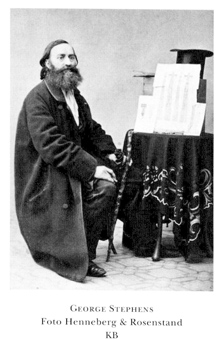
“[P]ioneering, erratic, and irascible”—that’s how scholar Andrew Wawn introduces a medievalist I’d never heard of, apparently because his spectre haunts only a few narrow stacks in Scandinavian libraries. Although George Stephens published more than 500 books, articles, pamphlets, translations, and plays, his Wikipedia entry is a sorry 120 words long, and it isn’t likely to be lengthened or annotated by legions of Tolkienesque fans. Even so, Wawn’s engaging 1995 article about him—“George Stephens, Cheapinghaven, and Old Northern Antiquity”—makes an amusing but sympathetic case for looking back at scholars of yore-days and seeing not pitiable caricatures, but weird, vivid, quizzical lives.

Wawn calls George Stephens “a fascinatingly marginal figure, an exile by choice, a rebel by temperament, cocooned in his book-lined Copenhagen study glowering across the North Sea at the (in his view) wretched condition of England.” Born in England in 1813, Stephens moved to Sweden in 1834 to teach English before taking a lectureship, and then a professorship, at the University of Copenhagen. (Hearken, jobless scholars! Three years earlier, the enterprising Stephens circulated an English-language pamphlet with the efficacious title Hurrah for Denmark.)

Stephens is one of many unsung souls who hammered out the cogs of the medieval-studies machine. He was an influential collector and classifier of folk tales, his work on runic inscriptions founded a sub-field, and he published the first translation of an Icelandic saga into English—albeit from Swedish. “He translated Icelandic sagas,” Wawn writes, “while contributing to their reoralization by writing saga-based parlor songs; he taught Shakespeare whilst himself writing plays on Viking subjects in Elizabethan style; and he contributed vigorously and unashamedly to popular polemics, finding it no mark of virtue to proclaim the virtues of a democratized literary-critical process in an impenetrable and robotic meta-language.”

He’s also easy to mock. Wawn devotes most of his article to Stephens’ virtually unread 1857 play, Revenge, or Woman’s Love, in which King Edgar of Mercia is waylaid by Vikings while on pilgrimage to Sweden, where he’s forced to summon his wife to be sacrificed to Odin. Wawn is patient with Stephens’ “pyrotechnic display of newly minted compounds, anaphoric elaboration, and (alas) syntactic congestion,” and I enjoyed picturing the climax featuring “the return of the cave-dwelling witch, accompanied by much smoke and many explosions,” but why snicker? “Notwithstanding its breathless and somewhat confusing denouement,” Wawn says, “there is much spirited and good-humored writing in the play, and it would be ponderously sobersided to miss the element of jeu d’esprit which helps to drive the whole work.”

What Wawn does here is humane. Seeing an eccentric medievalist rendered all the more comical by time, Wawn doesn’t “deconstruct,” “interrogate,” “negotiate,” or (good Lord) “problematize” him. Instead, Wawn peers into a bundle of contradictions—”the English Anglophile exiled in Scandinavia, the modern Christian fundamentalist fascinated by ancient paganism, the British Tory radical who translated a treatise in favor of an hereditary Danish monarchy”—and in 40 pages, reckons his humanity.

To my surprise, Wawn contrasts Stephens with another philologist whose life and work were shaped by Mercia. “George Stephens, it need hardly be said, was no Tolkien,” he admits, “and Revenge, it need hardly be added, is no Lord of the Rings. The play could number its nineteenth-century readers in tens, and its twentieth-century ones on the healthy fingers of a severely maimed hand.” I laughed at that line, because it’s tempting to see Stephens as a prevenient Ignatius Reilly bumbling around Copenhagen, crusading for influence, obsessed with tomorrow’s obscurities, repelling his colleagues with political rants. It’s harder, but kinder, to place this minor scholar alongside a famous one, in an article that’s more subtly and sensitively written than anything its subject could have mustered, and not lose him in the shadow.

“That one should succeed commandingly whilst another fails eccentrically needs (and finds) no explanation in the self-preoccupied world of modern literary theory,” Wawn concludes. “We might rather look to the chaos theory of real human lives.” In his choice of subject and through his own example, Wawn affirms something that isn’t always clear: there are people behind the scholarship we read.

“Well, I hit the rowdy road, and many kinds I met there…”

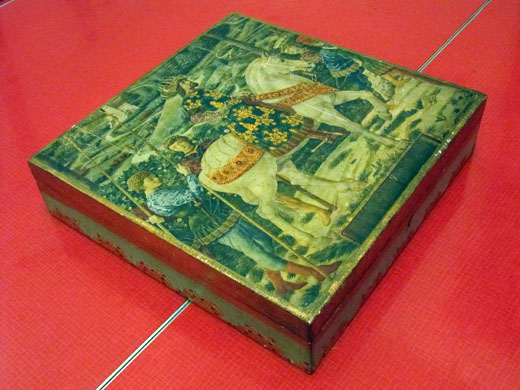
The best gifts come wrapped in a bit of mystery. Check out the old wooden box that surprised me this Christmas—and sent me on an art-quest.

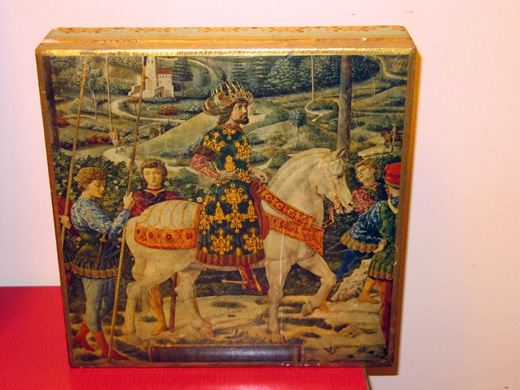
This box is 11.75 inches square and 2.75 inches deep. The sides are painted turquoise and golden. It used to have a lock—but who is that royal rider?

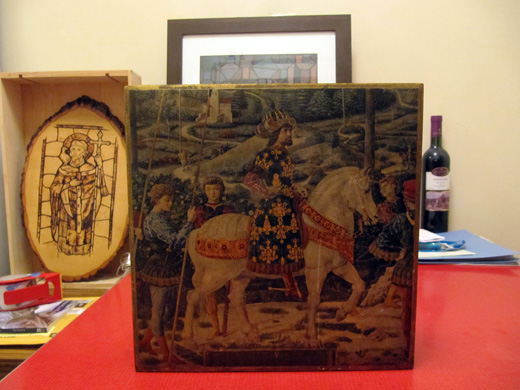
After several dead ends and a lucky hunch, I had an epiphany and identified this noble fellow and the larger work he inhabits. If you’re up for a Google challenge, see if you can do the same. Scrutinize a close-up of the box cover, and don’t ignore that rectangle at the bottom.

Happy twelfth day of Christmas!

* * *

(Give up? Here’s a stock photo with identifying information. There’s a Wikipedia entry on the complete work of art, and another site shows the box-cover scene in its full context.)