“Merciless, the magistrate turns ’round…”

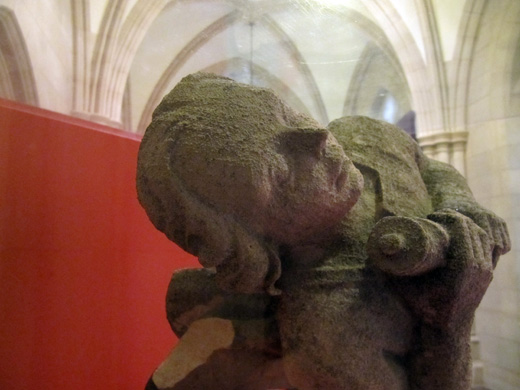
This pair of grotesques has always struck me as eerie. Is their fecundity enough, or are we meant to wonder what they smother under stony vegetation?

EMAIL FROM THE COMMUNITY GARDEN RULES COMMITTEE

No worm discerns the robin; we dispense
With blazing wing to herald your offense.
The slug secretes his shadow under chard
Where you malinger, lest your way be barred
By negligence that chokes your bolting plants.
We yet may cast you out, beyond the ants
That vainly pray for peonies to burst.
The mess you fell today you raised up first
In indolence. For fear of flaming brand
You hide with mites; we pluck you out. Now stand
As wordless witness wild around you breeds.
The wages of our mortal sin is weeds.

(For all the entries in this series, hit the “looking up” tab, or read the gargoyle FAQ.)

“…at a place where you can walk across, with five steps down…”

Starting today, more than 3,000 scholars, profs, and students will flock to Kalamazoo, Michigan, for the annual International Congress on Medieval Studies, an event that often prompts yuksters to claim it’s peculiar that medievalists should convene in a small city in the Midwest, as if the coasts, or bigger cities, are inherently more hospitable to historical musings.

…which, of course, is silly. Having just rolled back into D.C. after a 3,600-mile roadtrip, I’m pleased to share a few postcards from the medievalist Midwest, evidence that the Middle Ages wind also through the prairies and plains—if not as vitally as the Mississippi, then at least with the same circuitous certainty.

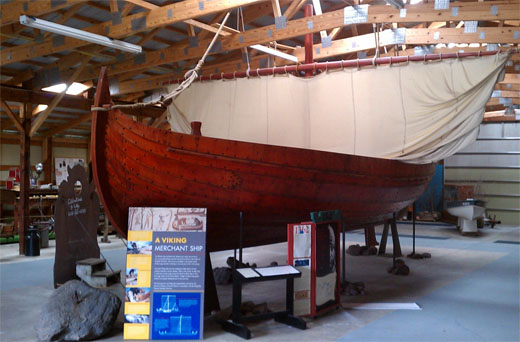
“The hammer of the gods will drive our ship to new lands….” You’ll find a Smithsonian-funded scale replica of a Viking knarr in Alexandria, Minnesota, a town with a gigantic Viking statue and a thriving spurious-runestone-based economy.

In downtown Minneapolis, look up to spot these funny, blockheaded grotesques on the spire at Central Lutheran Church, which just completed its neo-Gothic bell tower after nearly 80 years.

At the Cedar Rapids Museum of Art, you can see how Iowa’s own Grant Wood (painter of America’s great medievalist icon) combined his usual humor with a designer’s eye for medieval church pews to create this early-1920s “mourner’s bench” for the principal’s office at the local junior high.

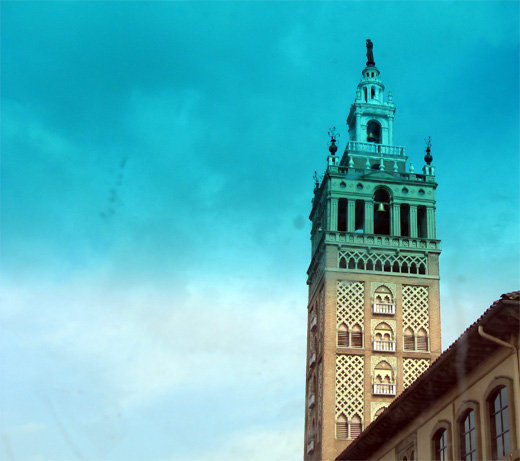
At the Plaza in Kansas City, Missouri, you can’t miss this gawkworthy replica of La Giralda, a minaret-turned-cathedral-tower in Seville. The Kansas City Giralda (shown here artlessly photographed from a moving car) represents the tower after its adornment with post-medieval doodads. (To the best of my knowledge, the one in Seville never had a Cheesecake Factory on the ground floor.)

On North 18th Street in Kansas City, Kansas, look up to see this grotesque on all four sides of the tower at St. Paul’s Episcopal Church, designed by an artistic medievalist rector. According to a friendly parish worker we met, the church plans to sell reproductions of this mascot; he’s known as “the Grinning Gargoyle.”

Whether you’re en route to Kalamazoo or writing and teaching in what some would consider a far-flung place, look up and gaze around. Chances are, a deliberate reworking of something medieval is craving a chance to leer back.

“I can see the path you’re cutting…”

From Jefferson’s fascination with Old English to the indefatigability of Cajun ring-jousters, American medievalism has long enjoyed a reputation as (in the words of one prominent scholar) “a tough little sister just looking for Mister Right on the wrong side of town.” While the “Quid Plura?” kobolds and I track down traces of medievalism far afield from the D.C. area, please partake of these medieval-ish and literary links from the cleverest of souls.

Steve Donoghue reads Froissart’s Chronicles and St. Augustine’s Confessions.

Nancy Marie Brown’s A Good Horse Has No Color: Searching Iceland for the Perfect Horse enjoys new life as an e-book.

Dame Nora ekes out a medieval flower.

Ephemeral New York spies grotesques on 181st Street.

Makers of the Middle Ages is now available in print.

Steve Muhlberger alerts us to a book about a Tudor minstrel.

Julie K. Rose is reading from her novel Oleanna at Norway Day in San Francisco.

Is Edward Bulwer-Lytton mocked for all the wrong reasons?

Bill Peschel uses poet Rupert Brooke to rewrite Maslow’s hierarchy of needs.

Dylan pens “Ode 2.0,” a charmingly honest poem about social media.

Anna Tambour, connoisseuse of strange fruit, cultivates French crabs.

Benjamin Buchholz quaffs a cup of Khan.

Hats & Rabbits wonders what a science fiction author sees that others don’t.

Steven Hart want to give you the Kindle edition of his well-reviewed New Jersey crime novel.

Writer Beware warily eyes the restored “Poetry.com.”

Kevin at Interpolations is glad he’s no Middlemarch scholar.

First Known When Lost questions poems about poems.

“So, I continue to continue…”

“April,” said Edna St. Vincent Millay, “comes like an idiot, babbling and strewing flowers.” In the same giddy spirit, here’s a florilegium of sweet-smelling links.

First Known When Lost sees clouds in poems, poems in clouds.

Julie K. Rose, author of Oleanna, looks at meadows, trysts, and Norwegian identity.

Witan Press, publisher of scholarly medieval e-books, seeks a virtual intern.

Bill Peschel visits Cupboard Maker Books and tells parents to let their kids self-publish.

Prof Mondo spots a songwriter “at the intersection of Bacchan depravity and commerce.”

George reads In Plato’s Cave, an academic memoir.

Who deserves the Arthur C. Clarke Award? This year, there’s controversy.

Jake Seliger asks: Are you more than a consumer?

Hats & Rabbits pens a parable.

Dr. Beachcombing hails a handlist of adult changelings.

Benjamin Buchholz takes us to Oman, where they still build dhows by hand.

Y.S. Fing reviews a book about the man who invented Ignatius Reilly.

PeteLit finds Beatrix Potter’s bunnies bred from a letter.

Lingwë dabbles in absinthe.

Steve Donoghue, man of a million interests, introduces you to opera.

The Book Haven calls for an end to Orwellian “wars.”

Writer Beware! tells you why small publishers fail.

Stephen Akey reads raw Catullus.

Frank Wilson writes a haiku or two.

“The rebel and the teacher, the vandal and the saint…”

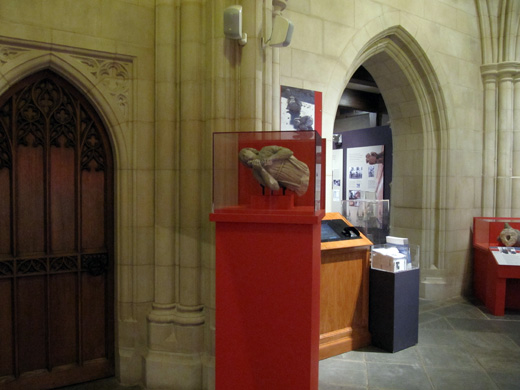
Since the August 2011 earthquake, this previously camera-shy angel at the National Cathedral has become a minor celebrity, as well as a herald of the restoration work to come.

VIGIL

No furling earth, no incandescent wing—
You know your ruin by what your ruin is not:
No bounding vault, no lapidary gate,
No corbels raised to frame the blazing glass,
No graven arch to turn the pilgrim purse,
No choristers to round the close with verse,
No patrons’ patient faces grazed with sun,
No pedestals for patronage to come,
No babbling pandemonium of spring,
No spindling girls to bind their loves with blooms,
No censer-swirling deacon, nor his drudge
To agonize the vetch that winds the thyme,
No mourning dove to peck on wispy rhyme,
No scaffold-clambered bishop overhead,
No winch-raw backs, no oaken arms to roll
The stones to where they fit, before they fall,
No nobler you to pace the slouching wall
And squat by stumps, gnaw spalls of scaly bread,
And mutter to yourself, and to the night,
To columns crowded round you how you wait
For herald, harp, and scroll,
For pinnacles set perfectly alight,
For furling earth, for incandescent wing—


Undaunted, in the purple light we meet
As spider mites anticipate the shade
And halos haunt the vestibule. We kneel,
Unwrap our roundest rasps, and raze away
The hundred thousand afternoons you woke
And strained to brace the battlements you broke.

(For all the entries in this series, hit the “looking up” tab, or read the gargoyle FAQ.)

“Dust you down from tip to toe…”

For five years, this blog has argued that medievalism is durably American. From Gothic synagogues in the South to killer queens in New Jersey, from Cajun jousters and the saints of New Orleans to the gargoyles of Perth Amboy, from rivalries on the Potomac to dragons and Vikings at seaside resorts, from late-blooming scholars on postage stamps to courtly love on General Hospital, American medievalism is rooted in an unresolvable clash of classical and medieval aesthetics, the persistence of religious traditions, and complex nostalgia for Europes that never were.

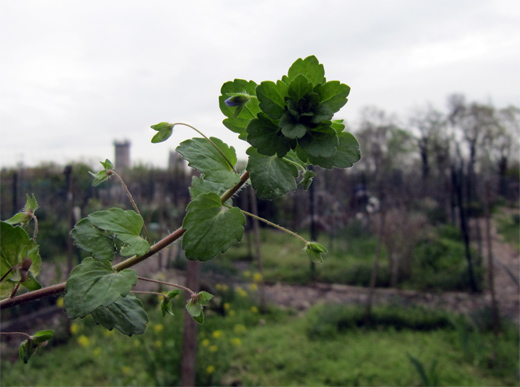
But did it have to take root in my garden?
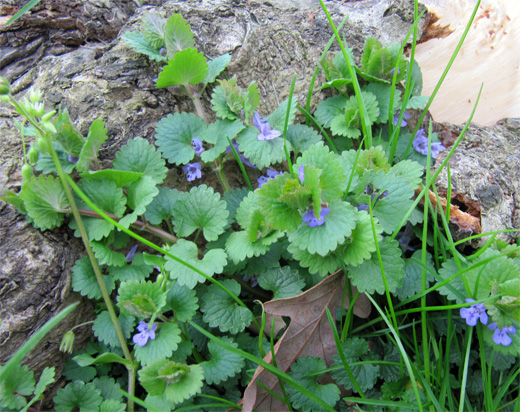
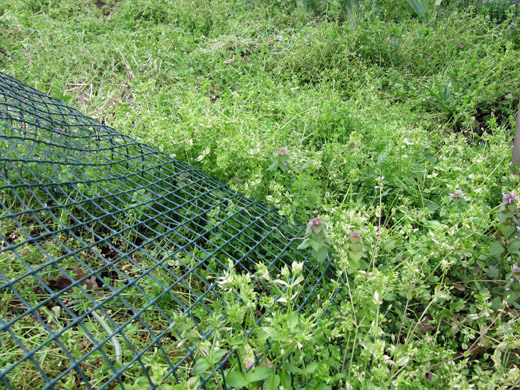
Meet Glechoma hederacea, the mint-like ground ivy called “creeping Charlie” in the United States and known, at least around my place, as “existence’s bane.” Rampant, sinister, nigh-unstoppable, this weed was brought to North America by early European settlers, who presumably appreciated its value as ground cover and its not-unpleasant scent.

Medieval people found Glechoma hederacea medicinally useful, as shown by a drawing of the stuff in a tenth-century manuscript from Constantinople. At the Metropolitan Museum of Art, you can buy a watch and other jewelry based on its depiction in a 15th-century woodcut, gifts apparently intended for people who’ve never torn intractable fistfuls of the stuff from the temperamental earth.

More interesting is its etymology in England, where it’s known as Gill-on-the-ground or, intriguingly, alehoof. Britten and Holland’s 1886 A Dictionary of English Plant-Names claims the word comes from “‘Ale-hoove,’ meaning that which will cause ale to heave, or work,” because in an era sans hops, the Anglo-Saxons used the plant to give their ale its bitterness. (The 2007 Dictionary of Plant Lore quips, too defensively, that “there have been other attempts at its etymology which may safely be ignored.”) The Bosworth-Toller Anglo-Saxon Dictionary finds the plant simply called “hófe,” with references to mersc-hófe, “marsh-hove,” túnhófe, “yard-hove,” brúnhofe, “brown-hove,” and phrases in medicinal texts such as genim hófan, “take hove.” If *ealu-hófe was an Old English word, no written trace of it survives.

The word may be gone, but the plant endures, creeping just beneath the soil, breeding pernicious new nodes as it roams. You can slow its advance, but smother it in mulch and it summons demonic strength and pushes ever upward. Like a neglected chip of pure evil smoldering in a toaster oven, alehoof is almost impossible to eliminate. “[P]ut every scrap of the plant in a bag and throw it away,” one site advises, “or it will reroot and take over again.” Other sites suggest tracing the runners several feet to their origin and, like Beowulf before you, destroying the monster’s mother, even if doing so leaves craters in your lawn.

Whatever medicinal purposes medieval people found in alehoof, it’s now thought to be toxic in large amounts. And don’t be fooled by those dainty, bumblebee-pleasing flowers; when alehoof goes berserk, as it did in a neighboring plot, it can help bring down an unsturdy fence.
It’s enough to make a despondent gardener fall back on an Old English plea to the forgotten goddess Erce:

Geunne him,
ece drihten,
(and his halige
þe on heofonum synt),
þaet hys yrþ si gefriþod
wið ealra feonda gehwaene,
and heo si geborgen,
wið ealr bealwa gehwylc,
þara lyblaca geond land sawen.

[“Grant to him, eternal ruler (and his holy ones, who in heaven are), that his ploughing be protected against any and all enemies and it be guarded against each and every evil, against those spells sown through the land.” trans. K.A. Laity]

Or maybe, in the proper spirit of the Anglo-Saxons, magic needs to surrender to stoicism: hófe bið ful araed. Like medievalism, alehoof has taken perennial root; from gift shops to gardens, it isn’t fated to fade.
“We’re doing fine, I’ll see you on the Nightline…”

The soil is warming, my garden abounds with daffodils abandoned by the land’s last tenant, and spiffy links blossom wherever you look.

King Alfred calls! Study intensive Latin and Old English online through Bemidji State.

Better Living Through Beowulf teaches Tennyson’s “Ulysses” in retirement.

Michael Drout wonders: So how big was the dragon in Beowulf?

The Cranky Professor spies Abbot Suger at a Coptic funeral.

Spring is here, but Lisa Peet seeks winter tales.

Sam Sacks ponders Frank Kermode, novels, and angels.

As a Linguist utters Irish slang.

Lingwë visualizes The Iliad.

A Momentary Taste of Being concludes that literary criticism is collaborative fiction.

University Diaries imagines what pharmaceuticals do to the poetry of grief.

Interpolations gets why Legends of the Fall is short on dialogue.

Jake Seliger wonders if he’s sufficiently cool for Elmore Leonard.

Steve Donoghue reads the new comic-book take on a Conan tale.

The Arthur C. Clarke Foundation launches a new biography.

Prof Mondo won’t let his students write papers on Poe.

Painting and poetry: Anecdotal Evidence notes verse about Wyeths.

D.G. Myers reviews life at 60.

Hats & Rabbits grows gray gracefully.

First Known When Lost finds hedgehogs in poignant places.

On YouTube, Tom O’Bedlam reads “Fairy Tale Logic” by A.E. Stallings.

Dylan pens a fine ghazal: “Opening Act.”

“No hesitation, no heart of gold…”

Outdated technology has a grotesqueness all its own. It reminds us of old ideas, and what we once hoped to do with them.

CONJURING THE SPRITE

Through moonlight, in my infancy, I traced
No sphere, no stars, but grids of perfect lines
Whose magnitude redoubled as I paced
And poked the air. A fading charm defines
My life: It came, unheralded by signs,
In blue oblique, a blur, a block of smoke
Divine; and being bound by my designs
It swayed, a silent, hexachromal cloak
Of nothing. I rejoiced in what I woke,
Unnumbered form, a notion turned to light,
And bowed, and laughed, and see now that it spoke
In evanescent noiselessness: Rewrite,
Return, recast, you never will excel
The devilry of this, your only spell.

(For all the entries in this series, hit the “looking up” tab, or read the gargoyle FAQ.)

“So perhaps I should leave here, go far away…”

“You say I’m a dreamer; we’re two of a kind,” the Saxon theologian Gottschalk wrote to Frankish abbot Walahfrid Strabo in A.D. 848, “both of us searching for some perfect world we know we’ll never find.” Walahfrid never did convince his friend to spurn his heretical ways, but you’re doubly predestined to enjoy these Tuesday links.

Nora Munro, medievalist, responds to Jonathan Franzen’s e-book quips.

Vitoð ér enn, eða hvat? A.S. Byatt revisits Ragnarok.

Anecdotal Evidence: in praise of swink.

Michael Drout ponders why Tolkien’s writing lends itself to recitation.

Wuthering Expectations discovers Portuguese poet Sophia de Mello Breyner Andresen.

A Poem a Day answers, twice, “How do I become a poet?”

Dylan looks askance at W.S. Merwin.

Rose Kelleher blurbs a poetry book about office work.

The Rumpus charts T.S. Eliot’s career in banking.

A decade ago, Cynthia Haven visited Cavafy’s flat in Alexandria.

Now she finds Ivanhoe, edited.

Flavia gets her students scanning Shakespeare.

Don’t miss the Richard III play Shakespeare should have written.

Lingwë explores the roots of “Gandalf.”

Dr. Beachcoming digs up Irish giants.

Bill Peschel remembers Dickens on stage.

Jeff Alessandrelli listens as Erik Satie Watusies His Way Into Sound.

Ephemeral New York hears the call of the South Bronx Lorelei.

Australian fantasist Anna Tambour spins a new tale: “Cardoons.”

The great New Jersey band Gaslight Anthem evokes “The ’59 Sound.”

“Singing, not necessarily sorted…”

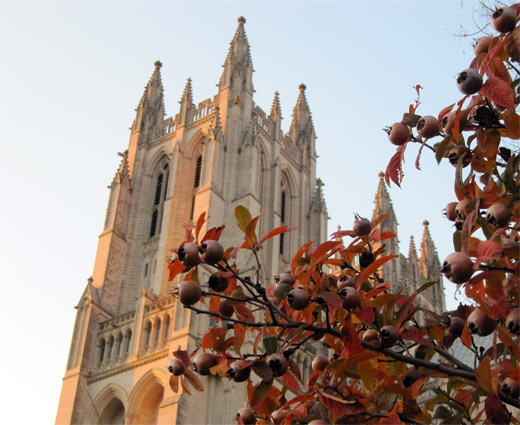
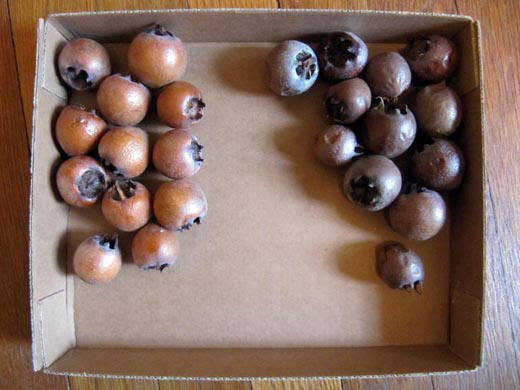
The Bishop’s Garden at the National Cathedral is home to a medlar (Mespilius germanica, or die Mispel in German), a tree that was far more common in medieval gardens than it is now in North America. Its homely fruit are inedible until they “blett,” when they become little mush-balls that taste a bit like spiced apples and wine—but only after time and frost render them wrinkled and weird. This bellyacher knows that with medlars, timing is everything, even with noises that disregard sense but feel right on the tongue.

MEDLAR SONG

Til we be rotten, kan we nat be rype.
—Chaucer, “The Reeve’s Prologue”

In sawdust ruts, the roots encroach
On walls where wintered widows poach.
Hear sepals peep what reeves forgot:
Fast we ripen; first we rot.

A ritter rests. His jonquil dream
Shall reck in every rustling beam
What shrivling scops by lines allot:
Fast we ripen; first we rot.

A shovel drudge, his leafs mislaid,
Fears bishops, like their mispels, fade,
But sets aside the lightest plot:
Fast we ripen; first we rot.

A goblin sunders thist and thorn
By mispel moonlit shade, to mourn
One perfect pearl she misbegot:
Fast we ripen; first we rot.

Now pray we bless the bletted mess,
That fine and blither minds profess
To round the rinds that rime did not.
Let them ripen; let me rot.

The medlar in the Bishop’s Garden, autumn 2010:

Medlar fruit (harvested with permission of the cathedral), unbletted and bletted, December 2010:

(For all the entries in this series, hit the “looking up” tab, or read the gargoyle FAQ.)