“So I associated myself with fossilized figures…”

Memes come, memes go, and I rarely inflict personal stuff on readers of this blog. However, this meme is fun: list the ten books that most influenced you. Forget the books you love, or the books you think you need to say you’ve read; instead, list the books that answer the question, “Who are you, and how did you get that way?”

Anne Terry White, The Golden Treasury of Myths and Legends (1960).
They’re all here: Theseus, Narcissus, the Volsungs, Beowulf and Grendel, Charlemagne, Tristan and Iseult, all strikingly illustrated by Alice and Martin Provensen. Finding this book in my elementary school library was like falling into a whole new universe, one I haven’t quite climbed out of yet.

Literature I: The Oregon Curriculum (Holt, Rinehart and Winston, 1968).
When my fifth-grade teacher saw me reading The Golden Treasury of Myths and Legends, he decided I was ready for this more advanced textbook. He marked the Greek myths with a paperclip, but I soon moved on to the Norse myths, literary ballads, fables, folktales, and short stories, not knowing I was reading Aesop, Goethe, Kipling, Poe, William Morris, Ray Bradbury, and Robert Graves. Thirty years later, I’m amazed by the breadth of this book’s gorgeous color illustrations: ancient and medieval art from India, China, and Scandinavia, colonial American folk art, and paintings by Breughel, Rembrandt, Chagall, Grandma Moses, Calder, Warhol, Dürer, and Klee. Could we even publish such a sophisticated textbook today?

All of those hardcover Dungeons & Dragons rulebooks from the early 1980s.
Judge me if you must, but I stand by what I wrote in my appreciation of Gary Gygax: “[f]or those of us who were raised outside of an academic milieu, D&D also offered a valuable experience that later served us well: the game offered a preview of the systems, organization, and culture of a worldwide scholarly community.”

Commodore 64 Programmer’s Reference Guide. (Commodore Business Machines, Inc., 1982).
We humanities types blather on about “critical thinking skills,” but if you really want to create English majors who can ace an upper-level college course on symbolic logic, make them program a computer.

Douglas Hofstadter, Gödel, Escher, Bach: An Eternal Golden Braid (Basic Books, 1980).
I bought this book in high school on the recommendation of a friend who went on to become an engineer. I didn’t entirely get it, I don’t think I finished it, and I doubt I’ll ever return to it, but the lesson was useful: The world is full of people who are much smarter than you are, and you sound like a fool when you call their work “weird” or “esoteric” just because you don’t understand it.

J.D. Salinger, Nine Stories (1953).
It’s exciting to be 17, and to be charmed by a book, and to think, “I want to write like that.” Only when the author kicks the bucket 20 years later do you realize what his book was trying to tell you: “This isn’t the sort of thing you’re meant to write.”

Ben T. Clark, Russian: Third Edition (Harper and Row, 1983).
It’s 9 o’clock in the morning on your first day of college, no one can yet imagine a world in which the Berlin Wall falls and “Winds of Change” is the #4 song in America, and you’ve never seriously studied another language—but within minutes, you’re learning a new alphabet, holding rudimentary conversations, and absorbing terms and concepts that will help you dabble in languages for years to come. Спасибо, Ben T. Clark.

Henry Treece, The Crusades (1964).
I still have my crummy paperback copy of this lurid pop-history, which introduced me to all sorts of wild medieval nutjobs, including Pope Urban, Peter the Hermit, Peter Bartholomew, and Henry Dandolo. Wanting to understand why angry mobs would tear people apart for the sake of relics, I became a medievalist—and as a result, here you are, reading this blog.

Bruce Mitchell and Fred C. Robinson, A Guide to Old English, Fifth Edition (Blackwell, 1992).
So maybe you don’t grow up to become an Anglo-Saxonist. So what? Spend a semester working through this tome and you ought to agree with C.S. Lewis: “The taproot, Anglo-Saxon, can never be abandoned. The man who does not know it remains all his life a child among real English students.”

A.S. Byatt, Possession (1990).
Few novels matter, so it’s nice when a work of fiction speaks to you, offering assurances that leaving grad school is okay—and that trying your hand at writing might be more fun than making a career out of studying the works of others.
“And he plays at stocks and shares, and he goes to the regatta…”

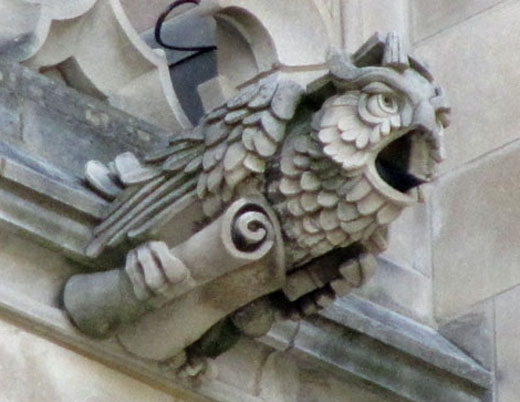
When I asked the owl on the north nave to contribute a poem to this project, I assumed from his mortarboard, scroll, and book that he’d hand me a pile of self-aggrandizing verse. Instead I got this shamefully loose translation of a pseudo-Ovidian poem written sometime between the 12th and 14th centuries. I guess a gargoyle, like the occasional human, reserves the right to remain enigmatic.

THE LOMBARD AND THE SNAIL

Loudly, the Lombard lopes over the landscape, and stops;
Leery, he lights on the lushest and loveliest crops.
Frabjous he feels, for his fields are not fated to fail—
Then forth springs a spectacle strange and stupendous: a snail.
Cowed and confounded, he quivers and quavers and groans;
Witless, he whitens, as wonderment welters his bones.
Seizing his senses, he summons the sangfroid to say:
“Fie on a felon! My fortune is forfeit today!
No suchlike scoundrel has slithered or skulked here before.
Mark well his message: he musters to meet me in war.
Horns are his heralds; his shield makes his handiwork plain.
Shall I not spurn him? No—better, in sooth, to be slain.
What if I poke and provoke him? Perhaps I’ll prevail!
Minstrels and merchants will mimic my marvelous tale.
What am I saying? To fight with a fiend is uncouth!
Easier warfare abounds; it’s a world-weary truth.
Men will say ’madness!,’ maligning me under their breath:
’It’s not meet and fitting to seek an uncivilized death.’
What if my children should walk by this waelstow and see?
Faced with this fiend, they would fathom his fierceness and flee!
Still, they’d concede that this combat is clearly unfair:
Armed is this beast, but no buckler or broadsword I bear.”
Fretful, he freezes, as Fear grapples fiercely with Shame;
Shame is pugnacious, but Fear keeps his temperament tame.
Competent counsel can kindle a capable life;
Thus he petitions the heavens, and checks with his wife.
Promptly, the gods promise palms for the victor, and praise;
Nervous, he nurtures no trust in their numinous ways.
Thence to his wife; she is timorous, tearful, and true:
“Listen, you lunatic, what are you looking to do?
Scuttle your strife; let your spirit sit safe on a shelf.
Mind no more monsters—and muse over more than yourself.
Spurn not your children and spouse! Let your senselessness stall;
Ill-omened days will bring dolor and doom to us all.
Hector would crumble, and even Achilles would quail;
Fast would the firmness of Hercules fracture and fail!”
Roused, he retaliates: “Rein in your runaway fears!
We who dare Death are undaunted, dear woman, by tears.
Great be the gods, for they grant me a glorious name.
You and the family fare well! For I follow my fame.”
Forth to the field, where he faces the fiend in the fray;
Stalking around him, he steadies his stomach to say:
“Beast, you are feral, unnatural, immoral, and vague!
Monster of monsters, as mean as the mortalest plague,
Hold high your horns! I am horrified hardly at all.
Show me your shield! Into no stealthy shell shall you crawl.
Righteous, I raise my right hand! Now your ruthless reign stops!
Savagely sully no more my salubrious crops!”
Swinging and swatting and shaking and sticking his spear,
Panting, he presses; the palm of the victor is near.
For heroes who rate such renown, what reward is supplied?
The matter is lofty; their lawyers will likely decide.


(For all the entries in this series, hit the “looking up” tag.)

“The girls would turn the color of the avocado…”

According to Gasch’s Guide to Gargoyles and Other Grotesques, the cathedral’s beret-wearing, paintbrush-toting deer is a verbal and visual pun: “This ‘endearing’ artist is undoubtedly ‘fawning’ on art.” Forever facing south toward the city’s museums, this creature is finding that a life in the arts, or in Washington, is about acquiring far more than the proper costume or kit.

ARS GRAVIS, VITA LEVIS

“Oldenburg, Rauschenberg, Klimt, or Klee:
When will I know what my passion should be?
Bierstadt, Bearden, de Kooning, Kinkaid:
How will their worth and my wisdom be weighed?
Is Calder too cutesy? Is folk art still fab?
Must Modern mean morbid? Devotional drab?
Are Memmi’s Madonnas deserving of fame?
Is liking them rightly ironic, or lame?
Is Flagg too American? Catlin taboo?
Is Russell too western? Is Parrish too blue?
Is Fauve far too Fauvist? Is Nevelson fluff?
Noguchi not nearly noetic enough?
What if I’m cornered, but plead my release
By deftly decrypting a daring new piece?
‘Problematizing. Pedantic. Profane.
Derivative. Kitschy. Impassioned but vain.’
Stone-faced, I’ll suffer no pleasure to show.
What if they squint through my brilliance, and know?”

(Say God replies. His pronouncement drifts down:
“Art’s not an adjective, only a noun.”)

(For all the entries in this series, hit the “looking up” tag.)

“It’s the only the thing that never gets old.”

The conversations one overhears around the cathedral are enlightening. An eavesdropper soon learns that there are answers to seemingly impossible questions, including this one: “Why is that gargoyle smiling?”

A MOTHER CONSOLES HER DAUGHTER

“Lizards must perish, as sure as they’re born;
Children who love them are fated to mourn.
Yet lizards live on when their season is flown:
Scales fall away; the remainder is stone,
And wings, like green legends, burst forth and unfold.
The beasts they become covet altars of gold;
They roost on cathedrals, unnoticed and gray,
Watching the centuries die in a day.
Well may you wonder, ‘But what happens next?’
This question leaves even the wisest perplexed.
The wyrd of these wyrms is a subtle decree,
But here’s what a wyvern once whispered to me:
When Time bids these buttresses buckle and break,
Scattering rubble and ruin in their wake,
Things wearing wings will awake and take flight.
On towering temples a few will alight;
Some will watch kobolds construct them a shrine;
Some will stalk longships, their prows to entwine;
Some will grind gryphons to dust in their claws;
One may remember a child, and pause.
So listen, for wings carry comforting truth:
Honor the monsters that creep through your youth,
And never make light of a reptile’s pride;
A lizard, though small, is a dragon inside.”


(For all the entries in this series, hit the “looking up” tag.)

“…and the music there, it was hauntingly familiar.”

It’s a commonplace among historians that in the murky recording studio of medieval imperialism, Alcuin played a wizened Stevie Nicks to Charlemagne’s picky but regal Lindsey Buckingham. I can’t tell you how often some sharp young scholar has commandeered the conference lectern to rail against this tired way of imagining Europe at the turn of the ninth century, yet the metaphor persists, as metaphors do, because they’re the overwrought but ever-tempting self-guided audio tours that help us see beyond the bored security guards in the hushed, carpeted galleries of the past.

Similes, on the other hand, are like Canadian character actors in Sci-Fi Channel Original Movies: they jar you out of pseudo-historical reveries and lodge you unmistakably in the present. Case in point: the Los Angeles Times sent a writer to the Vancouver Olympics, and like Ignatius Reilly pursuing a Big Chief Tablet delivery truck, the King of the Franks followed him:

Besides, I don’t travel particularly well. Me flagging a media bus in a new city is like Charlemagne chasing the Saxons. But OK, whatever. I like the snow.

This curious simile is the brainchild of a reporter who assumes that the reader has some knowledge of medieval history, or at least possesses the basic curiosity required to look up stuff on Wikipedia. Bravo! That puts him ahead of other newspaper writers.

But what on earth does it mean? Is a portly king waddling with comical incompetence after a band of tireless warriors? Does the writer’s pursuit of public transportation take decades to accomplish while leaving headless corpses scattered among once-sacred groves?

I don’t know, but this simile slips from the reporter’s fingers (to quote Charlemagne himself) “just like a white-winged dove sings a song.” Perhaps, like the finest Carolingian poetry, this cryptic reference to Charlemagne is best read allusively, not logically. Otherwise, like a homesick reporter stranded on a Vancouver curb, we’re left to chase mysteries we weren’t really meant to understand.

“Everything is quiet, everyone has gone to sleep…”

I’m wide awake, but these links—these links can’t wait.

Over at The Burgundian, the ancient and medieval edition of Carnivalesque is in full swing.

The Cimmerian offers a lengthy review of the forthcoming Solomon Kane movie.

Jason Fisher is vindicated in his criticism of what may be the worst Tolkien book ever published.

Michael Drout wonders how much of scholarly success involves giving people what they want to hear. He also writes, with welcome bluntness, about the academic job market.

Meet a New Jersey shire-reeve straight from the pages of Chaucer.

When you’re on a mailing list for a Newfoundland gift shop—and really, what well-rounded individual isn’t?—you’re privy to some pretty grody specials.

The Philadelphia Inquirer researches Hercules, George Washington’s slave. 

Julie Rose reviews the novel Ice Land.

Neil Gaiman goes to Alabama.

Finally, how about some jazzy German pop?

“I said we walked around for practically forever singing…”

If you’re one of the new readers who found this site in recent days, scratcheth not thy head! Peruse the “about” page; I hope you’ll stick around. You can browse the best of 2009, 2008, or 2007 and receive word of new posts via Twitter. You can also support this whole bumbling enterprise by ordering The Tale of Charlemagne and Ralph the Collier either in a snazzy paperback edition or as a Kindle e-book.

Typically, this blog is about books and medievalism. Lately, it’s been taken over by gargoyles. Today, I offer only these diversionary links.

With all the snow we’ve gotten lately, one must learn how to distinguish a yeti from a wendigo.

At The Chronicle of Higher Education, “Thomas H. Benton” follows up his previous jeremiads about grad school with “The Big Lie About ‘The Life of the Mind.'”

Of course, you can show off your humanities chops by writing an online serial epic in verse.

I recently chatted about writing and translation with the good folks at Medievalists.net.

In Maryland, they’re preserving video-game code for posterity.

Jason Fisher has bad news about the publication of Tolkien’s translation of The Book of Jonah.

If you live near Highland Park, N.J., drop by Nighthawk Books, an ambitious venture by friend-of-this-blog Steven Hart.

Finally, here’s a number few have seen since 1980: writer, actor, and jolly Irish polymath Malachy McCourt backs up Christine Ebersole as she sings the most average love song in the world.

“There is a green hill far away…”

Despite the presence of noble-minded buffoons sitting around tables making futile plans, Washington is not an Arthurian town. Sure, there’s that suburb with corny Arthurian names, but Washington culture may be better suited for mocking fabliaux than the charming fictions of medieval romance.

Still, this city never stops sprouting quasi-medieval surprises. Trudge through the snow three days after a blizzard, and you do so alone; no one’s out taking pictures anymore, not even at the perpetually lovely Bishop’s Garden. Climb over a wall or two, send a few squirrels bounding away from the racket you make, and you’ll stumble onto this, in the driveway of a neighborhood school: a tree which the gardening guild claims was grown from the Glastonbury Thorn.

Of course, the “real” Glastonbury Thorn, dubiously rooted in history, has died several times over the centuries, and there’s reason to believe that my neighbors occasionally replace the local offshoot. Interest in the Washington thorn peaked in the 1950s, which partly explains why I’ve spent many a summer afternoon dozing on the Bishop’s Lawn unaware that this trace of Arthuriana prospered a few yards away, the quiet center of its own Tennysonian scene:

“The cup, the cup itself, from which our Lord
Drank at the last sad supper with his own.
This, from the blessed land of Aromat–
After the day of darkness, when the dead
Went wandering o’er Moriah–the good saint
Arimathaean Joseph, journeying brought
To Glastonbury, where the winter thorn
Blossoms at Christmas, mindful of our Lord.
And there awhile it bode; and if a man
Could touch or see it, he was healed at once,
By faith, of all his ills. But then the times
Grew to such evil that the holy cup
Was caught away to Heaven, and disappeared.”

It’s a silly thing, really, but after a week of Washingtonians grousing about winter, I’ll be glad when they’re back to chasing political grails. In a city that imports its legends, we could do worse than remember stories that teasingly promise perpetual spring.

“It’s nothing but time and a face that you lose…”

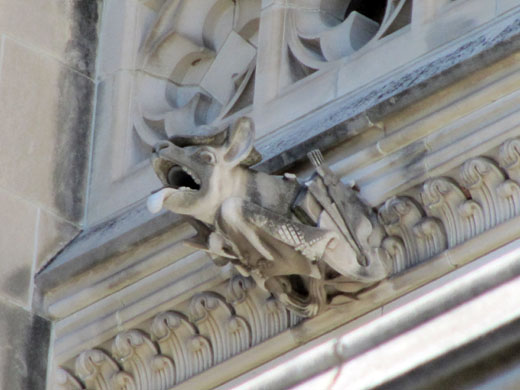
Where the south nave meets the south transept, near the entrance to the gift shop, is this fellow. As gargoyles go, he’s not lurid or menacing, but he does know his role in architectural tradition.

FEBRUARY 14

“On a skull in Salamanca
High within a grand façade
Croaking notes of grace eternal
Roosts a rana loved by God.”

So the tourist told his lover
Smiling up through falling snow.
“Strange,” she said, “sounds Salamanca.
What bright boon do frogs bestow?”

“Should two souls in Salamanca
Chance to see the frog,” he said,
“Blessed days are bound to follow;
In a year, the two will wed.”

Glancing down, she glimpsed a garden;
Frozen roses felt her sigh:
“We are not in Salamanca.”
Windy whipped the winter sky.

Side by side, the silent strangers
Shuffling slowly through the snow
Spoke no more of Salamanca;
Where they went, I do not know.

(For all the entries in this series, hit the “looking up” tag.)

“I can’t keep my eyes open, wish I had my radio.”

The little satyr outside the cathedral’s herb cottage patiently pipes his silent tune regardless of the season. He’s not a gargoyle, but why hold that against him? When he heard we’re getting more snow on top of the two feet that fell on the city last weekend, he took it personally.

SAUDADE

I pipe under protest, knowing no blizzard will trouble to tell me
Why I was banished, a fantasy long since forgotten.
Older eyes see an Arcadian prelude, when straw-skirted shepherd girls
Swooned at my lyrics, eternally light-eyed and lewd…
One day, the sun shone down drowsy. I curled upon emeraldine moss-root,
Dozing insensate, for nothing that dreams is immortal.
Stretching, I stirred—and I gasped at the winter that rose all around me:
Blinding white pastures and hillsides and frost-shrouded peaks.
Heartsick, I shook—and then Zephyrus whispered, so hyacinth-sweet,
Dissolving the winter; the world was a fresh, flawless green.
Snow turned to cloudbursts, all wet-nosed and panting. They pressed for a melody,
Cheerful but soothing, as pale and as patient as peonies.
Storm-god, I’m hardly as young as I look. Your rage to benumb me
Kindles a memory: waking to sheep in the spring.


(For all the entries in this series, hit the “looking up” tag.)