“The forming of a new connection, to study or to play…”

As rainy gloom descends on D.C., we call the kobolds to come in from the fields. Enjoy what they bring: books, medievalism, and a bit of poetry.

Medievally Speaking reviews Tolkien’s The Fall of Arthur. (Kathy Cawsey recently read it, too.)

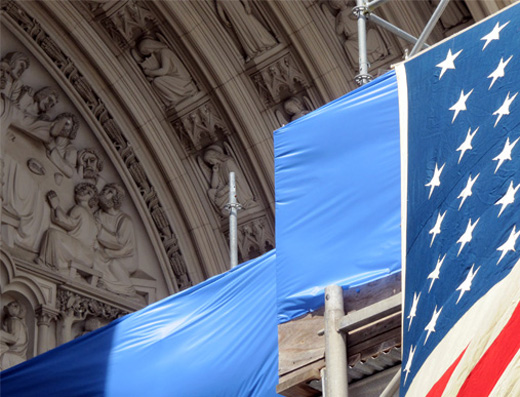
Box Elder explores an old church in the French town of Morlaix, both inside and out.

Nancy Marie Brown, author of the recent Song of the Vikings, fondly remembers a teacher, mentor, and friend.

Congrats to Michael Livingston, who’s published a casebook on Owen Glendower.

Steve Muhlberger spots a modern-day stylite living on a (large) pillar in Georgia.

Bibliographing likes and doesn’t like George R.R. Martin.

The Gargoyle Girl unveils a new alchemist-and-gargoyle mystery series.

Open Letters Monthly highlights The Black Spider, a Swiss horror novel from 1842.

Michael Drout announces his audiobook about the liberal arts.

Cynthia Haven hardly minds when American novelists don’t win the Nobel Prize.

With Halloween in mind, I’ve Been Reading Lately seeks out ghost stories in Boswell’s Life of Samuel Johnson.

Laudator Temporis Acti finds books in art.

Chris at Hats & Rabbits defies “the gods of creativity.”

First Known When Lost offers poems of arrival and departure.

“We walked around in circles, singing…”

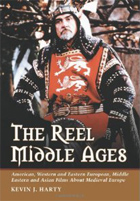
Ars longa, vita brevis! Although I’m holding down two jobs and working on two new books, I do have several posts in the queue about matters medieval—but until they get done, please indulge me in something atypical for this blog: blatant promotion. If any of these medieval-minded books should strike your fancy, I’d be delighted—and grateful.

When Becoming Charlemagne came out in 2006, I saw it as (among other things) a story about how swiftly time overtakes us. Little did I know that its elegiac mood would soon apply to the many defunct bookstores where it made its debut.

The book tells the story of Charlemagne’s imperial coronation in the year 800—one of the most important events in European history—by showing the early medieval world from the perspectives of people great and small: Frankish peasants, Jewish farmers, the monks of Tours, the caliph of Baghdad, a sneering empress in Constantinople, and world-weary locals in Rome. It’s a five-year slice of history that reads, I hope, like a brisk little novel.

Becoming Charlemagne is available as a paperback or an e-book. (You can also settle in with some popcorn and watch me gab about the book on C-Span in 2007.)

* * *

In the 15th century, an anonymous poet composed “The Tale of Ralph the Collier,” a 972-line Middle Scots romance about the kerfuffle that ensues when Charlemagne, separated from his entourage by a snowstorm at Christmastime, seeks refuge in the home of a proud and irascible collier. Combining folklore motifs with burlesque humor and elements of chansons and chivalric romances, “Rauf Coilyear” is a lively but rarely-read tale of courtesy, hospitality, and knighthood. To my knowledge, it’s also the only medieval romance in which Charlemagne totally gets slapped in the face.

This translation, which reproduces the rhyme and alliteration of the poem’s difficult 13-line stanzas, is available in a $9 paperback and a version specially formatted for the Kindle. (To get a taste of the translation, sample this low-res PDF of the first few pages, or check out the original Middle Scots to see what I was up against.)

* * *

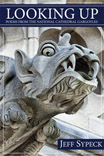
From 2009 to 2012, I posted the first drafts of 51 poems on this blog, each one inspired by a gargoyle or grotesque at Washington National Cathedral. What started as a lark turned serious when the cathedral granted me permission to show their typically camera-shy gargoyles in a compilation of the poems. In return, I’m donating 75 percent of the net profits to them to help repair damage from the 2011 earthquake.

Looking Up: Poems from the National Cathedral Gargoyles collects the final versions of these poems, plus two that are exclusive to the book. (You can browse a clickable list of the first drafts here.) The book is on sale at the cathedral gift shop and at the usual venues like Amazon, but you’d really be helping this project reach profitability much faster if you bought directly from me, whether using Google Checkout on this page or popping me a payment via Paypal. (Or heck, just send me a check. Questions? jeffsypeck -at- gmail – dot – com.)

“Where the scent of wild roses turns the milk to cream…”

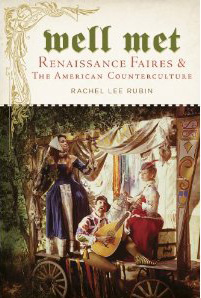
What hath the Renaissance faire to do with psychedelic rock? The vogue for “world music”? The frilly shirts of Jimi Hendrix? The rise of craft breweries? The House Un-American Activities Committee? Before reading Well Met: Renaissance Faires and the American Counterculture, I hadn’t thought to ask—but Rachel Lee Rubin’s book is a useful reminder that pseudo-medieval pursuits are sometimes more about the present than they are about the past.

Rubin starts with the basics: how the first faire grew out of a children’s commedia dell’arte troupe organized at a California youth center by teacher Phyllis Patterson. In May 1963, Patterson and others organized the first “Renaissance Pleasure Faire and May Market” as a fundraiser for left-wing Pacifica Radio, drawing more than 3,000 revelers to a North Hollywood ranch. Associated with hippies and drugs by local detractors, the event quickly outgrew Pacifica. It spawned its first imitators in Minnesota and Texas in the early 1970s; more than 200 Ren fests of varying sizes now thrive across the United States.

So how did a countercultural crafts-and-music romp evolve into a nationwide subculture overseen, in some cases, by a large entertainment corporation? Well Met doesn’t chart the growth and commercialization of the Ren faire. Instead, Rubin has two goals: to explain “the ways in which various forms of cultural expression ‘tried out’ first at the faire became recognizable staples of American social and cultural life,” and to restore the Renaissance faire to a central place in the history of the counterculture. Once I got past my initial disappointment that the book wasn’t a history, I was won over by Rubin’s argument for the importance of the Renaissance faire to the culture of the 1960s and 1970s—and its long-overlooked ubiquity.

Her evidence is legion: how the Los Angeles Free Press began as the Ren faire newspaper; how Americans, who now consume beer from nearly 2,500 craft breweries, first sampled ale at the faire; how fashion choices and even the typefaces on psychedelic album art recall early faire fliers; how the faire anticipated renewed markets for handmade crafts and set precedents for large outdoor rock concerts; how occasional faire-goer Michael Jackson mimicked the moves and style of faire mime Robert Shields; how the Flying Karamazov Brothers, the Firesign Theater, and Penn and Teller all got their start at Ren faires; and how the faire coincided with a Middle Eastern cabaret boom in California that helped build an audience for international music. Rubin even suggests that the Ren faire helped revive interest in the klezmer. Who knew?

Although Well Met is packed with wonderful “aha!” moments, the book does wander. Sometimes, disorganization drives Rubin to interesting places, as when she asks black faire-goers and plus-sized women about their experiences, or when she randomly chats up knights and wenches about the faire as a gay-friendly environment, a refuge for misfits, and an escapist haven where costumes deliberately obscure real-world class signals. At the same time, there’s way too much detail about the history of a couple of psychedelic bands, and a chapter about Ren fests in fiction feels like a conference paper brought in to serve as padding. It’s particularly jarring when patches of academic jargon turn up in such an accessible and pleasantly written book, as when Rubin muses on “the ways in which the faire has enabled (perhaps paradoxical) strategies of resistance to the very forces of corporatism and cultural centrism that have inexorably resituated it in the American expressive landscape.” Surely there’s a less turgid way to say that.

Well Met also frustrated me with the tantalizing questions it doesn’t ask. Rubin mentions conservative critics of those first California Ren faires, but she provides almost no information about or firsthand commentary from them. Why not? Did neighbors’ complaints about traffic, drugs, and crime have no validity? Picking though pseudonymous rants on message boards and blogs, Rubin devotes one chapter, shorter than the others, to “Hating the Faire.” She catalogs all the usual gripes about Ren faires, pointing out that accusations of nerdish celibacy exist alongside the contrary complaint that faires are over-sexualized. But are there no valid criticisms of Ren-faire culture beyond the ones Rubin handily swats down? Are the only disillusioned folk the wistful souls who wish the faire were as spontaneous and uncommercial as it was in the ’60s? Are there credible witnesses to the dark side of faire life? What does it mean that so many faire-goers told Rubin they’re “working class,” and can we trust their self-reporting? Rubin sometimes seems so charmed by Ren-faire subculture that it delights the cold spirit of scholarly inquiry right out of her.

Of course, I’m in danger of faulting Rubin for the book she didn’t write, when she’s clear about the purpose for the one she did. Perceptive and engaging, Well Met proves something the rest of us shouldn’t have missed: that the Ren faire isn’t an isolated cultural strand but a subculture that’s more interwoven with the rest of American life than even many faire-goers appreciate.

Well Met also answers, mirabile visu, a question that’s long nagged me: Why the heck aren’t they called “medieval faires”? According to Rubin, co-founder Phyllis Patterson did pitch the first faire to Pacifica Radio as a medieval-style open-air festival, but “[a] lawyer on KPFK’s board reportedly objected on the grounds that human rights in medieval Europe were so few, so Patterson swiftly suggested calling it a ‘Renaissance Faire.'” I appreciate Rubin digging this nugget out of a book of historic photos; even if Well Met doesn’t answer all of my questions, it does answer several I hadn’t known to ask—a rare feat for a cultural-studies book from an academic press, and well worth a hearty huzzah.

“We’re just fol-low-ing ancient his-to-ry…”

Every so often, I stumble onto some relic of American medievalism that seems charming but inconsequential—until a bit of digging brings out something more.

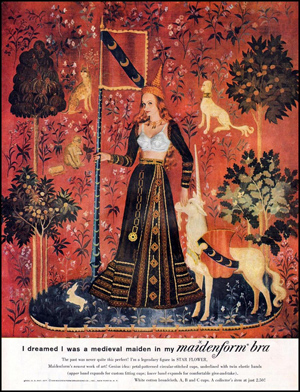
Behold: “I dreamed I was a medieval maiden in my Maidenform bra,” an ad that ran in magazines in 1959 and 1960. (Click here to see it larger.) The ad is based on the late-15th-century “Lady and the Unicorn” tapestries designed in Paris, woven in Flanders, and now on display at the Musée National du Moyen Âge in Cluny. Five of the tapestries are devoted to the senses; a sixth tapestry has been variously interpreted.

Maidenform’s “I Dreamed…” campaign, which began in 1949 and ran for 20 years, was apparently so successful that it’s still studied in business schools. The other ads weren’t medievally themed, but they all showed a shirtless woman in some professional or historical setting. The “medieval maiden” ad stands out, though, for its fidelity to its source.

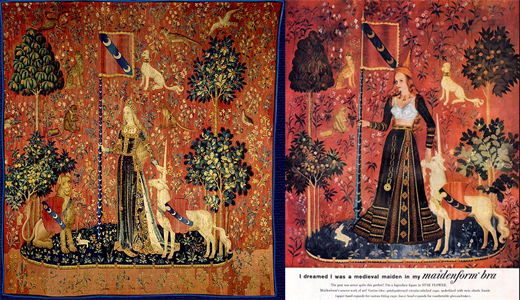
Place the ad and the tapestry side by side and you can see how little got removed (other than the maiden’s blouse).

The heraldic symbols on the banner (and on the unicorn’s little Thundershirt-shield) are intact, even though they’re meaningless now. The grimacing lion is gone; modern people might have have been distracted by him or found him comical. The woman no longer holds the unicorn’s horn but caresses it near its mouth. She’s also been decked out in a hat on loan, I would guess, from the neighborhood gnome.

Maidenform was determined to portray not just some fantasy scene, but a real and very specific medieval work. Why?

For one thing, the decade leading up to this ad was florid with chivalry, at least at the movies: Rogues of Sherwood Forest, Ivanhoe, Richard and the Crusaders, Knights of the Round Table, Prince Valiant, Lady Godiva, The Court Jester, Saint Joan, The Vikings, and at least two TV versions of A Connecticut Yankee. (With The Seventh Seal and The Virgin Spring, Ingmar Bergman cast a pall over these Technicolor revels, but he was an anomaly.) It’s no wonder that a couple years later, the press was quick to cast John F. Kennedy’s candidacy and presidency in terms of fair ladies and storybook heroes—even if there’d be no “Camelot” talk until after his assassination.

But maybe the Maidenform maiden is more of a high-culture dream. At the end of the 1950s, tapestries were big news: A decade earlier, the Metropolitan Museum of Art had hosted a show about French tapestries from 1375 to the present, and in 1958 and 1959 the Cloisters made two major tapestry acquisitions. In 1959, the Philadelphia Museum of Art acquired several tapestries about the exploits of Constantine, while the Brooklyn Museum showed off Norwegian tapestries from the 16th through 18th centuries.

(…and curiously, the New York Times reported in May 1958 that sculptor Elbert Weinberg had installed a terra-cotta lady-and-unicorn in the lobby of 405 Park Avenue.)

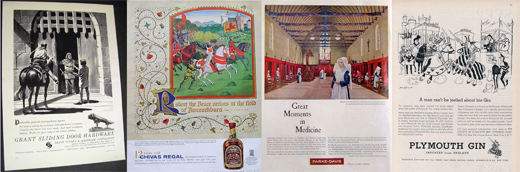
In 1959, American medievalism was enjoying a sort of historicist autumn. Renaissance fairs were a few years off and Tolkienesque fantasy had yet to go mainstream, so when people thought of the Middle Ages, they imagined the tidy past they enjoyed in movies—and, apparently, in magazine ads.  It took me only a few minutes to find several advertisements from 1958 to 1960 that make the Middle Ages look as pleasant as it did in the movies of the time.

Plymouth Gin evoked jousting to invite Americans to join an international band of drinkers, pharma giant Parke-Davis paid tribute to hospitals in 12th-century France, Chivas Regal reveled in Scottish heritage, and the Grant Pulley and Hardware Corporation, makers of sliding doors, assumed you would know what a “portcullis” was. The medieval people in these ads—knights, nurses, architects—set precedents, and served as examples.

When Austrian historian Herwig Wolfram considered American medievalism in the 1970s, he saw more than folly. “What might sometimes appear to a European as slightly comical is nevertheless an expression of astonishing vitality,” he wrote. “And what many a dry pedant might dismiss as low-brow is in reality a kind of learning experience on a level different from that to which most Europeans are accustomed.” Interweaving high and not-so-high culture, the Maidenform ad shows the mass appeal of America’s medieval dream, even if nobody’s heeding the small print: “The past was never quite this perfect!”

“And still I hear that sharp tongue talking…”

When I skulk through used bookstores, I scan the spines for books by John Hollander, whose death on August 18 at the age of 83 was overshadowed by the passing of another fine poet whose work sits nearby on the shelves. Hollander got a nice obit in the New York Times, but he deserves a more appreciative sendoff—and many new readers. “[A]s far as endings are concerned,” he once wrote, “One does not begin feasting at dawn, but at sundown.”

Hollander published two dozen collections of his own verse, but far more books with his name on their covers attest to his calling as a sort of poetry evangelist. In addition to the Oxford Anthology of English Literature, he edited collections of poems for children, garden poems, war poems, and countless more. Spend five bucks on, and a long plane ride with with, Committed to Memory: 100 Best Poems to Memorize and you’ll have a sturdier acquaintance with well-known poems than most tuition-soaked English majors.

Last week, one of Hollander’s friends called him “the great explainer,” and that’s his exact role in Rhyme’s Reason, a short, chatty book that takes readers on a tour of common poetic forms and techniques. Hollander was no mere docent; to demonstrate most forms, he provided his own poems. Check out the first few lines from his “Ghazal on Ghazals,” which uses and explains the Persian form:

 For couplets the ghazal is prime; at the end
Of each one’s a refrain like a chime: “at the end.”

But in subsequent couplets throughout the whole poem,
It’s the second line only will rhyme at the end.

On a string of such strange, unpronounceable fruits,
How fine the familiar old lime at the end!

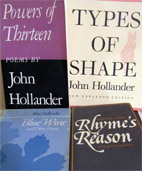
Hollander’s ghazal, a favorite of mine, is typical not only of his unfashionable championing of form but also the great fun he has with it. His 1983 book Powers of Thirteen contains 169 poems, each one consisting of 13 unrhymed 13-syllable lines. Types of Shape collects 35 carmina figurata, poems typed out in shapes—a cat, an arrow, the state of New York—to bolster or complement the words.

Some people assume that a love of form is an inherently conservative impulse, but Hollander harumphed. “I don’t know why some people have an ideology about form—’open,’ ‘closed,’ whatever,” he told the Paris Review in 1985; in the introduction to Rhyme’s Reason, he deems everyone else skittish and unadventurous:

In former times, the region of verse was like an inviting, safe municipal park, in which one could play and wander at will. Today, only a narrow border of that park is frequently used (and vandalized), out of fear that there is safety only in that crowded strip—even as the users’ grandparents would cling to walks that went by statues—and out of ignorance of landscape. The beauties of the rest of that park are there, unexplored save by some scholars and often abandoned even by them.

I am old enough to have grown up in the park, and to map a region one loves is a way of caressing it.

Hollander appears to have had a undramatic life, which is perhaps why one critic dubbed him “a virtuoso without a subject matter,” but the poet found it silly to separate the two:

Great poems are all fables about life. There are two popular and radically antagonistic views in the world today about what the best literature does. One is that literature is only about itself. The other view is that literature is all about life, and that the more directly it transcribes experience the better it is. These are two views I find equally implausible. I think one of the things about poetry (and certain great fiction would be included in this) is that the whole notion of “aboutness” is peculiar. One of the ways literature is about life is by way of being about itself. Or, to put it better, literature gets to be about life genuinely by taking very great regard of how much it is about itself.

Plenty of goofy writers declare that they “love language,” but Hollander was the real deal:

Let’s put it this way: I don’t take laudanum. I take pains. Actually, what summons up vision and voice from wherever they ordinarily hide is the dangerous charm, the potent magic of language itself. Language and its structures—the alchemy of syntax, the temples and sacred precincts of verse. Solving puzzles of construction that I’ve propounded for myself. Discovering secret doorways and hidden surprising staircases in formal rooms that had been lived in for centuries. Those are what lead to unfoldings for me.

I’ll keep expanding my Hollander collection; whether lucid or murky, each new book is a surprise. How could one poet possess such range, articulate so many voices? The first page of Powers of Thirteen suggests an answer, and a worthy epitaph:

This is neither the time nor the place for singing of
Great persons, wide places, noble things—high times, in short;
[ . . . ]
I do what I am told, and tell what is done to me,
Making but one promise safely hedged in the Poets’
Paradox: I shall say “what was never said before.”

“With a torch in your pocket, and the wind at your heels…”

Disentangling sickly cucumber vines, dispatching peppers that chose not to thrive—the maudlin side of late summer gardening got me thinking this week about Walahfrid Strabo, the 9th-century abbot and gardener who tutored Charlemagne’s grandson. Walahfrid was famously unafraid of hard work, so perhaps I cheapened his memory when I sat down to translate his poem “To a Friend.”

Because the poem is only 10 lines long and grammatically compact, I made the same careless assumption as the day I broke ground in my garden: “How hard can this be?”

AD AMICUM

Cum splendor lunae fulgescat ab aethere purae,
Tu sta sub divo cernens speculamine miro
Qualiter ex luna splendescat, lampade pura,
Et splendore suo caros amplecitur uno
Corpore divisos, sed mentis amore ligatos.
Si facies faciem spectare nequivit amantem,
Hoc saltem nobis lumen sit pignus amoris.
Hos tibi versiculos fidus transmisit amicus;
Si de parte tua fidei stat fixa catena,
Nunc precor, ut valeas felix per saecula cuncta.

I haven’t been in a Latin classroom for 15 years, so when I try to translate verse, I get that Flowers for Algernon feeling—but it’s not hard to render this poem into clunky English prose:

“TO A FRIEND: When the splendor of the moon glitters from the pure heavens, stand under the sky and behold with wonder as you see the pure light shine from the moon, see its brilliance embrace dear ones divided bodily but connected by love in their minds. If face may not gaze on beloved face, then at least let this light be proof of our love. Your faithful friend has sent these little verses. If, for your part, your bond of loyalty stands firm, then I pray you be happy and well forever.”

Translating Latin poetry into English is a nasty job; you’re duty-bound to smother some gasping aspect of meaning or form and bury it deep in your notes. Lines of Latin verse don’t rhyme at the ends; they’re ruled by vowel quantity, using long and short vowels where we use stressed and unstressed syllables. Walahfrid composes hexameter lines: the first four feet have to be dactyls or spondees, the fifth foot is usually a dactyl, and the sixth foot is always spondaic—but there are also three places where a good Latin hexameter line ought to have a caesura, and at least two places where it’s verboten to break up a word across different feet.

Ever versatile, “Hexameter Hank” Longfellow adapted the form for English metrical verse in the 1,400-line Evangeline: “This is the forest primeval, the murmuring pines and the hemlocks.” (I’ve tried it too by adapting elegiac couplets, which alternate hexameter and pentameter.)

So I sat down to translate Walahfrid’s poem, expecting to be done in a day.  I stumbled first on the diction: A poet who varies his language is a translator’s dream, so I frowned to realize that Walahfrid twice uses both pura (“clear, pure, simple, plain”) and splendor (“brilliance, brightness, luster”).

Using the same word twice (and then doing it twice) emphasizes a bond between two friends, but that’s just a small part of what’s going on in this poem. You don’t need to know a word of Latin to see it:

Cum splendor lunae fulgescat ab aethere purae,
Tu sta sub divo cernens speculamine miro
Qualiter ex luna splendescat, lampade pura,
Et splendore suo caros amplecitur uno
Corpore divisos, sed mentis amore ligatos.
Si facies faciem spectare nequivit amantem,
Hoc saltem nobis lumen sit pignus amoris.
Hos tibi versiculos fidus transmisit amicus;
Si de parte tua fidei stat fixa catena,
Nunc precor, ut valeas felix per saecula cuncta.

Rhyme! Medieval Latin poets often played with internal rhyme, but one German scholar in 1965 spotted Walahfrid doing something special: Each line has two rhyming syllables, one on a rising, stressed syllable, the other on a falling, unstressed syllable. Like Walahfrid and his friend, they’re distant, and a little bit different, but share a bond. At the end, the tenth line brings them as close as can be in an idiom that means “forever.”

Are there artful ways to render this in English? I tried:

“When the pure moon sends forth its brightness in splendor from the heavens…”

Bleah. Even if I pretend that’s a proper rhyme, the hexameter is lifeless, and the diction is novice, pocket-dictionary stuff. Walahfrid may have bonded by moonlight with his long-distance friend, but I won’t be the one to craft an English translation that illuminates modern readers with a medieval truth: that the body and soul of a poem are one.

“A week without you, thought I’d forget…”

Colorado! Spectacular vistas by day, darkness and quiet at night—all draws for the vacationing medievalist.

I was determined to take a mental vacation, to look past the state’s old, medieval-minded Missions and Gothic Revival buildings and dwell instead on the American West. Mountains! Sand dunes! Cowboys!

The Denver airport had other ideas.

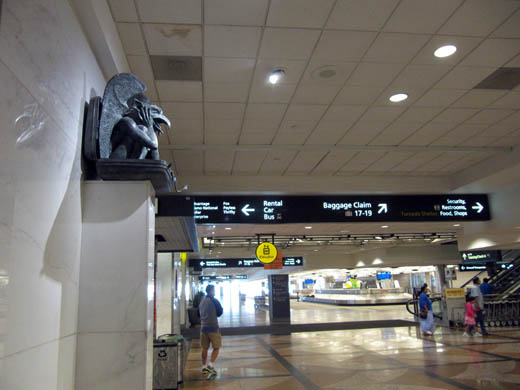
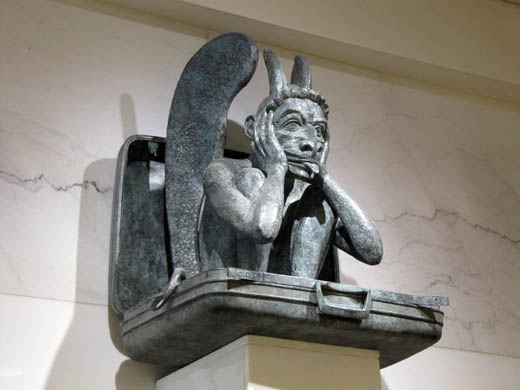
There he was, on a pedestal overlooking the baggage carousels: a familiar face.

This guy is the most famous gargoyle from Notre-Dame in Paris—only he’s not a gargoyle, since he doesn’t spit water, and he’s not medieval, but a modern beastie grafted onto the building during a 19th-century restoration. Architect Eugène-Emmanuel Viollet-le-Duc, who oversaw the work at Notre-Dame, called these 54 replacement monsters chimères—chimeras.

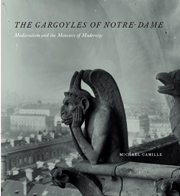
In his 2009 book The Gargoyles of Notre-Dame: Medievalism and the Monsters of Modernity, the late Michael Camille explains how these modern “chimeras” entered European and North American popular culture through engravings, etchings, photographs, postcards, paintings, and books—and how quickly the world forgot that they weren’t medieval creatures at all.

Ever since this monster—dubbed le stryge, or “the vampire,” by the engraver who made him famous—first glared down at Paris in the middle of the 19th century, no one has been sure what he is. The embodiment of evil? An icon of Romantic melancholy? An ambassador from an era that predated him by centuries? An antisemitic caricature? Is he bitter and apathetic, or contemplative and morose—or is he being cheeky? And what is he doing in Denver?

According to a nearby wall plaque, Notre Denver by artist Terry Allen has been installed here since 1994: “Historically, gargoyles were placed on buildings to protect the site. These are placed slightly above the travelers’ heads to oversee and ensure that baggage will arrive safely at DIA.” Popping out of a suitcase to protect travelers is a new role for le stryge, who’s now part of the Denver airport’s art program—although few people noticed him until they saw me snapping his picture. (The humungous Gamma World laser space mustang outside the airport is literally far more grotesque.)

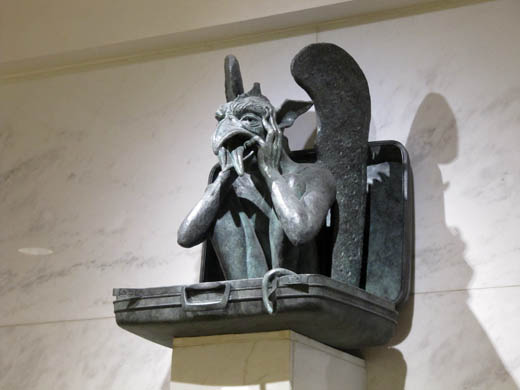
Far across the baggage-claim area, le stryge has an unexpected counterpart.

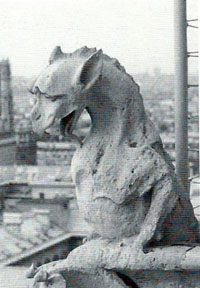
When I spotted this critter, I was certain I’d seen him before. I mentioned to my traveling companion that several of Notre-Dame’s 19th-century chimeras didn’t look “medieval” at all but reflected 19th-century France’s fascination with Egypt. Although that’s true, when I later flipped through The Gargoyles of Notre-Dame, past demonic birds, a goat, an elephant, a pelican, a wild boar, a two-headed dog, a (now destroyed) unicorn, and (lamentably) a Wandering Jew, I was surprised to find that the chimère I remembered didn’t look much like the statue in Denver at all.

Le stryge is the only Notre-Dame chimera who makes that Home Alone gesture, and the birdlike face of this second monster only somewhat resembles one actual creature on the cathedral. This baggage-sentinel seems to be Terry Allen’s own invention, a horror that might exist if late one night, weary from another day of menacing glares, le stryge and his fellow chimera threw back too much Beaujolais nouveau, discovered a shared adoration of Edith Piaf, and one thing led to another…

So what are le stryge and his grotesque partner doing here? I could point out that 19th-century architect-designer Viollet-le-Duc and sculptor Victor Pyanet accomplished something akin to what Grant Wood did with American Gothic by creating something so recognizable and yet so enigmatic that people have never tired of seeing their own beliefs reflected by it.

Or perhaps artist Terry Allen, who appears to have a sharp sense of humor, got one over on the Denver airport authority by casting the miseries of air travel as downright “medieval.” One screeching infant or some surly cretin kicking the back of our seat, and we all might make such a face.

(Related post: Spotting the grand-nephew of the Notre-Dame chimeras on a pharmacy in Newark, Delaware.)

“As we get older, and stop making sense…”

English teachers make great idols. Rich kids who can’t pursue their dreams should kill themselves. Such are the awful lessons of Dead Poets Society, a movie I love to hate—not only because real-life English teachers are dubious exemplars, but also because the movie takes too much glee in damning “Dr. J. Evans Pritchard, Ph.D,” the textbook author who supposedly reduces the evaluation of poems to a simple trick of geometry. Not even my worst English teachers would have endorsed the idea, so I assumed such a book didn’t and couldn’t exist—until I discovered the real Dr. Pritchard, but found that he’s hardly as bad as he seems.

When the Dead Poets Society teacher, played by Robin Williams, asks a student to read aloud from a textbook by “Dr. J. Evans Pritchard, Ph.D,” this is what we hear:

 To fully understand poetry, we must first be fluent with its meter, rhyme, and figures of speech, then ask two questions: (1) How artfully have the objectives of the poem been rendered; and (2) how important is that objective? Question one rates the poem’s perfection; question two rates its importance; and once these questions have been answered, determining the poem’s greatness becomes a relatively simple matter. If the poem’s score for perfection is plotted on the horizontal of the graph and its importance is plotted on the vertical, then calculating the total area of the poem yields the measure of its greatness. A sonnet by Byron might score high on the vertical but only average on the horizontal. A Shakespearean sonnet, on the other hand, would score high both horizontally and vertically, yielding a massive total area, thereby revealing the poem to be truly great.

As you proceed through the poetry in this book, practice this rating method. As your ability to evaluate poems in this manner grows, so will your enjoyment and understanding of poetry.

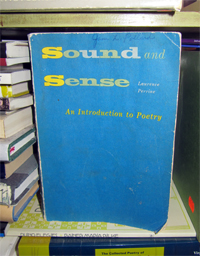
In 1956, Southern Methodist University lit professor Laurence Perrine published the first edition of Sound and Sense: An Introduction to Poetry, which he apparently developed for use in his own classroom. Flip through the book, and there it is, in similar wording, the notion that anthropomorphized a thousand bales of straw:

In judging a poem, as in judging any work of art, we need to ask three basic questions: (1) What is its central purpose? (2) How fully has this purpose been accomplished? (3) How important is this purpose? The first question we need to answer in order to understanding the poem. The last two questions are those by which we evaluate it. The first of these measures the poem on a scale of perfection. The second measures it on a scale of significance. And, just as the area of a rectangle is determined by multiplying its measurements on two scales, breadth and height, so the greatness of a poem is determined by multiplying its measurements on two scales, perfection and significance. If the poem measures well on the first of these scales, we call it a good poem, at least of its kind. If it measures well on both scales, we call it a great poem.

Boo! Hiss! Down twinkles! Blockin’ out the scenery, breakin’ my mind!

Dead Poets Society imagines this infamous passage occurring on “page 21 of the introduction,” but you won’t find it in Perrine’s introduction. Sound and Sense doesn’t have an introduction; Perrine’s shaky effort to quantify taste occurs way in the back of the book—on page 198, in the penultimate chapter, which focuses on learning to spot obviously bad poetry. In real life, Perrine chases this passage with a near-retraction:

The measurement of a poem is a much more complex process, of course, than is the measurement of a rectangle. It cannot be done as exactly. Agreement on the measurements will never be complete. Yet over a period of time, the judgments of qualified readers tend to coalesce: there comes to be more agreement than disagreement . . .

[…]

For answering the first of our evaluative questions, How fully has the poem’s purpose been accomplished? there are no easy yardsticks we can apply. We cannot ask, Is the poem melodious? Does it have smooth meter? Does it use good grammar? Does it contain figures of speech? Are the rimes perfect? Excellent poems exist without any of these attributes. We can judge any element in a poem only as it contributes or fails to contribute to the achievement of the central purpose; and we can judge the total poem only as these elements work together to form an integrated whole. But we can at least attempt a few generalizations.

Of course, all this comes not on the first day of school, but near the end of the course, after an absolute beginner has learned about figurative language, imagery, allusion, tone, rhythm, meter, sound, and pattern—subjects I daresay many English majors can’t discuss competently now.

Still, Perrine/Pritchard is a bit dry, isn’t he? Hasn’t his soul been smothered by tweed? Aren’t his whimsies constrained by the iron cage of reason?

Here’s what “Pritchard,” in his real first chapter, actually says.

Poetry is spiritually vital:

Poetry in all ages has been regarded as important, not simply as one of several alternate forms of amusement, as one man might choose bowling, another chess, and another poetry. Rather, it has been regarded as something central to each man’s existence, something having unique value to the fully realized life, something which he is better off having and which he is spiritually impoverished without.

Poetry lets us live deeply:

Indeed, the two approaches to experience—the scientific and the literary—may be said to complement each other. And it may be contended that the kind of understanding one gets from the second is at least as valuable as the kind he gets from the first.

Literature, then, exists to communicate significant experience—significant because concentrated and organized. Its function is not to tell us about experience, but to allow us imaginatively to participate in it. It is a means of allowing us, through the imagination, to live more fully, more deeply, more richly, and with greater awareness.

Poetry helps us live triumphantly:

We find some value in all intense living. To be intensely alive is the opposite of being dead. To be dull, to be bored, to be imperceptive is in one sense to be dead. Poetry comes to us bringing life, and therefore pleasure. Moreover, art focuses and so organizes experience as to give us a better understanding of it. And to understand life is partly to be master of it.

Poetry is rich:

If it is to communicate experience, it must be directed at the whole man, not just at his understanding. It must involve not only his intelligence but also his senses, his emotions, and his imagination. Poetry, to the intellectual dimension, adds a sensuous dimension, an emotional dimension, and an imaginative dimension.

Poetry can’t be quantified:

You may have been taught to believe that poetry can be recognized by the arrangement of its lines on the page or by its use of rime and meter. Such superficial tests are almost worthless. The Book of Job in the Bible and Melville’s Moby Dick are highly poetical, but a versified theorem in physics is not. The difference between poetry and other literature is one only of degree. Poetry is the most condensed and concentrated form of literature, saying most in the fewest number of words. It is language whose individual lines, either because of their own brilliance or because they focus so powerfully on what has gone before, have a higher voltage than most language has. It is language which grows frequently incandescent, giving off both light and heat.

And that’s just the first chapter! Despite that one iniquitous passage at the end of Sound and Sense, Perrine spends much of the book arguing against the quantification of poetry. At one point, he contrasts the chemical equation for sulfurous acid with the limitless connotations of the word “sulfurous” in a poem. “The poet, we may say, plays on a many-stringed instrument,” he writes. “And he sounds more than one note at a time.” If Perrine often mentions science and psychology, particularly in the chapter on imagery, he does so because he assumes his students already speak those languages. He’s not diminishing poetry; he’s offering novices a way in.

Perrine frequently sounds just as you’d imagine someone who got a Ph.D from Yale in 1948 ought to sound, but I find his old-fashionedness refreshing. “The difference between your figures of speech and the poet’s is that yours are worn and trite, his fresh and original,” he tells his readers, making clear that he’s not some fretful “facilitator,” but the expert in the room. A man of his times, he urges the cultivation of taste through study, scrutiny, and thought—and in his own genteel way, he advocates zeal:

Undoubtedly, so far in this chapter, we have spoken too categorically, have made our distinctions too sharp and definite. All poetic excellence is a matter of degree . . . But a primary distinction between the educated man and the ignorant man is the ability to make value judgments.

A final caution to students. In making judgments on literature, always be honest. Do not pretend to like what you really do not like. Do not be afraid to admit a liking for what you do like. A genuine enthusiasm for the second-rate is much better than false enthusiasm or no enthusiasm at all. Be neither hasty nor timorous in making your judgements. . . . Honesty, courage, and humility are the necessary moral foundations for all genuine literary judgment.

Yes, Perrine can be stuffy. The 1956 debut edition of Sound and Sense contains more than 200 poems, but there aren’t many by women, and as far as I can tell, only one is the work of a non-white poet, Countee Cullen. (Not even Paul Laurence Dunbar? Oh, professor.) Perrine’s idea of a wild, loosen-the-spats, extra-credit challenge? The Love Song of J. Alfred Prufrock. 

Still, the poets in Sound and Sense would make fine desert-island companions—Noyes, Tennyson, Millay, E.A. Robinson, Wilfred Owen, Emily Dickinson, Richard Wilbur, Robert Frost, Carl Sandburg, even James Joyce—and anyway, isn’t academia usually behind the times? My professors in the 1980s and 1990s taught the poets of the 1950s and 1960s as if they were the consummation of poetry itself. They didn’t clue us in to the New Formalism occurring off-campus. Perhaps they weren’t aware of it.

(Sound and Sense is still in print in an overpriced 14th edition. Two editors have updated and broadened the selection of poems—but amazingly, as recently as the 13th edition, the first half of the paragraph that bred “Dr. J. Evans Pritchard, Ph.D” is still stinking up chapter 15! At what point in the past 50 years did that passage get pruned: before or after Dead Poets Society in 1989?)

It’s a shame Perrine has been vilified in fiction, because in chapter 15the chapter with the dreaded Dead Poets Society passage—he begs students to think for themselves, with no histrionic page-ripping or standing on desks. He flings out examples of trite popular verse so students won’t be suckered by sentimentality, rhetoric, didacticism, and cheap appeals to emotion, patriotism, and religion. A truly excellent poem, he says, will be complex and fresh; it “will not be merely imitative of previous literature, nor appeal to stock, pre-established ways of thinking and feeling which in some readers are automatically stimulated by words like mother, baby, home, country, faith, or God, as a coin put into a slot always gets an expected reaction.” He would have liked Roger Ebert’s dismissal of Dead Poets Society as “a collection of pious platitudes masquerading as a courageous stand,” a movie that “pays lip service to qualities and values that, on the evidence of the screenplay itself, it is cheerfully willing to abandon.”

Four years ago, I sat across a conference table from an assistant dean with a Ph.D in the humanities who, with no evident trace of self-loathing, asked me to write bullet points summarizing the “workplace relevance” of medieval literature. (That day I confirmed that the soul really does exist, because I felt mine howling to leave my body.) More recently, I rolled my eyes at the news that a “professor emeritus and former chair of the department of recreation and leisure studies at Southern Connecticut State University” has developed the “Collegiality Assessment Matrix and Self-Assessment Matrix,” which are “designed to clearly assess the level of collegiality of a faculty member.”

This sort of dehumanizing Taylorism thrives in education these days, but you won’t find an endorsement of it even in the final subdued paragraph of Sound and Sense:

Yet, after all, we have provided no easy yardsticks or rule-of-thumb measures for literary judgment. There are no mechanical tests. The final measuring rod can only be the responsiveness, the maturity, the taste and discernment of the cultivated reader. Such taste and discernment are partly a native endowment, partly the product of maturity and experience, partly the achievement of conscious study, training, and intellectual effort. They cannot be achieved suddenly or quickly; they can never be achieved in perfection. The pull is a long pull and a hard pull. But success, even relative success, brings enormous rewards in enrichment and command of life.

Perrine’s conclusion is tepid, but his purpose is profound: He wants you to use poetry to think harder, live better, and feel more deeply. There’s more depth, pleasure, and (every committee’s Questing Beast) “critical thinking” in the stuffiest chapters of Sound and Sense than you’ll find in the latest platitude-sodden government report on the humanities. If you live to defend the value of literature, history, and the arts, turn your Dead Poets Society DVD into a drink coaster and take heart. In real life, “Dr. J. Evans Pritchard” is an ally after all.


“Not under the thumb of the cynical few…”

“In fact, the great champions of liberty against oppression, if their own words are to be trusted, have fought for the maintenance of liberties inherited from the Middle Ages. In our own day such traditional conceptions of liberty appear less seldom perhaps, for many liberals, and certainly most extreme radicals, are now frequently struggling for rights for which the Middle Ages can furnish few precedents. But this should not blind us to the all-important fact that for a long period in this historic struggle, indeed for the whole of the early part of it, it was for their medieval inheritance that all opponents of oppression engaged.”

—C.J. McIlwain, “Medieval Institutions in the Modern World,” Sixteenth Annual Meeting of the Medieval Academy of America, April 26, 1941, Princeton, N.J.

“You really ought to give Iowa a try…”

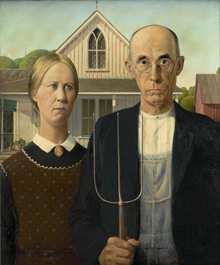
Fireworks! Barbecues! The Fourth of July approacheth, and as Americans dwell on traditions, origins, and independence from the Old World, it’s a fine time to reconsider American Gothic. Everyone knows the painting, but few people really look at it—but when you do, you’ll find that Grant Wood uses serious medievalism to find humor in a 200-year identity crisis.


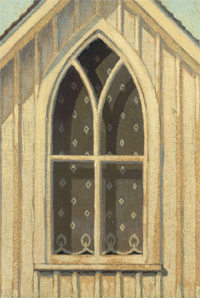
Wood based his painting around a modest house in Eldon, Iowa, whose only flourish was a Gothic window he found both delightful and pretentious. Wood’s sister and a local dentist posed as the sorts of people he imagined would live in such a house; most of the time, Wood insisted that his characters were father and daughter, not husband and wife. The painting was a smash at both a 1930 Art Institute of Chicago exhibition and the 1933 World’s Fair, and in 1934 the entire country saw American Gothic in full color in Time magazine.

Art historian Thomas Hoving has pointed out the painting’s clever composition: how the top of the middle pitchfork tine marks the center of the painting; how the three tines are echoed in the stitching of the man’s overalls and in the window tracery; how the bulb at the top of the lightning rod echoes the button on the man’s collar; and how the lines of the peaked roof point directly to the man and the woman. “The house and the couple are utterly unified, like the statues on thirteenth-century cathedrals,” Hoving writes—which is appropriate, because it’s remarkable how European American Gothic actually is.

Grant Wood’s name normally evokes the Midwest, not the Middle Ages. After a stint in France and a fling with Impressionism, Wood hurried back to his Iowa home and happily let the press turn him into the champion of a new regionalism in American art. He donned overalls, sought out local subjects, and created an icon of Americana that either enshrines or mocks its subjects, depending on your point of view. “The farther a critic lived from the Midwest, the more predisposed he or she was to read the painting as satire or social criticism,” one art historian quipped about American Gothic—but what if most viewers for 80-odd years have focused way too much on the “American” and not nearly enough on the “Gothic”?

Quoth Wood biographer R. Tripp Evans: “Wood’s attraction to the Arts and Crafts movement—which advocated hand craftsmanship, rural simplicity, and even the revival of the guild system—had led him from an early age to associate his work with that of medieval artisans.” Yes, but Wood didn’t just imitate the medieval past; he found humor in comparing the Middle Ages and modern America. Last year at the Cedar Rapids Art Museum, I got a kick out of Wood’s “Mourner’s Bench,” a medieval church pew that stood outside the principal’s office at the local junior high. (The tops of the posts are faces: two disciplinarians and a wailing student.)

“The lovely apparel and accessories of the Gothic period appealed to me so vitally,” Wood wrote, “that I longed to see pictorial and decorative possibilities in our contemporary clothes and articles.” One art historian points out that Wood was fascinated by late Northern Gothic painters, especially 15th-century German-born Flemish artist Hans Memling. When you put some Memling portraits alongside Woman with Plants, Wood’s painting of his mother, it’s clear what he was imitating—the landscape, the poses, the stark black clothing and cloudless blue skies—with humor implicit in the comparison.

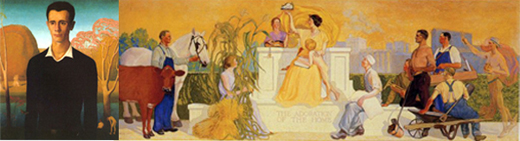
Other art historians have listed Wood’s many medieval and early Renaissance influences. Biographer R. Tripp Evans finds that the tiny bathing figures in Arnold Comes of Age (below left) look like miniature depictions of Adam and Eve being expelled from Paradise in the backgrounds of Nativity and Crucifixion scenes on medieval altarpieces, and he points out that Wood’s huge Dinner for Threshers evokes the Last Supper and mimics a medieval triptych. In Adoration of the Home (below right), Wood expert Wanda Corn sees a medieval altarpiece with a Madonna and Child surrounded by saints.

After Wood died in 1942 at the age of 50, trendier critics condemned him as nationalistic and reactionary, and some ludicrously likened his work to Nazi art. The joke’s on them: They missed the centuries-old motifs that linked Wood’s “regionalism” to traditions more venerable than most of the century’s fads.

Then again, they were only doing what most of us do: obsessing over the American while ignoring the Gothic. Photographer Gordon Parks was the first to parody the painting in 1942, and since then it’s become a boon for lazy political cartoonists, ad agencies, movie-poster designers, and anyone who wants to suggest that a stuffy, old-fashioned sensibility is being tweaked, surpassed, desecrated, defied, or redefined. Nothing is more establishmentarian than parodying American Gothic.

…and while everyone looks at the people in the painting, no one considers that silly little window behind them.

According to his recent biographer, Wood focused on arched windows and doors in his early French paintings, and he specifically said that American Gothic was meant to feature “American Gothic people” whose features complemented architecture that emphasized vertical lines. “These particulars, of course, don’t really matter,” Wood wrote in a 1941 letter. “What does matter is whether or not these faces are true to American life and reveal something about it. It seemed to me that there was a significant relationship between the people and the false Gothic house with its ecclesiastical window.”

Wood toyed with the idea of a companion painting that would have put squat Americans in front of the horizontal lines of Mission architecture, but of course he never created it—because he was beguiled by the Gothic, as two generations before him had been.

By 1930, America was coming off a multi-decade Gothic Revival bender. Since the second half of the 19th century, architects across the country had been dreaming up American Gothic buildings: churches, cathedrals, college campuses, prep schools, factories, skyscrapers, courthouses, apartments, at least one synagogue, and even crummy “Carpenter Gothic” houses like the one in Eldon. Their neo-medieval look was sometimes democratic, sometimes aristocratic, sometimes religious, sometimes secular, old and European but American and new. It’s a fine, precarious ambivalence: Are we making a New World here, or not?

Wood’s painting is satiric, but it pokes fun at pretensions that weren’t (and still aren’t) confined to the Midwest. Sometimes, Americans aspire to be medieval; other times, we’re medieval by accident. What’s great about American Gothic is that Grant Wood, however fond he is of his subjects, exposes them to democratic judgment. Each of us gets to look over the heads of two imaginary Iowans and decide for ourselves whether our collective pretensions are noble or foolish, or if we really are late Gothic people just posing in latter-day garb.